The marlin hit the spread at first light, forty miles off the coast, and for the next forty minutes the whole boat became a machine with one purpose. The captain worked the throttles from the tower, the mate cleared lines in a cockpit the size of a small apartment, and the angler in the fighting chair leaned into a fish that weighed more than a piano. When the fish finally came alongside, silver and furious, the crew released it and the boat turned for home at thirty knots, still ready to do it all again tomorrow.
That is what a luxury sportfishing yacht is for, and it is why one costs what a small hotel costs. It is a boat that must run fast through open ocean, hold station in a rolling sea, fight a thousand-pound fish, and then serve dinner in air-conditioned comfort as if the day had been a gentle cruise. Nothing else on the water is asked to do both halves of that job at once.
The price is not one thing. It is a stack: the hull, the engines, the tower, the cockpit, the electronics, and the interior, each built to a standard that would be expensive on its own. This is where the money goes, and why the bill ends up where it does.

Where the money goes
A new luxury sportfishing yacht in the 60 to 70-foot class costs an estimate of $6 to $12 million. Here is how that figure breaks down.
| Cost area | Share of the price |
|---|---|
| Hull and structure | 25–30% |
| Engines and running gear | 20–25% |
| Tower and helm systems | 10–12% |
| Cockpit and fishing gear | 8–10% |
| Electronics and navigation | 8–10% |
| Interior and finish | 15–18% |
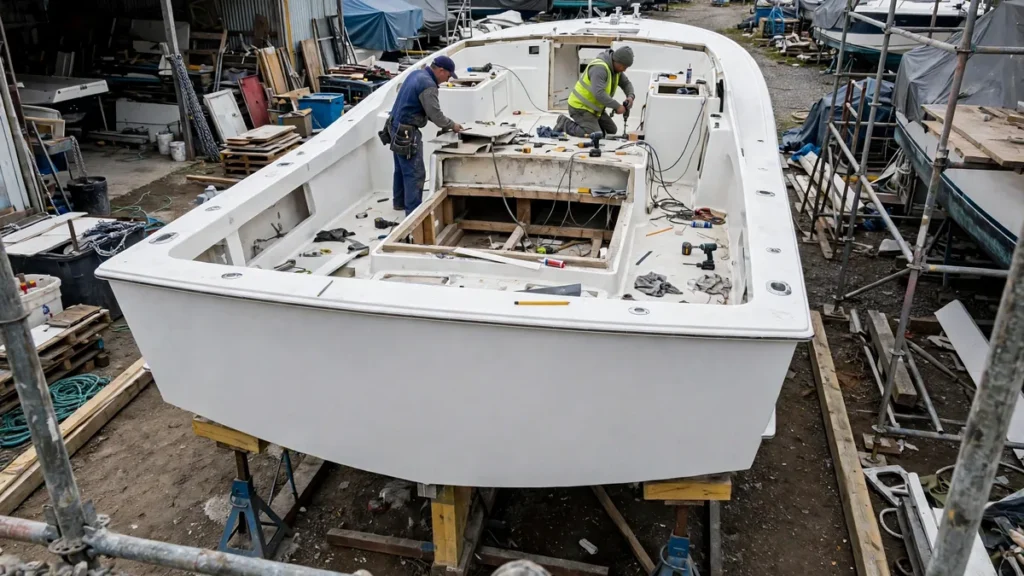
The hull is the biggest single line, and it earns it. A sportfishing hull is built to run at thirty knots into a head sea, day after day, without flexing, cracking or pounding its crew to pieces. The laminate is thick, the stringers are heavy, and the bow is a deep V that slices through waves instead of slamming into them. Builders vacuum-bag the hull to squeeze out excess resin and keep the weight down, because every extra pound is speed lost and fuel burned.
The engines: speed is a system
Two big diesels, each producing 1,200 to 1,900 horsepower, sit in the engine room of a 65-foot sportfisher. Together they cost an estimate of $800,000 to $1.5 million installed, and they are the reason the boat can run thirty knots to the fishing grounds, troll all day at eight, and sprint back before the weather turns. Speed is not a luxury on a fishing boat. It is the difference between fishing the good water and fishing the water everyone else has already worked.
Those engines burn fuel at a rate that shocks first-time owners: 100 to 150 gallons an hour at cruising speed, or an estimate of $500 to $800 an hour in fuel alone at current marina prices. A tournament season can run to an estimate of $100,000 in fuel. The propellers, shafts, struts and rudders are machined to tolerances a car factory would envy, because a vibration at thirty knots becomes a repair bill in a hurry.

The tower: the captain’s office, sixty feet up
The tuna tower is the silhouette that defines a sportfishing yacht, and it is one of the most expensive structures on the boat. A full tower with a crow’s nest, controls, and a helm station can cost an estimate of $300,000 to $600,000, built from welded aluminium tube, engineered to hold steady while the captain stands sixty feet above the water looking for birds, weed lines, and the slick of a feeding marlin.
From up there, the captain sees what nobody on deck can see: the colour change in the water, the frigate birds circling a bait ball, the tail of a fish breaking the surface a quarter mile away. The tower is not a fashion statement. It is the boat’s eyes, and on a fish that can be worth a tournament win, the eyes are worth every cent. A smaller cousin, the center console, carries the same idea at a smaller scale, and why a luxury center console boat is so expensive shows how the tower, the engines and the electronics add up even without a cabin.
The cockpit: a workplace dressed as a lounge
Step into the cockpit and the boat’s second job becomes clear. This is a fishing deck the size of a living room, finished in teak, with a fighting chair bolted to the centre, live bait wells built into the transom, and rod holders, tackle drawers and freezer space everywhere a hand can reach. The cockpit must be washable with a hose and presentable at a marina party in the same afternoon. The chase boat that shadows the big yacht carries a lighter version of the same kit, and why a luxury chase boat is so expensive explains what a small boat must carry to keep up with a big one.
The fishing gear itself is a small fortune. A set of tournament rods and reels can cost an estimate of $30,000 to $60,000. Outriggers — the long poles that spread the trolling lines wide — run an estimate of $15,000 to $30,000 a pair. The live bait system, the tuna tubes, the fish boxes chilled to near freezing: each is a specialised machine, and together they are the reason the cockpit of a sportfisher looks less like a deck and more like a laboratory.
Electronics: finding fish you cannot see
The electronics package on a modern sportfisher can cost an estimate of $200,000 to $400,000. Sonar that reads the water column a thousand feet down, radar that finds birds three miles away, satellite weather, thermal cameras for running at night, and a helm display the size of a television. The sonar alone is a marvel: it can show the captain the shape of a bait ball, the depth of the thermocline, and the mark of a single big fish holding under the school.
Price: the full picture
Add it up and a new 65-foot luxury sportfishing yacht costs an estimate of $6 to $12 million, with annual running costs of an estimate of $300,000 to $600,000 — fuel, crew, insurance, dockage, and maintenance. The specs of a luxury sportfishing yacht show what that engineering looks like on paper; the price shows what it costs to build it in a shed by hand. A used boat costs less to buy but rarely less to run, because the engines, the tower and the electronics age on the same clock whether the boat is new or ten years old.

A rare fact
Here is the detail the spec sheet hides in plain sight: the fastest thing on a sportfishing yacht is not the boat. It is the line. When a marlin takes a bait at trolling speed, it can strip line off the reel at seventy miles per hour, faster than the boat can ever run, and the drag on the reel is the only thing between the angler and an empty spool. A tournament reel is set to hold back a fish pulling with hundreds of pounds of force, smoothly, for an hour or more, without the drag overheating or jerking.
That is the sportfishing yacht in one image: a machine worth millions, crewed by professionals, burning fuel by the hundred-gallon, all to catch a fish that is let go. The price is not about the fish. It is about the morning the boat leaves the dock before dawn, the captain in the tower, the crew on the deck, and the whole expensive, beautiful apparatus pointed at the open sea.