Before dawn in a small Italian workshop, a bare carbon-fibre tub sits on a stand like the skeleton of some beautiful animal, and a technician in white gloves runs a hand along its edge, feeling for a flaw no eye could see. There is no conveyor belt here, no river of identical cars, only a handful of bays, a handful of people, and a car that will take weeks to finish. The car is a luxury supercar, and it is made the way a fine watch is made: slowly, by hand, by people who have done one job for years and who sign their work when it is done.
This is how a luxury supercar is made, in six steps, from the first carbon fibre to the day the car is handed to its owner: the tub, the engine, the body, the paint, the interior, and the testing that proves a car this fast is also safe enough to drive home.
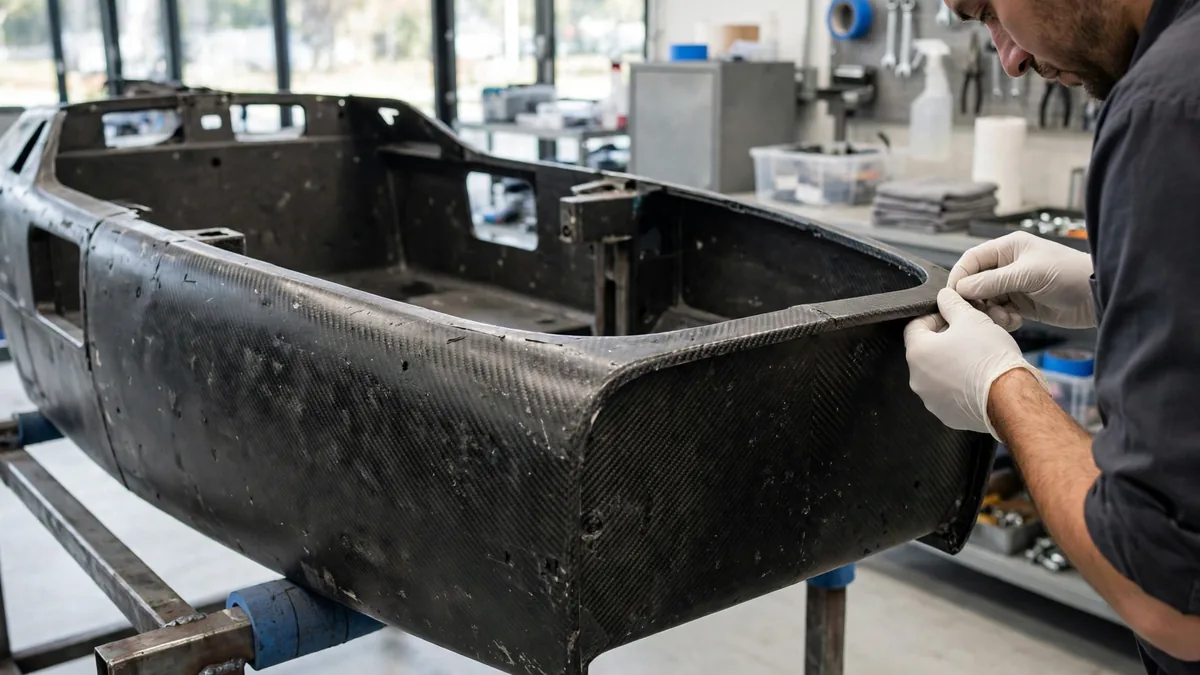
Step 1: Weaving a tub from carbon fibre
The tub is the heart of the car, holding driver, engine and suspension in one rigid shell. A tub can take a whole day to lay up, and it is weighed and X-rayed before it is accepted, because a supercar with a weak tub is a supercar that flexes at speed, and flex is the enemy of everything that follows. The guide to how a luxury sports car is made follows a steel-bodied cousin through a faster factory, where the same idea holds: the body is the foundation, and if the foundation is wrong, nothing bolted to it can ever be right.
Step 2: Building an engine that breathes fire politely
The engine is run on a test bench before it ever meets a car, and it is listened to, quite literally, by engineers who know what a healthy engine sounds like and what a sick one sounds like. Only when it passes does it travel to the tub, where it is lowered in from above and bolted to the back of the car, a moment the workshop treats as a small ceremony.
Step 3: Hanging the body, panel by panel
A door that sits a millimetre proud will catch the light wrong, and a customer paying this much will notice it, so the fitters spend hours on a single door, shimming and nudging it until the gap is even along its whole length. The panels are made from carbon fibre or aluminium, both light and both hard to repair, and each one is marked with the car’s number, so that a panel can never be fitted to the wrong car by mistake.

Step 4: Painting a car that will be stared at
The body is washed, primed and sprayed by hand, coat after coat, each one baked before the next, until the paint is deep, even and hard enough to resist stone chips at speeds most cars never reach. Some buyers order paint that changes colour in the sun, or paint mixed with flakes of real gold, and those finishes take days longer, because each extra layer is another chance for something to go wrong. The finished paint is measured in microns and polished by hand, and the inspectors check it under lights so bright they show every ripple, because a supercar’s paint is not a coating, it is part of the car’s face.
Step 5: Fitting an interior that feels like a cockpit
The interior of a luxury supercar is trimmed by hand, and the leather is cut from hides that have been inspected for marks, because only the best part of each hide is good enough for a car that costs this much. The seats are stitched by people who have sewn the same seam for years, and the stitching is checked by touch, because a crooked stitch is felt every time the driver sits down. The dashboard is a mix of leather, carbon fibre and metal, and the controls are placed where a driver wearing gloves can still reach them, because a supercar is meant to be driven hard, not just admired. The guide to luxury supercar specs, explained sets out the numbers behind this cabin, where the weight of the seats, the size of the brakes and the power of the engine are all part of the same calculation: how fast the car can go, and how safely it can stop.
Step 6: Testing a car that must never fail
Before a supercar leaves the workshop it is tested more thoroughly than almost any other car on the road, because a car that can travel at over two hundred miles an hour must never fail at that speed. Water is sprayed over it to test for leaks, and it is left in the rain, because a supercar that leaks is a supercar that will come back. Only when it has passed every test is it washed, polished and handed over, usually in a small ceremony, because the workshop knows that this is not just a delivery, it is the end of weeks of work by dozens of people.
The supercar at a glance
| Part | Typical luxury figure | What it tells you |
|---|---|---|
| Tub | Carbon fibre, baked in an autoclave | How stiff the car is, and how light it can be |
| Engine | V8 or V12, one builder, name on a plaque | How the car sounds, and how hard it pulls |
| Body | Hand-fitted panels, even shut lines | How the car looks, and how carefully it was built |
| Paint | Hand-sprayed, measured in microns | How the car survives stone chips and sunlight |
| Interior | Hand-stitched leather, carbon and metal | How the car feels when you sit in it |
| Testing | Rolling road, track laps, rain test | How the car proves it is safe at full speed |
| Build time | Weeks, not hours, per car | How much human time is inside the price |

What it costs
A luxury supercar typically costs an estimated $250,000 to $500,000, depending on its engine, its body and the standard of its interior, and the estimate covers the car alone, not the insurance, the servicing or the options, which are a real part of buying a car like this, and which can add tens of thousands before the car ever leaves the workshop. The guide to how a luxury sports car works follows a faster, lighter cousin through the same ideas, where the engine, the brakes and the aerodynamics are all part of one calculation about speed.
A rare fact
One detail few buyers ever learn is that some supercar makers still employ a person whose only job is to listen to the finished car. The listener sits in the car while it runs on the rolling road, with the radio off and the windows up, and they listen for sounds no instrument is set to find: a faint whistle from a seal, a buzz from a trim piece, a tick from a valve.
Follow the six steps in order, tub first, then engine, body, paint, interior and testing, and a luxury supercar stops looking like a fast car with a big price and starts looking like what it is: weeks of careful work by people who have done one job for years, in a workshop where nothing is rushed, because rushing is how mistakes are made, and a car this fast cannot afford a single one.


