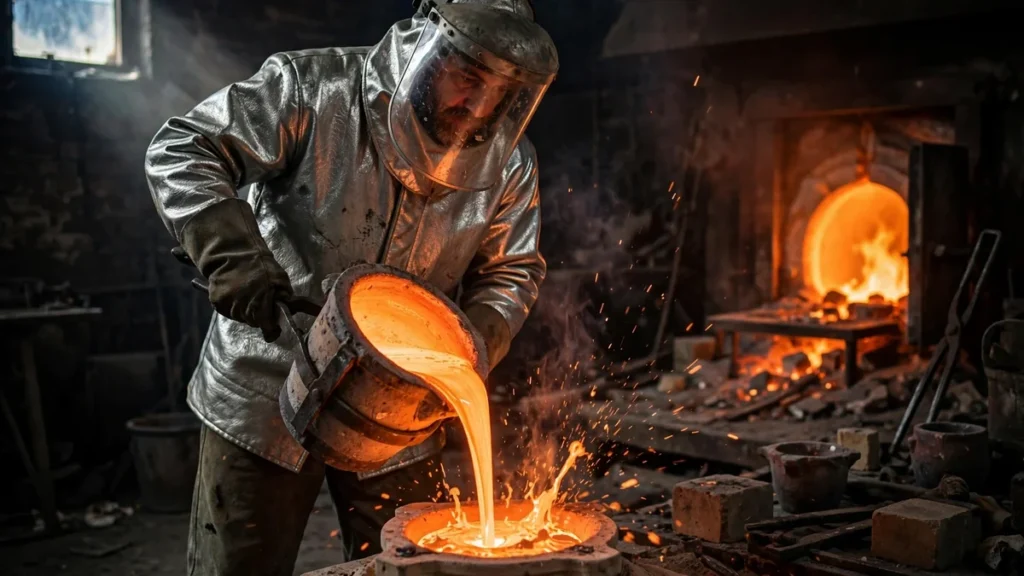
The first time you stand beside a superalloy pour, the heat finds you before the metal does. It rolls across the foundry floor in a wave, and then the crucible tips and a ribbon of liquid metal, brighter than the sun at noon, falls into the mould. The men and women around it do not flinch. They know the glowing stream in front of them will, in a few weeks, become a turbine blade spinning at thirty thousand revolutions a minute inside a jet engine, in air hotter than the metal should be able to survive.
That is the strange magic of superalloys: metals built to survive conditions that should destroy them. A nickel-based superalloy turbine blade lives in the hottest part of a jet engine, where gas temperatures reach 1,500 degrees Celsius, and it holds its shape and strength while the engine screams around it. No ordinary steel could do that, and no ordinary casting process could make it either. This is how superalloy casting is made, from the first weighing of the metals to the final test that decides whether a blade flies or is melted down and started again.
How Superalloy Casting Is Made
A superalloy is not one metal but a carefully balanced team of them. Nickel forms the base, often more than half the mix, with chromium, cobalt, aluminium, titanium, tungsten, tantalum, and rhenium added in precise proportions. Each element has a job: chromium fights corrosion, aluminium forms a protective skin, tungsten and rhenium add strength at high temperature. Change one element by a fraction of a percent and the blade can fail.
1. Mixing the alloy
The process starts in the melt shop, where ingots and master alloys are weighed out to the gram. Workers load nickel, chromium, cobalt, and the smaller additions into a vacuum induction furnace, a sealed chamber where an electric coil melts the charge without letting air in. Air is the enemy here: oxygen and nitrogen would form impurities that weaken the finished blade. The metal melts at around 1,400 degrees Celsius, and samples are taken and analysed by a spectrometer while the melt is still liquid, with small additions made until the chemistry is exactly right. The related craft of shaping hot metal under pressure is explored in titanium forging, where the same obsession with chemistry and temperature decides the strength of the finished part.
2. Making the wax pattern
While the metal is prepared, pattern makers build a perfect copy of the finished blade in wax. The wax pattern is injected into a steel die, cooled, and removed, complete with the blade’s twisted airfoil shape and its internal cooling channels. For the most advanced blades, a ceramic core sits inside the wax, forming the hollow passages that will later carry cooling air. Several patterns are joined to a central wax sprue, forming a tree that will be cast in one pour.
3. Building the ceramic shell
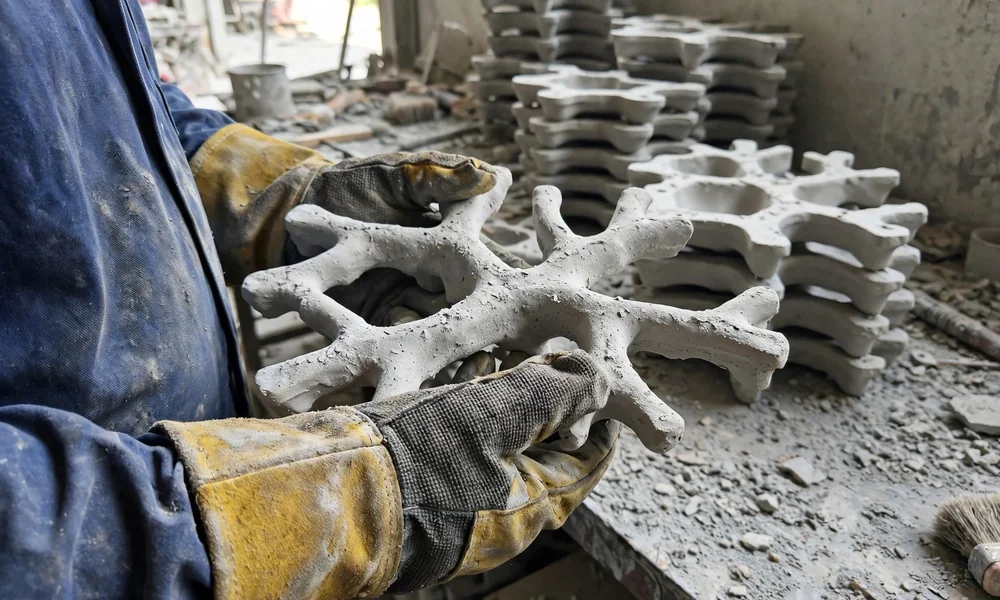
The wax tree is dipped, again and again, into a ceramic slurry, then coated with fine sand, then dried. After six to ten coats the shell is several millimetres thick and hard as stone. Then the assembly goes into an autoclave, where steam melts the wax out through a hole at the bottom, leaving a hollow ceramic mould with the exact shape of the blades inside. The empty shell is fired in a kiln at around 1,000 degrees Celsius until it is strong enough to hold molten metal and hot enough that the metal will not freeze the instant it touches the walls.
4. The pour
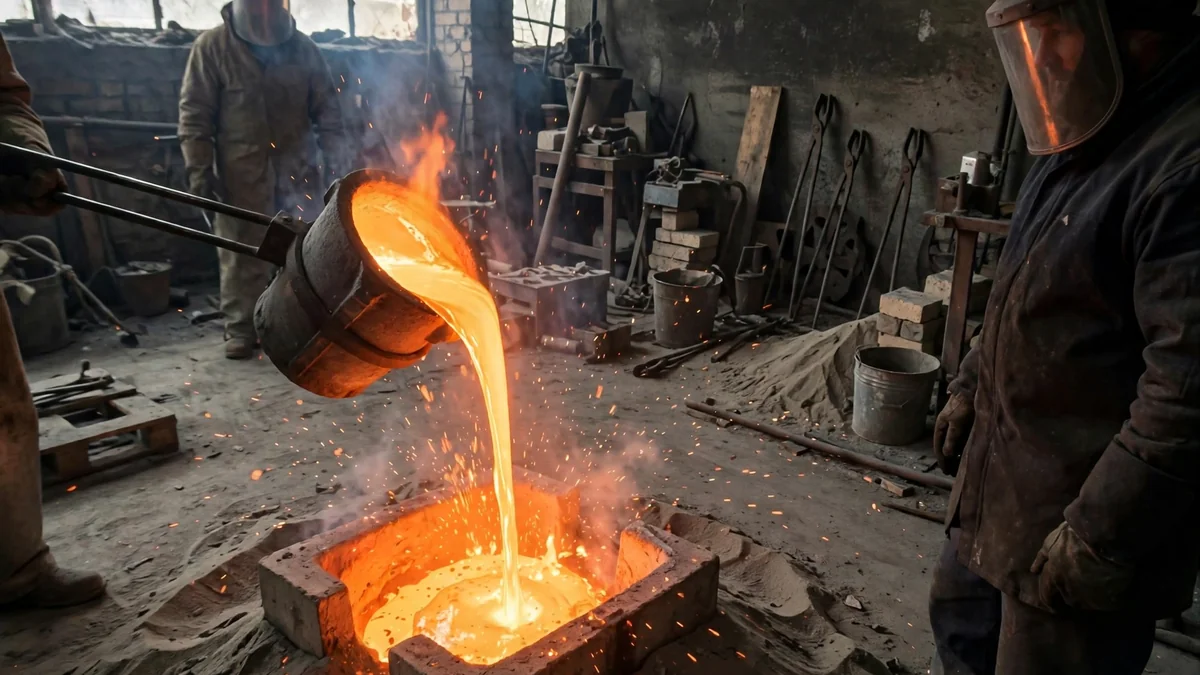
The pour is the moment everything depends on. The mould, glowing from the kiln, is placed in a vacuum chamber, and the molten superalloy is poured in a thin, steady stream. The vacuum pulls the metal into the finest details of the mould and stops air being trapped inside. For the most demanding blades, the casting is directionally solidified: the metal is cooled slowly from the bottom up, so the crystals grow in long columns aligned with the blade instead of in a random jumble. The best blades of all are single crystals, grown as one continuous crystal from base to tip, with no grain boundaries at all for cracks to follow.
5. Cooling and knockout
Once poured, the mould is left to cool under controlled conditions, sometimes for hours. When the casting is cool, the ceramic shell is broken away with vibration and water jets, and the metal tree is revealed: a cluster of rough grey blades joined to the central sprue. The blades are cut from the tree, and the ceramic cores inside them are dissolved away, leaving the hollow cooling passages open.
6. Heat treatment and finishing
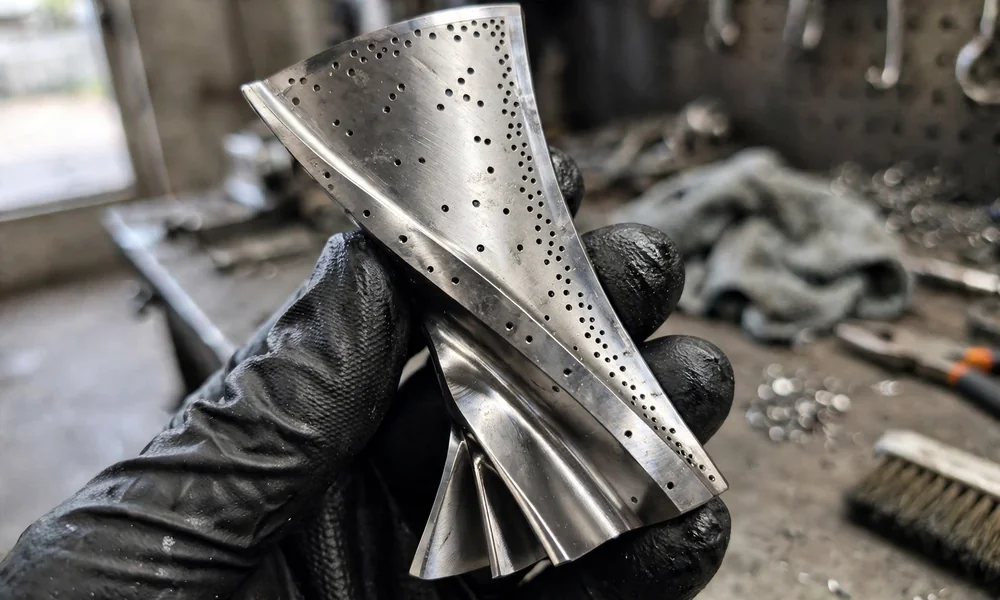
The rough blade goes through heat treatment, a carefully timed cycle of heating and cooling that grows the tiny strengthening particles inside the alloy, the gamma-prime precipitates that give superalloys their high-temperature strength. Then the blade is machined: its root is ground to tolerances measured in microns, its surface is polished, and a ceramic thermal barrier coating is sprayed on. The whole journey from wax to finished blade can take weeks.
7. Inspection and testing
Before any blade is allowed near an engine, it is tested as if lives depend on it, because they do. X-ray and fluorescent penetrant inspection look for cracks and hidden voids, and ultrasound probes the inside. A sample blade from each batch is cut open and examined under a microscope, its crystal structure checked grain by grain. A blade that fails any test is scrapped without argument, however much time and money went into it. The same discipline appears in the forging shops described in how aluminium forging is made, where inspection is the last line of defence between a good part and a disaster.
Superalloy Casting Specifications
| Feature | Typical Value |
|---|---|
| Base metal | Nickel, 50–70 percent of the alloy |
| Melting temperature | Around 1,300–1,400°C |
| Service temperature | Up to 1,100°C in the metal, with gas at 1,500°C |
| Shell coats | 6–10 layers of ceramic |
| Shell firing temperature | Around 1,000°C |
| Blade weight | Typically 200–500 grams |
| Cooling channels | Hollow passages, less than 1 mm wide in places |
| Production time | Several weeks from wax pattern to finished blade |
Those figures are typical for a modern jet engine blade. Larger superalloy castings, such as those for power station gas turbines, can weigh tens of kilograms and take even longer. The production line itself is covered in inside superalloy casting production, where the whole factory is laid out step by step.
What Superalloy Casting Costs
Superalloy casting is expensive, and there is no cheap version of it. As an estimate, a single finished turbine blade for a commercial jet engine costs from around $5,000 to $20,000, depending on its size, its cooling design, and whether it is a single crystal. The raw materials alone are costly: rhenium, one of the key additions, is one of the rarest metals on earth. The furnaces, vacuum chambers, and inspection equipment cost millions to install. Yet airlines pay it gladly, because a hotter-running engine burns less fuel on every flight for twenty years.
A Rare Fact
Here is a detail that still surprises engineers from other fields: a modern single-crystal turbine blade has no grain boundaries at all. It is, in effect, one single crystal of metal, grown like a gemstone, from the root to the tip. If you cut it open and etched it, you would see no grain pattern, because there are no grains. The technique was developed in the 1970s and 1980s, and it works because the blade is solidified so slowly, in a mould withdrawn gradually from a furnace, that a single crystal seed at the bottom grows upward and fills the entire blade.