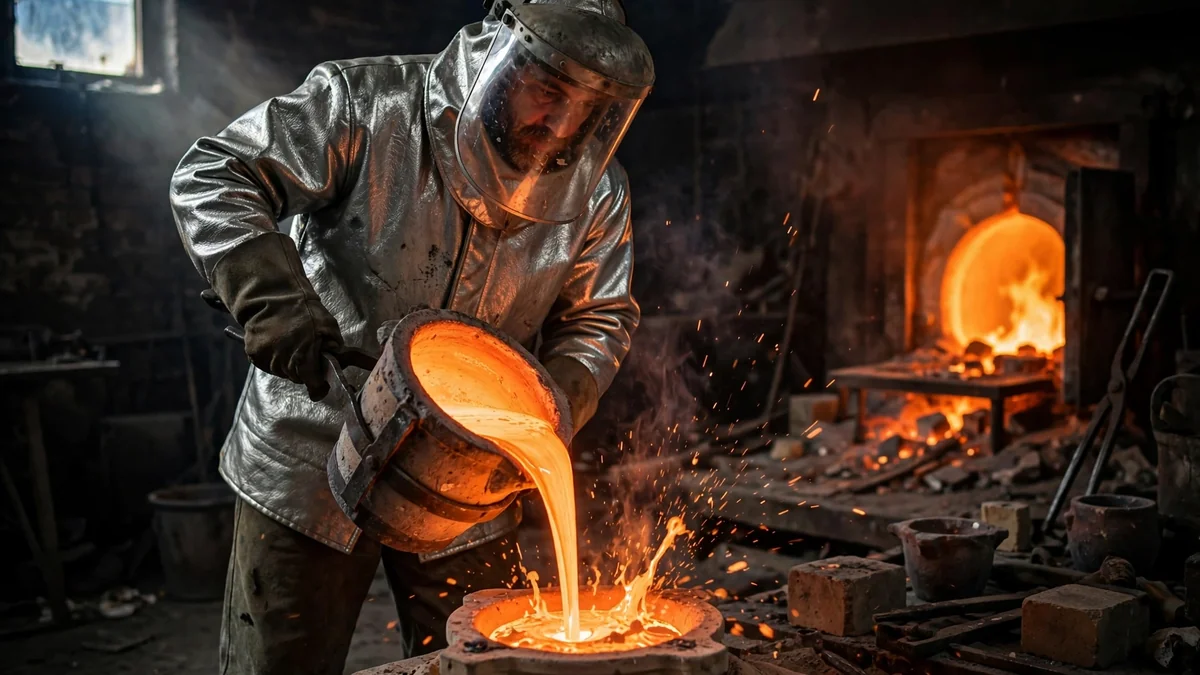
In a dark foundry, a worker in a silver heat suit tips a crucible, and a stream of glowing orange metal pours into a white ceramic mould. The metal is hotter than lava, and it will spend the next hours cooling inside its shell. When the shell is broken away, the part inside will be a turbine blade — a piece of metal that will spin at thousands of revolutions per minute inside a jet engine, in gas hotter than its own melting point.
That is superalloy casting. It makes the parts that live in the hottest, most punishing places on Earth, and everything depends on the material: an alloy that keeps its strength when ordinary steel would soften like toffee, a mould that survives the pour, and a cooling process that freezes the metal into a single crystal. Get it right and a blade can run for thousands of hours. Get it wrong and it creeps, cracks or melts.
Superalloys power jet engines, gas turbines and rocket motors, and they are among the most demanding materials engineers have ever made. Their closest relatives here are how superalloy casting is made, which follows the metal from crucible to finished blade, and the superalloy casting specifications that set the temperatures and tolerances. Here is what the materials are, and why engineers chose them.
Nickel: The Metal That Refuses to Soften
The heart of almost every superalloy is nickel. Nickel keeps its strength at temperatures where steel gives up — above 1,000 degrees Celsius — because its crystal structure stays stable and its atoms move slowly, which stops the metal from creeping under load. The classic recipe adds chromium, for a protective oxide skin, and cobalt, which raises the temperature the alloy can survive. Aluminium and titanium are added in smaller amounts, and they form tiny hard particles inside the metal that block the atomic slips that let metal bend.
The most famous of these alloys have names engineers know by heart. Inconel 718 is the workhorse, used for discs, casings and fasteners that must survive heat and stress together. Rene 80 and CMSX-4 are the blade alloys, built for the very hottest part of the engine, where gas temperatures can exceed 1,500 degrees. The newest alloys add rhenium, a rare metal that slows creep even further — and pushes the price higher still.
The Mould: Ceramic That Survives the Pour
A superalloy is poured at around 1,400 to 1,600 degrees Celsius, far too hot for a steel mould, which would melt on contact. The mould is therefore made of ceramic, built up layer by layer around a wax copy of the part. The wax is melted out, leaving a hollow shell, and the shell is fired until it is hard enough to hold the molten metal. Silica and alumina are the usual ceramics, chosen because they do not react with the alloy and do not crack as the metal cools and shrinks.
For the finest blades, the mould has one more job: it must grow a single crystal. The mould sits on a water-cooled plate, and as it is slowly lowered out of the furnace, the metal freezes from the bottom up, one crystal growing through the whole blade. Grain boundaries are where creep and cracking start, so a blade with no grain boundaries at all can run hotter and longer than any ordinary casting. A single stray crystal is enough to scrap the blade.

How a Superalloy Casting Is Made
- A wax copy of the blade is made by injecting wax into a metal die, complete with the ceramic cores that will form its cooling channels.
- The wax pattern is dipped repeatedly in ceramic slurry and sand, building a hard shell several millimetres thick around it.
- The shell is heated to melt out the wax, then fired in a kiln until the ceramic is hard and the mould is empty.
- Superalloy ingots are melted in a vacuum furnace at around 1,500 degrees Celsius, to keep oxygen out of the metal.
- The molten alloy is poured into the hot ceramic mould, which sits on a water-cooled plate so the metal freezes from the bottom up.
- After cooling, the ceramic shell is broken away, the casting is heat-treated, and the blade is inspected by X-ray for hidden defects.
When the Materials Fail
Failure in a superalloy casting usually begins with creep: the slow, permanent stretching of metal under stress at high temperature. A blade that creeps grows longer by fractions of a millimetre, and in a jet engine, fractions of a millimetre are the gap between the blade tip and the casing. Too much creep and the blade rubs, overheats and fails. The alloy’s chemistry fights this — rhenium and the tiny hard particles slow the atomic movement — but no alloy stops creep entirely, which is why blades have a strict service life.
The casting itself can fail before it ever flies. If the mould cracks during the pour, the blade is lost; if the metal cools too fast, it freezes into many small grains instead of one crystal. Porosity is another killer: tiny gas bubbles trapped in the metal become cracks under vibration. That is why every blade is X-rayed before it is fitted.
Superalloy Casting Materials
| Material | Where it is used | Why engineers chose it |
|---|---|---|
| Inconel 718 | Turbine discs, casings, fasteners | Strong and weldable; the workhorse alloy |
| CMSX-4 | Jet engine turbine blades | Single-crystal strength at extreme heat |
| Rene 80 | Turbine blades and vanes | High creep resistance in hot gas |
| Rhenium | Added to blade alloys | Slows creep; rare and costly |
| Chromium | Added to all superalloys | Forms a protective oxide skin |
| Silica / alumina ceramic | Casting moulds | Survives 1,500 °C without reacting |
| Wax and ceramic cores | Patterns and cooling channels | Melt out cleanly, leaving hollow passages |
What Does Superalloy Casting Cost?
Superalloy casting is one of the most expensive ways to make a metal part. The raw alloy is estimated to cost roughly $50 to $150 per kilogram, with rhenium-bearing grades higher still, and a single finished turbine blade is estimated at $5,000 to $15,000, depending on size and alloy; all of these are estimates, and every blade is bespoke. The vacuum furnace, the ceramic moulds and the X-ray inspection all add cost, and many castings are scrapped. The comparison that matters is with ceramic matrix composites, which are lighter and survive even higher temperatures, but are brittle and far harder to make in complex shapes.
A Rare Fact
A single-crystal turbine blade is, in a sense, one enormous crystal — a piece of metal with no grain boundaries at all, grown like a gemstone. The technique was developed in the 1960s and first flew in military jets in the 1970s, and it lets blades run about 100 degrees hotter than ordinary castings, which translates directly into more thrust and better fuel efficiency.
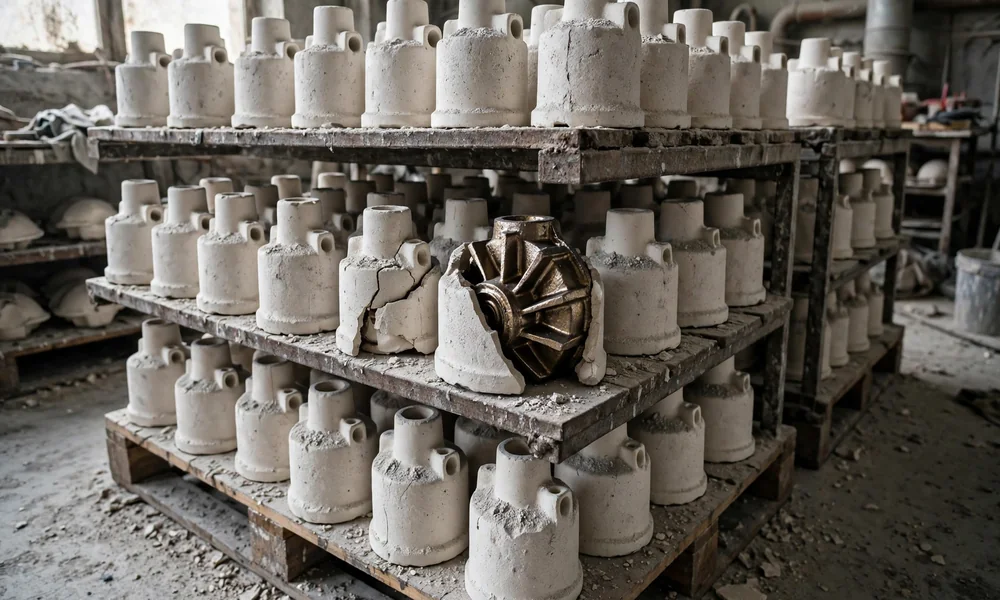
Superalloy casting looks like alchemy — glowing metal, breaking ceramic, a blade grown like a crystal — but it is really a materials story told three times over. The alloy must not soften, the mould must not melt, and the crystal must not break. Get all three right, and a piece of metal smaller than your forearm can hold back the fire of a jet engine, hour after hour, flight after flight.