Inside a jet engine, a few centimetres from a flame burning hotter than molten lava, sits a row of small metal blades. They spin at thousands of revolutions per minute, in gas so hot it would melt ordinary steel like candle wax. They do not melt. They do not bend, crack or stretch. They keep spinning, flight after flight, year after year, in conditions that would destroy almost any other material on Earth. Those blades are made from superalloys, and the way they are cast is one of the most extraordinary manufacturing processes ever devised.
Superalloy casting is not pouring metal into a mould and hoping for the best. It is a slow, controlled, almost surgical process in which a blade is grown, crystal by crystal, inside a ceramic shell, in a vacuum, at temperatures that would turn a kitchen oven to slag.
How Superalloy Casting Works
A superalloy is a metal — usually based on nickel — blended with a dozen other elements: chromium, cobalt, aluminium, titanium, tungsten and more, each added for a reason. Chromium fights corrosion, aluminium forms a protective skin, and tungsten and rhenium strengthen the metal at high temperature. The superalloy casting process turns this blend into a turbine blade by melting it in a vacuum, pouring it into a ceramic mould, and cooling it so slowly and carefully that the metal solidifies into a single crystal — or into a carefully controlled grain structure — with no weak points at all.
Step 1: Making the wax pattern
Every blade begins as a wax copy of itself. Molten wax is injected into a steel die shaped like the finished blade, complete with its complex internal cooling passages — tiny channels that will one day carry cooling air through the blade. The wax pattern is removed, checked, and then several patterns are joined to a central wax sprue, forming a tree that looks like a bunch of metal bananas. This wax tree is the blueprint for the whole casting. It has to be perfect, because every flaw in the wax becomes a flaw in the metal. The cooling passages inside are made with ceramic cores, delicate shapes that sit inside the wax and will later be dissolved away, leaving hollow channels behind. A single blade pattern can take hours to make and inspect.
Step 2: Building the ceramic shell
The wax tree is dipped, again and again, into a ceramic slurry — a liquid mixture of fine silica and binders — and then coated with dry sand. Each dip adds a layer, and after six to ten layers the shell is several millimetres thick and hard as stone. The shell is fired at high temperature until it is strong enough to hold molten metal, and it is kept hot so the metal does not freeze the moment it touches the mould.
Step 3: Melting the superalloy in a vacuum
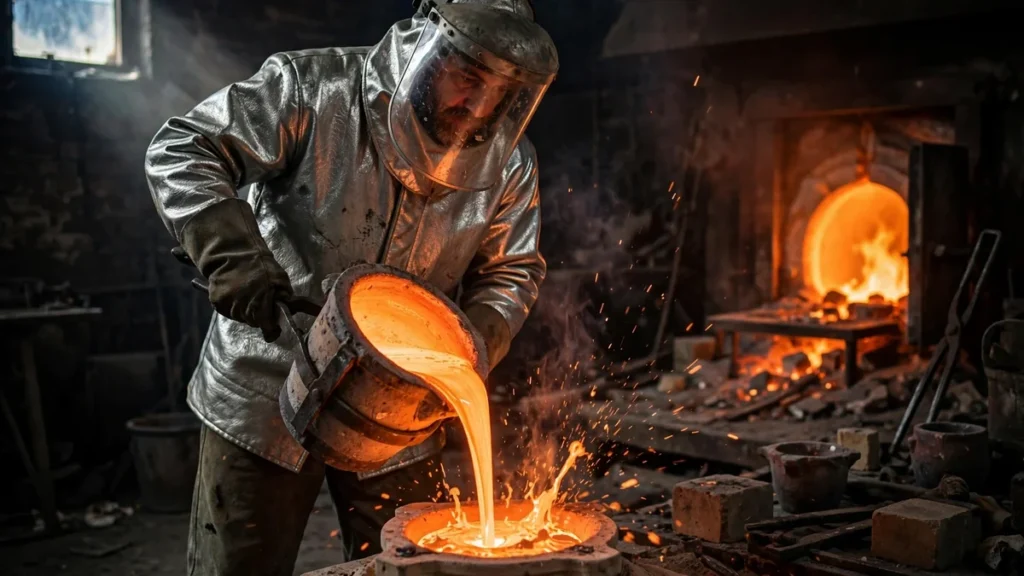
Meanwhile, the superalloy itself is being melted in a vacuum induction furnace. The vacuum matters: at these temperatures, the alloy would react with oxygen in the air and be ruined, so the melting happens in a chamber with almost no air at all. An electric coil heats a crucible of the alloy to around 1,500 degrees Celsius, and the metal turns into a glowing liquid, stirred by the magnetic field of the coil so its composition stays even. The molten metal is held at temperature, skimmed clean, and tested before a single drop is poured.
Step 4: Pouring and growing a single crystal
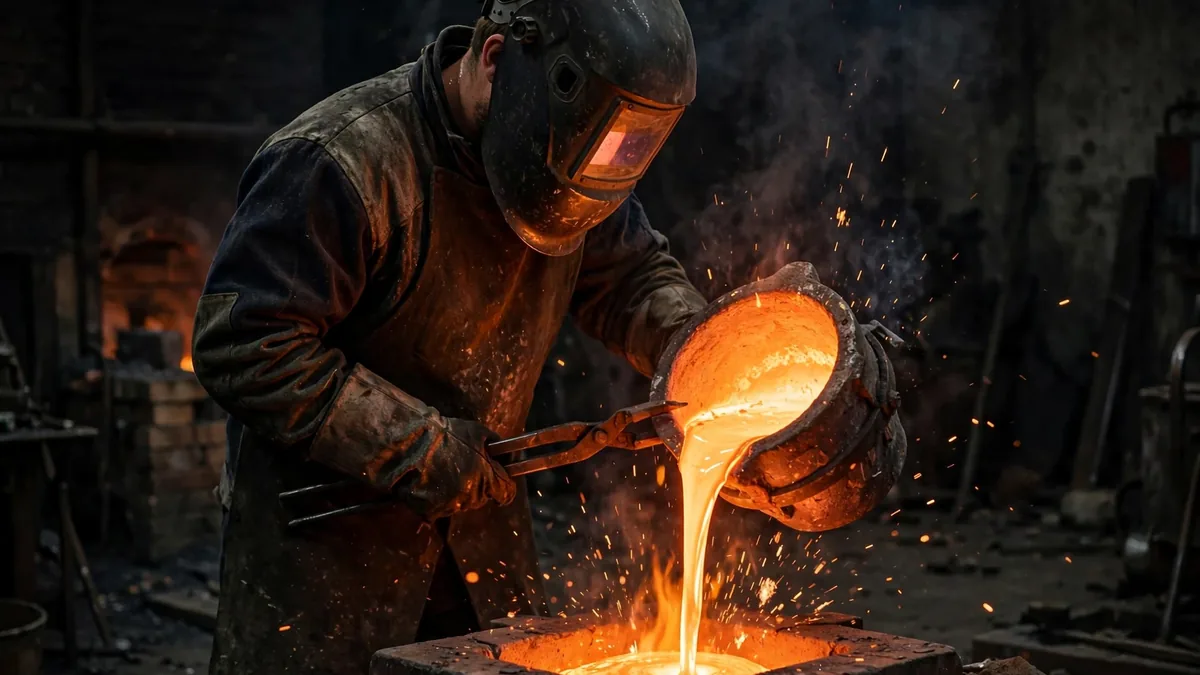
This is the step that makes superalloy casting special. The hot ceramic mould sits on a water-cooled plate inside the vacuum chamber, and the molten alloy is poured in. Then the mould is slowly withdrawn downward, out of the hot zone, so the metal solidifies from the bottom up. At the base of the mould sits a helical channel called a pigtail, or a grain selector, which lets only one crystal grow through into the blade cavity. The result is a blade made of a single crystal of metal — no grain boundaries at all. Growing a single crystal is slow, fiddly work, and if the cooling is disturbed, the blade grows extra grains and is scrapped.
Step 5: Cooling and breaking out the casting
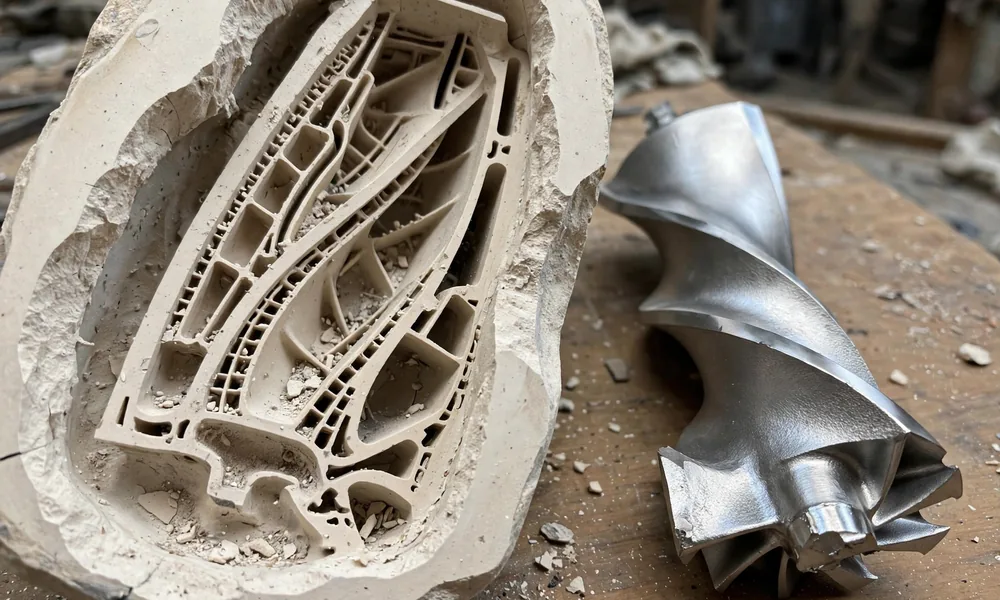
Once the metal has solidified, the mould is left to cool slowly, and then the ceramic shell is broken away — smashed off with vibration and blasting, since it is single-use. The metal tree emerges, and each blade is cut from the sprue. The ceramic cores inside the cooling passages are dissolved away with a caustic solution, leaving the hollow channels that will carry cooling air. The blades are then inspected with X-rays, which reveal any hidden voids or stray grains inside, and with fluorescent dye that shows cracks on the surface.
Step 6: Heat treatment and coating
A raw casting is not yet a finished blade. It goes through a carefully controlled heat treatment — hours at high temperature, then controlled cooling — that creates the microscopic structure the alloy needs: tiny cube-shaped particles of a phase called gamma prime, suspended in the nickel matrix, which block the movement of defects through the metal and give it its strength. Aerogel insulation works on a similar idea of stopping heat, though nothing insulates quite like a ceramic coating on a turbine blade.

Superalloy Casting at a Glance
| Specification | Typical value |
|---|---|
| Base metal | Nickel, with chromium, cobalt, aluminium, tungsten |
| Melting temperature | Around 1,500 °C |
| Melting environment | Vacuum induction furnace |
| Crystal structure | Single crystal, no grain boundaries |
| Service temperature | Up to 1,100 °C in the engine |
| Coating | Ceramic thermal barrier coating |
| Best for | Jet engine turbine blades, power-station turbines |
What Superalloy Casting Costs
A single finished turbine blade can cost roughly $5,000 to $20,000 as an estimate, and a full set for one jet engine can cost more than a luxury car. The price reflects the process: expensive alloying elements like rhenium, a vacuum furnace, single-use ceramic moulds, slow single-crystal growth, and a high rejection rate. The furnace and casting equipment for a production line can cost tens of millions of dollars.
A Rare Fact
The hottest part of a modern jet engine burns gas at around 1,600 degrees Celsius — hotter than the melting point of the nickel superalloy the blades are made from. The blades survive only because of two tricks working together: cooling air bled from the compressor flows through the hollow passages inside each blade, and the ceramic thermal barrier coating insulates the surface. Together they keep the metal itself below about 1,000 degrees while the gas around it is hundreds of degrees hotter than the metal could ever survive. Metal 3D printing can now make turbine parts with cooling channels no casting could produce, but for the hottest blades in the engine, the single-crystal casting still rules.
So the next time a jet climbs away from the runway, think of the blades inside it — each one grown as a single crystal in a vacuum, coated in ceramic, and cooled from within, spinning in gas hotter than its own melting point. It is a small, quiet miracle of materials science, and it is the reason a jet engine can do what no other machine can: turn fire into flight, hour after hour, without melting.