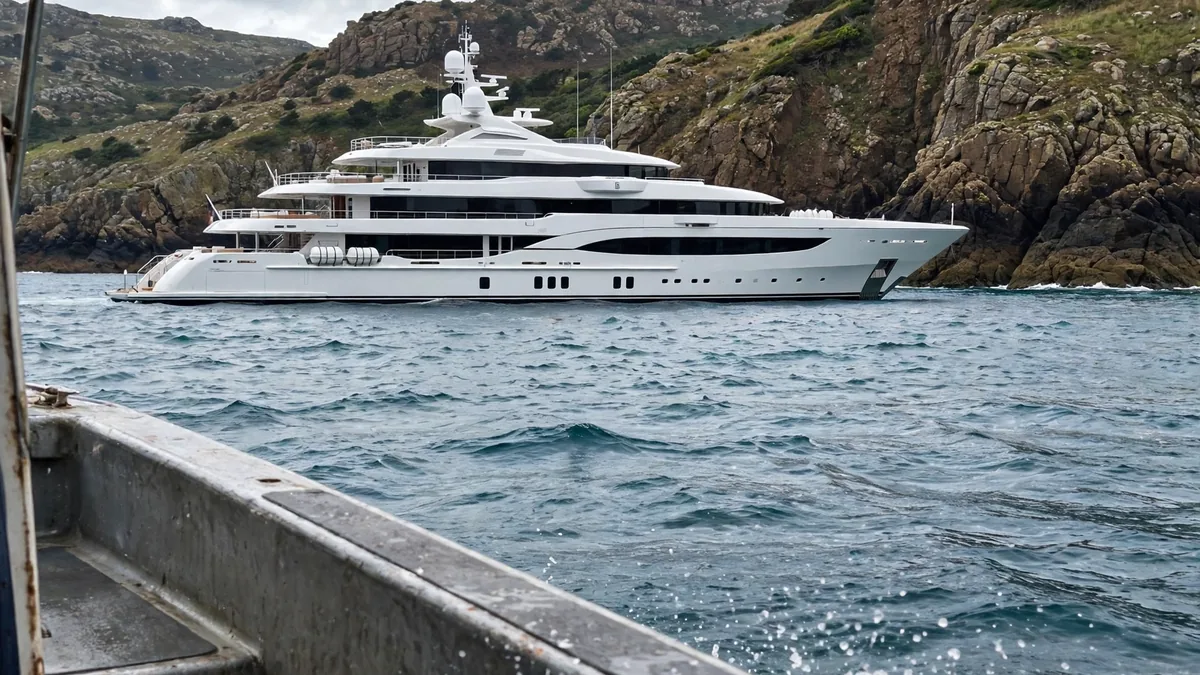
The superyacht sat off the coast in a stiff breeze, and it did not move. No anchor chain ran down, no rope tied it to a buoy, and the captain had not touched the wheel in an hour. The wind pushed, the current pulled, and the sea rolled under the hull, yet the yacht stayed over the same patch of seabed. A guest on deck asked how it was done. The answer was below the waterline, where thrusters were working constantly against the sea.
That is dynamic positioning: a system that holds a vessel in place without an anchor, using sensors, computers, and thrusters. It was invented for oil rigs and research ships, and it has moved onto superyachts that want to hover over a dive site or hold station in a crowded anchorage. This is how superyacht dynamic positioning works, from the satellite signal to the thrust under the hull.
How It Works
Step 1: Satellites and sensors find the yacht’s position
Everything starts with knowing exactly where the yacht is, and the main tool is satellite positioning, usually two independent GPS receivers that place the yacht to within a few centimetres. The receivers are mounted high on the mast, and they send their position to the control computer many times a second. They are backed up by other sensors: a gyrocompass for heading, a motion sensor for roll, pitch, and heave, and a wind sensor for the wind. Some systems add an acoustic beacon on the seabed, which the yacht pings for its position. No single sensor is trusted alone, because a wrong reading would misdirect the thrusters.

Step 2: The computer builds a model of the forces
The control computer takes the sensor readings and builds a model of what the sea is doing to the yacht. It knows the yacht’s size, weight, and windage, and it combines that with the measured wind, current, and waves to work out the forces pushing the hull. The computer also knows where the yacht is supposed to be, the target the captain set, and it calculates the difference between where the yacht is and where it should be. That difference is the error, and the computer’s job is to drive the error to zero. The model is updated constantly, because the wind and the waves change every few seconds.
Step 3: The computer decides how much thrust is needed
Once the computer knows the forces and the error, it decides how much thrust is needed and in which direction. If the yacht is drifting east, it orders thrust west; if the bow is swinging north, it orders thrust to turn it back. The loop is tuned so the yacht moves back smoothly, without overshooting past the target. The computer also thinks about efficiency, using the thrusters in the combination that gives the most push for the least power. The captain can watch all of this on a screen on the bridge, which shows the yacht, the target, and the thrust each unit is producing.
Step 4: The thrusters push the yacht back into place
The thrust comes from the yacht’s thrusters: bow and stern tunnel thrusters that push sideways, and azimuthing pods that can push in any direction. The bow thruster is the workhorse for holding heading, built to run for hours at a time, as described in how a yacht bow thruster is made. The computer sends a thrust command to each unit, the electric motors spin up, and the propellers push water in the direction ordered. The thrusters respond in seconds, and the yacht begins to move back towards its target. The system is always working, even when the yacht looks still, because the sea never stops pushing, and the thrusters never stop pushing back. The power comes from the engine room, built as in how a superyacht engine room is made.
Step 5: The system watches itself and stays safe
A system that can move a yacht on its own needs to be watched closely, so dynamic positioning is built with redundancy: two computers, two sets of sensors, and thrusters that can cover for each other if one fails. If a sensor disagrees with the others, the computer ignores it and warns the crew. If a thruster fails, the computer reworks its plan around the ones that are left. If the position error grows too large, or the wind rises past a set limit, the system alarms and hands control back to the captain. The navigation bridge, where the captain watches all of this, is built as described in how a yacht navigation bridge is made, and the bridge team trains for the moment the system says it can no longer hold.
Step 6: The yacht holds station hour after hour
With the loop running, the yacht holds its station hour after hour, drifting a metre or two either side of the target. The thrusters hum below the waterline, and the guests on deck notice nothing at all, which is the point. The captain can move the target with a touch on the screen, sliding the yacht sideways to a better spot over a reef or turning it to face the sunset, and the system follows. When the captain is done, one touch switches the system off, and the yacht is free to sail away, with no anchor to haul up.

Superyacht Dynamic Positioning Specifications
| Specification | Typical figure |
|---|---|
| Position accuracy | Usually within 1 to 3 metres |
| Heading accuracy | Usually within 1 degree |
| Position sensors | Dual satellite receivers plus gyro |
| Thrusters | Bow, stern, and azimuthing pods |
| Control computers | Redundant pair, hot standby |
| Wind limit | Typically 25 to 35 knots |
How Much Does Superyacht Dynamic Positioning Cost?
Dynamic positioning is one of the more expensive systems on a superyacht, because it needs sensors, computers, thrusters, and the power to run them all. Industry estimates put a full dynamic positioning system at roughly $500,000 to $2 million (estimate) for a large yacht, on top of the thrusters themselves, depending on the size of the yacht. The cost also shows up in fuel, since holding station burns fuel all day, where anchoring burns none. Owners pay it for the freedom it gives: to hover over a dive site, to stay put in a crowded bay without swinging on an anchor, and to hold still while a helicopter lands on deck.
A Rare Fact About Superyacht Dynamic Positioning
Here is something few people realise: a dynamically positioned yacht is never actually still. It is always moving, a metre this way and a metre that, as the wind gusts and the waves pass under the hull, and the system is always correcting. The yacht traces a slow, wandering path around its target, like a dog on a long lead, and the track on the bridge screen looks like a scribble rather than a dot. The skill of the system is not in stopping the movement, which is impossible, but in keeping it small and smooth, so nobody on board feels it. A guest who stands on deck will swear the yacht is anchored, and that is the highest compliment the system can earn.
So the next time you see a superyacht sitting motionless with no anchor in the water, remember what is holding it there: satellites in the sky, sensors on the mast, a computer building a model of the sea, and thrusters under the hull pushing back against every gust and wave. Dynamic positioning is an invisible anchor, made of maths and thrust.


