A superyacht is a floating hotel, and its engine room is the basement that makes everything else possible. It is a steel room deep in the hull where two huge diesel engines sit side by side, surrounded by generators, pipes, pumps, and tanks. It is hot, loud, and cramped when the yacht is running — and yet the guests above should never hear it, feel it, or smell it. That silence is not an accident. It is built in, layer by layer, before the yacht ever touches the water.
Inside the shipyard that builds the superyacht engine room, the work begins long before the engines arrive. The steel hull is still open to the sky, and the room is an empty box of bare metal. Over months, it fills with machinery lowered in by crane, pipes bent by hand, and kilometres of cable. Every piece must fit exactly, because once the deck above is closed, there is no easy way to get a large engine out again.
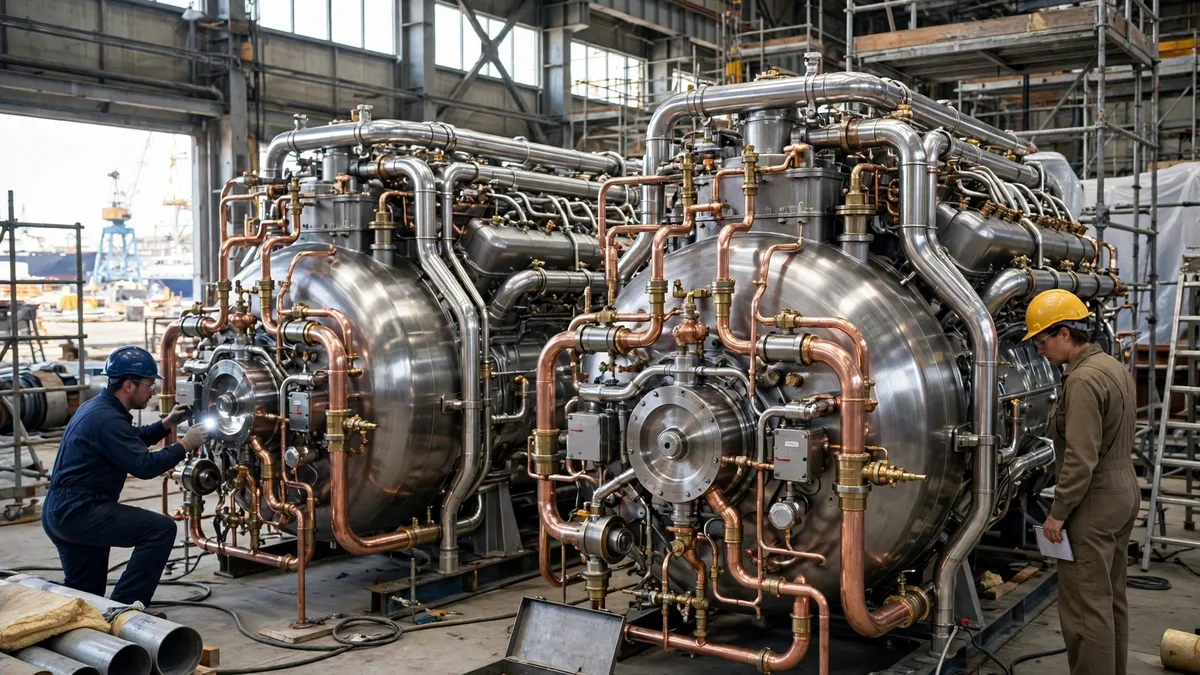
Inside the Production
Step 1: Preparing the steel room
The engine room starts as an empty steel compartment in the hull, its walls still showing the marks of welding. Workers clean and prime the steel, then fit the engine beds — heavy steel foundations welded to the hull that will carry the weight of the engines and absorb their vibration. The beds must be level to within a fraction of a millimetre, because an engine sitting even slightly out of line will wear its bearings and shake the whole yacht. Insulation is fitted to the walls and ceiling: thick mineral wool behind steel panels, to keep heat in the room and noise out of the cabins above.
Step 2: Lowering the engines in
The main engines arrive by road on low loaders, each one weighing as much as several cars. A yard crane lifts them over the open hull and lowers them gently onto the engine beds, while workers guide them with ropes and hand signals. The engines are bolted down with large foundation bolts, then aligned with the propeller shafts using laser measuring tools. Alignment is slow, patient work: the engine and the shaft must be in a perfectly straight line, or the shaft will vibrate and wear out its seals. A big yacht engine can take days to align properly.

Step 3: Fitting the generators and tanks
While the main engines are aligned, the rest of the room fills up. Generators — smaller diesel engines that make electricity for the yacht — are fitted on their own mounts, along with fuel tanks, fresh-water tanks, and the pumps that move fuel, water, and oil around the yacht. Each tank is pressure-tested before it is fitted, and every pipe connection is checked twice. The room is planned like a puzzle: the heaviest items sit low for stability, and anything that needs regular servicing is placed where a person can actually reach it.
Step 4: Pipework and cabling
Next comes the pipework: fuel lines, cooling water pipes, exhausts, bilge lines, and air conditioning ducts, all running through the same crowded space. Many pipes are bent by hand on the spot, because no two yachts have exactly the same layout. Copper and stainless steel are used where corrosion matters, and every joint is tightened and tested under pressure. At the same time, electricians run kilometres of cable through trays along the walls — power cables, control cables, and sensor wires — each one labelled so that a fault years later can be traced in minutes rather than days.
Step 5: Soundproofing and fire protection
With the machinery in place, the room is sealed up for silence and safety. Extra layers of sound-absorbing material go on the walls and around the engines, and floating floors are fitted so vibration does not travel into the hull. Fire protection is fitted throughout: fixed fire extinguishers, heat sensors, smoke detectors, and fireproof bulkheads that can seal the room off in seconds. The way the room is put together, steel first and silence second, is part of what how a superyacht steel hull is made describes, and the engine room is where that hull becomes a working ship.
Step 6: Testing the whole room
Before the deck above is closed, the whole engine room is tested as a system. The engines are started and run at full power, the generators are loaded, the cooling systems are checked for leaks, and the exhausts are watched for smoke. Vibration is measured at the beds and in the cabins above, and the fire systems are tested with drills. Any leak, rattle, or vibration is fixed while the room is still open. Only when the engines run smoothly, quietly, and coolly is the deck closed over the room and the yacht moved on to fitting out.

Specs
| Specification | Typical figure |
|---|---|
| Main engines | Two diesel engines, 2,000–5,000 hp each |
| Generators | Two or three, 100–300 kW each |
| Fuel capacity | 50,000–200,000 litres on a large yacht |
| Top speed | 15–25 knots, depending on size |
| Engine weight | 5–15 tonnes per main engine |
| Cooling | Seawater cooling through heat exchangers |
| Soundproofing | Mineral wool, floating floors, sealed bulkheads |
| Fire protection | Fixed extinguishers, sensors, sealed bulkheads |
| Testing | Full-power run and vibration check before closing |
Price
The engine room is one of the most expensive parts of a superyacht, and its price is usually given as an estimate. As an estimate, the main engines alone cost roughly $1 million to $3 million each for a large yacht, and the full engine room — engines, generators, tanks, pipes, and installation — can cost $5 million to $15 million. These are estimates, and the real figure varies with size, power, and the yard — but the rule holds: the machinery below the waterline is where a large share of the yacht’s price is hidden, out of sight of the guests above.
A Rare Fact
A superyacht engine room is so well soundproofed that the crew can hold a normal conversation beside a running engine. The trick is not one thick wall but many layers: steel, mineral wool, air gaps, and floating floors, each one stopping a different kind of sound and vibration. Some yards measure the noise in the guest cabins while the engines run at full power and aim for a level quieter than a normal living room. It is one of the strangest facts in yacht building — a room holding thousands of horsepower, quieter than the cabin of a car, separated from the guests by a few layers of carefully fitted silence.
The engine room is the heart of the yacht, but it only makes sense alongside the hull and the rooms it powers. The materials behind its steel and copper are laid out in the superyacht engine room materials engineering guide, and the room that steers the whole ship is explained in how a yacht navigation bridge works. The next time a superyacht glides past in silence, remember the crane, the laser alignment, and the room below the waterline that makes it all possible.