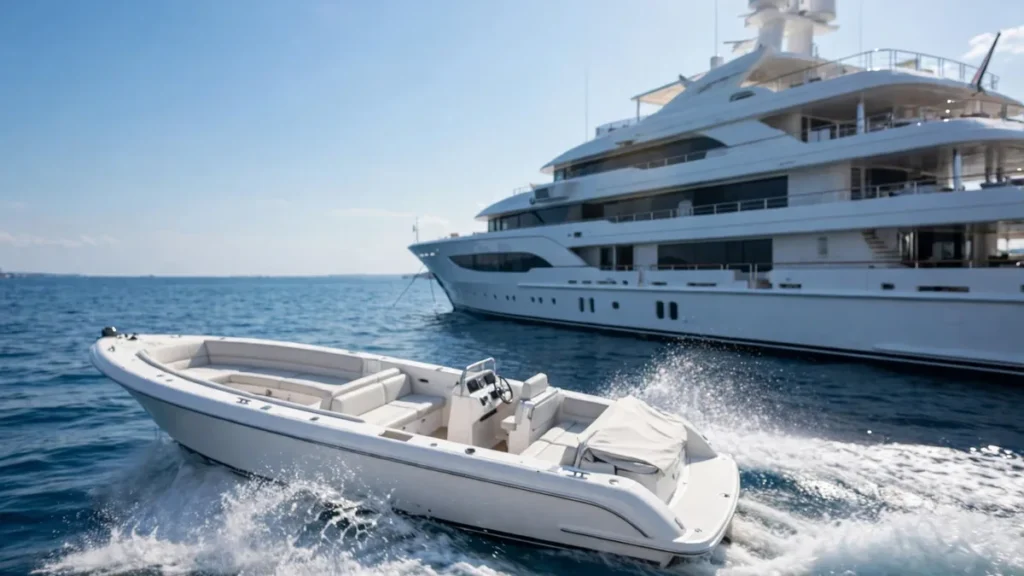
The superyacht was anchored off a quiet bay in the Mediterranean, and the only way ashore was a boat barely longer than a family car. The tender slipped away from the yacht’s stern garage, its engine humming low, and carried its passengers across water so clear they could see the sand below. It was a ten-minute trip, and the most important of the day — without the tender, a superyacht is a floating hotel with no front door.
A superyacht tender is a small boat with an impossible job. It must be fast enough to be fun, tough enough to be beached on a stony shore, elegant enough not to embarrass a yacht worth a hundred million dollars, and small enough to fit inside a garage barely bigger than itself. It carries guests, luggage, divers and water skis, in salt water, sun and spray. Building one is a craft of fibreglass, foam and fine joinery, and it starts with a shape drawn for speed.

How a Superyacht Tender Is Made
Step 1: Designing the tender and building the mould
Every tender begins with a hull shape designed to do two contradictory things: plane across the water at speed, and stay stable when eight people stand up in it at once. Designers draw a deep V at the bow to cut through chop, flattening towards the stern so the boat lifts onto the plane quickly. Once the shape is settled, a full-size plug is built from foam and finished to a mirror shine, and a mould is taken from it in fibreglass.
Step 2: Laying up the fibreglass hull
The hull itself is made by laying up fibreglass inside the mould, layer by layer, by hand. Workers brush gel coat into the mould first — the smooth, coloured skin that will become the outside of the boat — then lay sheets of glass fibre mat and cloth, wetting each layer with resin and rolling it flat to squeeze out air bubbles. The whole lay-up can take days, and it cures in a warm room so the resin hardens evenly.

Step 3: Fitting the deck, stringers and structure
Once the hull is cured and lifted from the mould, the inside gets its structure. Longitudinal stringers and transverse bulkheads are bonded in, turning the flexible shell into a rigid boat, and the deck is fitted over the top, sealing the hull into a watertight box. The fuel tank, steering cables and wiring are installed at this stage, hidden under the deck. The way the structure is hidden and finished has much in common with a yacht keel, where enormous strength has to be packed into a shape that looks simple from the outside.
Step 4: Installing the engine and jet drive
Most superyacht tenders are powered by a compact inboard engine driving a water jet, rather than a propeller. The jet is chosen because it has no exposed blades — guests can swim around the tender safely, and the boat can run in shallow water without fear of striking the bottom. The engine is bolted to its mounts, aligned to the jet unit with millimetre precision, and connected to the fuel, cooling and exhaust systems. The steering is fitted next, with the jet nozzle linked to the helm so the boat turns by aiming the water stream. The same demand for smooth, safe power also shapes a yacht propeller installation, where the drive train must run quietly for thousands of hours.
Step 5: Trimming the cockpit and matching the yacht
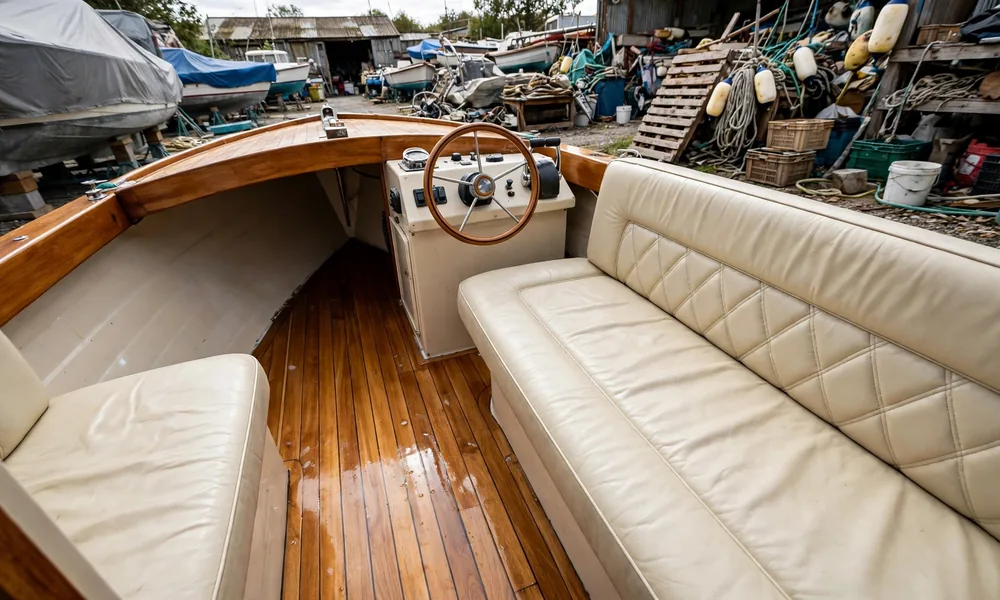
This is the step that separates a superyacht tender from an ordinary small boat. The cockpit is trimmed to match the mothership: leather seats stitched in the same colours, teak decking laid plank by plank, stainless steel handrails polished to a mirror, and the yacht’s name embroidered or painted in exactly the right place. The console gets its instruments, the upholstery is fitted over foam that will not soak up seawater, and every edge is finished so there is nothing sharp for a barefoot guest to catch. Builders work from the yacht’s own interior samples, so the tender feels like a small room of the big ship rather than a separate boat.
Step 6: Testing on the water
No tender is handed over without being run hard. The boat is launched and taken through its paces: full-speed runs, tight turns, sudden stops, and a test with a full load of passengers to check that it still planes and still handles. The builders check for leaks, for vibration, for water coming over the bow in a chop, and for the jet clogging with weed. They also test the tender’s most important trick — fitting back into the yacht’s garage, clearance measured in centimetres, because a tender that does not fit its garage is useless, however beautiful it is. Only when it passes does it get its final polish and its name on the stern.
Superyacht Tender at a Glance
| Specification | Detail |
|---|---|
| Typical length | 4–8 m, built to fit the mothership’s garage |
| Hull material | Hand-laid fibreglass, often with foam core or carbon fibre |
| Propulsion | Inboard engine with water jet drive, no exposed propeller |
| Top speed | Roughly 30–45 knots, depending on size and engine |
| Capacity | Typically 6–12 passengers plus a crew member |
| Deck finish | Teak planking, leather upholstery, stainless steel fittings |
| Key test | Full-load sea trial plus garage fit check |
| Build time | Roughly 3–6 months from mould to delivery |
What Does It Cost?
A new superyacht tender typically costs roughly $100,000 to $500,000, depending on its length, engine and the richness of its trim, while a large or fully custom tender can cost $1 million or more. The hull is only part of the price: the engine, the jet unit, the teak decking and the hand-stitched upholstery all add up, and matching a mothership’s interior exactly is slow, skilled work that cannot be rushed. Those figures are estimates, not quotes, and they do not include the cost of the crane or garage system on the yacht itself. The same obsession with a beautiful, hard-wearing deck also drives the making of a yacht teak deck, where every plank is laid by hand and expected to last for decades.
A Rare Fact
Some of the largest superyachts carry not one tender but a whole fleet — a fast guest tender, a work boat, a sailing dinghy and sometimes even a small submarine. The guest tender is often stored in a garage that floods: the yacht opens a stern door, water flows in, and the tender simply floats out, like a boat launching itself from inside another boat. It exists because a tender is too important to tow behind and too beautiful to leave on deck.
A superyacht tender is the smallest boat in the fleet and the one that gets used the most. It takes guests to dinner, divers to the reef and children to the beach, all while looking like it belongs beside a ship worth a fortune. The next time you see a gleaming white tender tied up beside a yacht, look past the leather and the teak — underneath is a hand-laid fibreglass hull, a jet drive with no propeller, and months of work by people who build small boats as carefully as others build big ones.