Glance at your wrist during a run and a little green light is quietly counting your heartbeats, measuring blood oxygen and guessing how well you slept. There is no cuff, no needle, no clinic: just a cluster of lights pressed against your skin, reading your body through the light it reflects. It feels like magic, but it is optics, electronics and materials science packed into a sensor the size of a coin, working where a laboratory instrument would refuse: sweat, motion, cold skin, a loose strap.
The sensor’s job is brutally hard. It must shine light into your wrist, catch the faint reflection that carries your pulse, and separate that whisper of a signal from the noise of every step you take. Get it wrong and the watch reports a heart rate of 180 while you sit on the sofa. Get it right and it can spot an irregular heartbeat days before you feel anything. The materials behind that little window decide which outcome you get.

The Materials Behind the Sensor
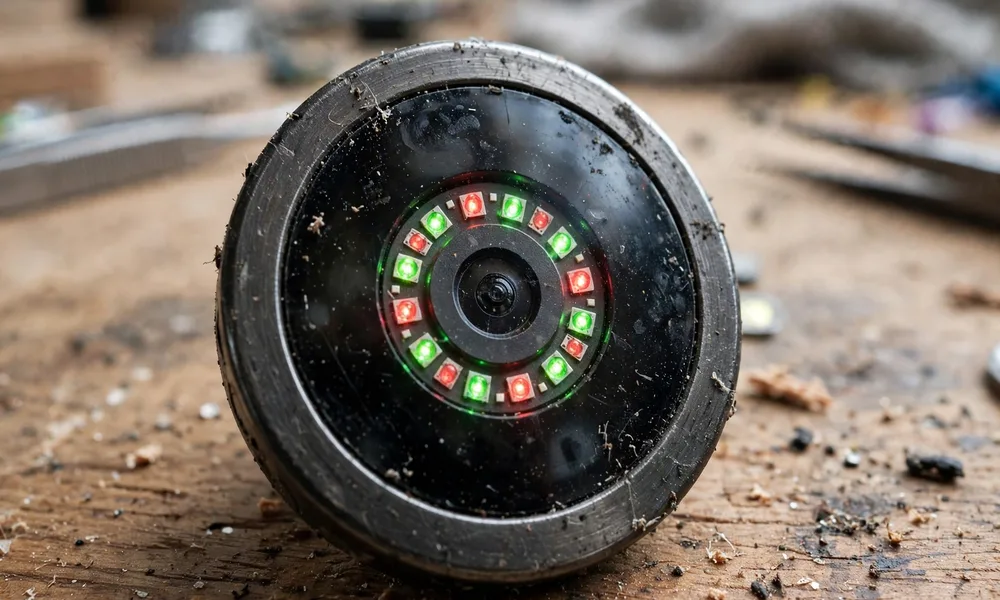
At the heart of the sensor sits a window of sapphire crystal or hardened glass, chosen because it must be almost perfectly transparent to green, red and infrared light while surviving daily knocks against door frames and gym equipment. Sapphire is second only to diamond in hardness, so it resists scratches that would scatter the sensor’s light and corrupt its readings, and it does not yellow or cloud with age like ordinary plastic. Beneath the window, an array of light-emitting diodes fires pulses of green light into the skin, because blood absorbs green strongly, so each heartbeat shows up as a clear dip in the reflected light.
The returning light is caught by silicon photodiodes, shielded by a dark optical barrier that stops light leaking sideways from the LEDs into the detector without ever touching your skin. The module is sealed against sweat and water with silicone gaskets and a ceramic or stainless-steel housing, and the circuit board beneath it is a rigid-flex design that bends around the watch case while carrying signals too faint to survive a noisy layout. Electrodes for heart-rate and blood-oxygen readings are plated in gold or titanium, because they must conduct perfectly while sitting against skin for hours. The same obsession with reading the body through light and touch shapes other tiny sensors, from the scanner that reads the fingerprint sensor in your phone to the display that shows the result, as in a micro-LED watch display.
How It Is Made
Building a health sensor is optics at watchmaking scale: a handful of parts, each smaller than a grain of rice, assembled so precisely that a speck of dust can ruin a reading. The process runs roughly like this.
- Grow the crystal. Sapphire is grown as a single crystal boule, then sliced, ground and polished into windows a fraction of a millimetre thick.
- Mount the LEDs. Green, red and infrared LED dies are bonded to a ceramic substrate and wire-bonded with gold wires finer than a hair, then tested for brightness.
- Place the photodiodes. Silicon photodiodes are set between the LEDs behind a light-blocking barrier, so they only see light that has passed through the skin.
- Seal the module. The optical assembly is potted in clear silicone that keeps sweat and dust out while letting light through, then bonded to the sapphire window.
- Assemble the watch back. The sensor module is fitted into the ceramic or steel case back with a gasket, and gold-plated electrodes are pressed into place around it.
- Calibrate on skin. Each finished watch is tested against reference signals on a phantom wrist and real volunteers, and any sensor reading weakly or noisily is rejected.
Why These Materials Win
Sapphire wins because a scratched window is a lying sensor: every scratch scatters light and adds noise that no algorithm can fully remove. Green LEDs win because blood absorbs green light far more strongly than red, so the pulse signal stands out against the background, while red and infrared light penetrate deeper and reveal blood oxygen. Silicon photodiodes win because they are sensitive, cheap and fast enough to sample the pulse hundreds of times a second, and gold electrodes win because they never corrode against skin, however much you sweat.
The failures are instructive, too. A cloudy window makes the watch read a steady heart rate that never changes. A loose strap lets daylight leak under the sensor and drown the signal. A cracked gasket lets sweat reach the electronics and corrode the fine gold bonds. Engineers fight all three with harder glass, better straps and tighter seals, and the result is a sensor that can track your heart through a marathon. It is the same materials logic that shapes the rest of the watch: the sensor must be accurate yet invisible, which is why the health sensor in a smartwatch is built the way it is, with every material chosen to keep a faint optical signal clean.
Specifications
| Specification | Detail |
|---|---|
| Sensor type | Optical photoplethysmography (PPG) |
| Window | Sapphire crystal or hardened glass |
| LEDs | Green, red and infrared, multiple emitters |
| Detector | Silicon photodiodes behind an optical barrier |
| Electrodes | Gold- or titanium-plated, skin-contact |
| Housing | Ceramic or stainless steel with silicone gasket |
| Sampling rate | 100 to 500 samples per second |
| Water resistance | 5 ATM, sensor sealed against sweat |
Price
A smartwatch health sensor is one of the cheapest modules in a modern watch, yet priced like a precision instrument. Replacement optical sensor modules for popular watches typically sell as spare parts for around $15 to $50 (estimate), and the sensor inside a new watch is estimated to cost the manufacturer only a few dollars at volume (estimate). The real expense is not the materials but the calibration: every sensor is tested against reference signals and on real skin before it leaves the factory, because a single inaccurate sensor would make a health watch untrustworthy. That testing is why a watch bought years ago can still count your pulse correctly.

Rare Fact
The green light in your smartwatch was chosen for a reason that has nothing to do with fashion: haemoglobin, the molecule that carries oxygen in your blood, absorbs green light far more strongly than red or blue. That means each pulse of blood through your wrist shows up as a sharp dip in green light bouncing back to the sensor, while red light barely notices it. Early wrist sensors tried red light first, and failed in bright daylight because the signal was too weak. Switching to green was the breakthrough that turned a laboratory curiosity into a watch you can buy, and it is why the glow on the back of your watch is green rather than any other colour.
That is the hidden craft of the smartwatch health sensor: a window harder than steel, lights tuned to the colour of blood, and detectors that can hear a heartbeat in a flood of daylight. You never see it working, yet it is the part of your watch that knows your body best, counting every beat while you get on with your day.


