There is a moment in every carbon mast factory that never stops feeling strange, no matter how many times it happens. A team of workers stands around a mould the length of a cricket pitch, smoothing down sheets of black cloth that look like nothing more than expensive fabric. A few days later, that cloth is a mast: a single rigid tube, lighter than the aluminium mast it replaces and several times stiffer, ready to carry a sail plan the size of a tennis court. Nothing about the raw material suggests what it will become, and that is why the factory matters: carbon fibre is only as good as the hands that lay it.
A yacht carbon mast is not woven or machined into shape. It is built up, layer by layer, in a mould, then cured under heat and pressure until the soft cloth and liquid resin become one solid structure. The process looks slow and almost old-fashioned — people in gloves, rollers, and a great deal of patience — but the tolerances are brutal. A single wrinkle, a pocket of trapped air, or a patch of resin that cures too fast can become a weak point forty metres above the deck. Here is how the factory gets it right.
How It’s Made
Step 1: Designing the laminate
Every mast begins as a laminate schedule, a recipe that says exactly how many layers of carbon cloth go where, and in which direction each layer’s fibres must run. The loads on a mast are not even: the base carries enormous compression, the middle takes the bending load of the sails, and the top must stay light. Engineers plot these loads in software, then translate them into a stack of plies — some running lengthwise for stiffness, some wrapped around the tube for crush resistance, some angled to handle twisting. The factory follows it like a script, because a layer in the wrong place is a mast with a built-in weak spot.
Step 2: Preparing the mould
The mould is a long, polished half-pipe, usually machined from steel or composite, and it is treated with great care. It is cleaned, inspected for the smallest scratch, and coated with a release agent so the finished mast will come out without sticking. Any mark on the mould becomes a mark on the mast. The mould is warmed to a steady temperature before work begins, because cold resin flows badly and leaves dry patches no later work can fix.
Step 3: Laying up the carbon fibre
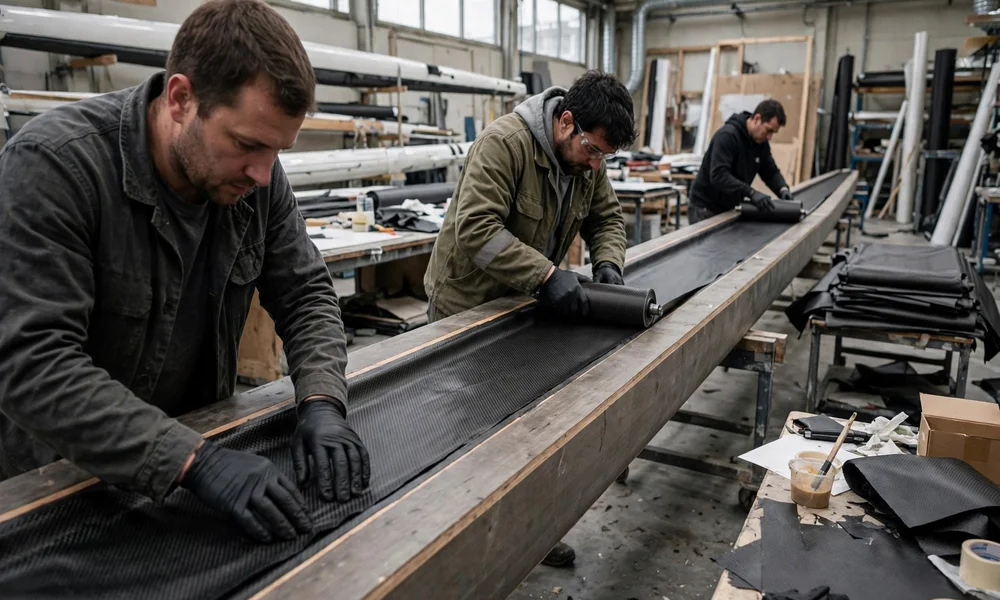
This is the heart of the whole job, and it is done mostly by hand. Workers cut the carbon cloth — prepreg, cloth already impregnated with resin — into precisely shaped pieces, then lay them into the mould one at a time, smoothing each layer down and pressing out every bubble of air. The fibre direction of each ply is checked against the schedule, and the overlaps are staggered so no two seams line up. It is slow, quiet work, and a big mast can take a team several days to lay up, but there is no shortcut: a mast tapers, curves, and changes thickness along its length, and only human hands can follow that shape.
Step 4: Adding the fittings and core
As the layers build up, the factory adds what the mast needs to work: tracks for the sail cars, halyard exits, sheave boxes, and spreader roots built in with extra reinforcement. Some masts carry a foam or honeycomb core in places, to keep the walls from buckling under load without adding much weight. Every fitting is positioned while the laminate is still soft, because drilling a new hole after curing means cutting fibres, and cut fibres are lost strength.
Step 5: Bagging and curing in the autoclave
When the layup is complete, the mould is sealed under a vacuum bag — a tough plastic skin sucked tight against the laminate — and the whole assembly goes into an autoclave, a giant oven that is also a pressure vessel. The cure cycle is closely watched: the temperature rises slowly, the pressure squeezes the layers together, and the resin flows, bonds, and hardens over many hours. Too hot and the resin scorches; too cool and it never fully cures. Technicians watch the temperature traces the whole time, and the autoclave does not open until the mast has cooled slowly, because a hot mast taken out too soon can warp.
Step 6: Finishing, testing, and stepping
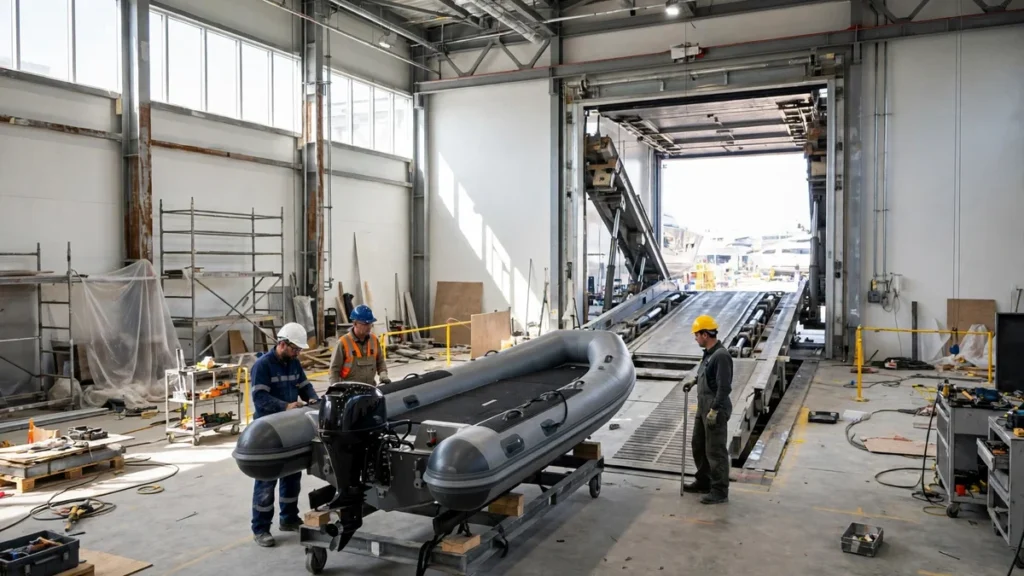
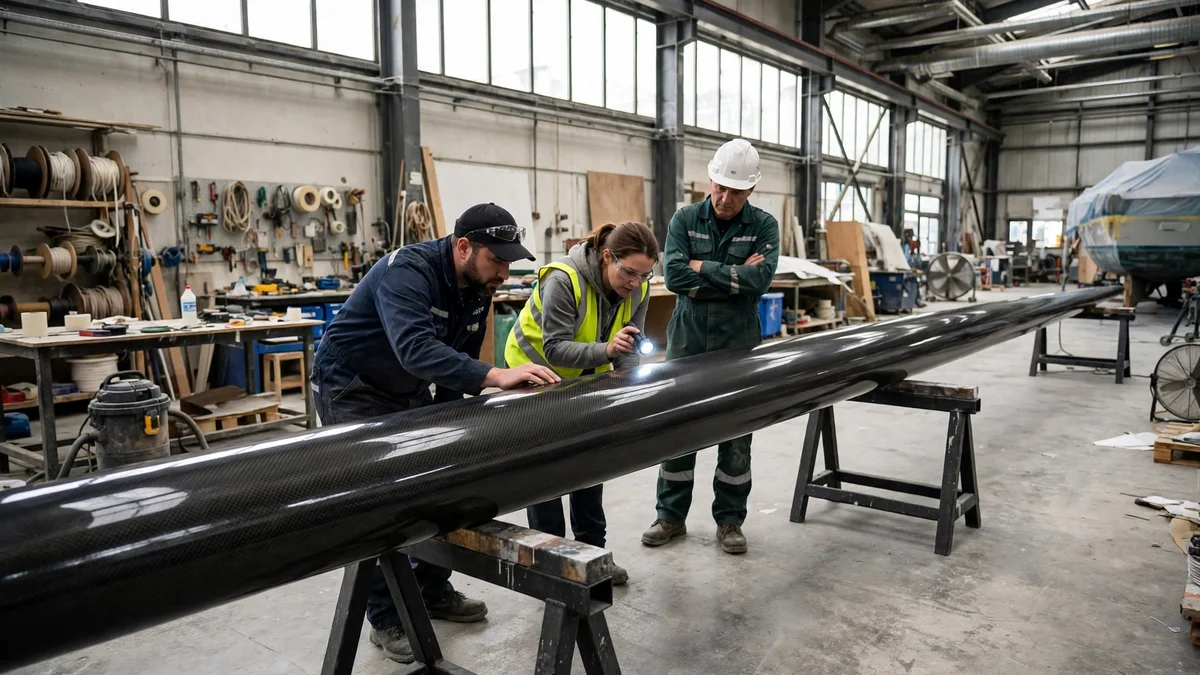
Out of the mould, the mast is a dull black tube. Its surface is faired, sanded, and polished to a deep gloss, then inspected by ultrasound and tap testing, listening for the dull thud that betrays a hidden void. Fittings are bolted on, the mast is weighed and measured, and a bending test proves it deflects as the engineers predicted. Finally, a crane steps it through the deck and it is tuned with the rigging. From black cloth in a mould to a mast carrying sails, the whole journey can take several weeks, and most of that time is spent waiting — waiting for resin to cure, for surfaces to polish, for tests to confirm what the hands already knew.

Specs
| Specification | Typical figure |
|---|---|
| Mast material | Carbon fibre prepreg, epoxy resin |
| Mast length | 20–40 metres on a large sailing yacht |
| Weight saving | Roughly 30–50% lighter than aluminium |
| Build method | Hand layup in a mould, autoclave cured |
| Cure cycle | Many hours under heat and pressure |
| Wall construction | Multiple plies, fibre direction varies by load |
| Fittings | Sail track, halyard exits, spreader roots built in |
| Testing | Ultrasound, tap testing, bending test |
| Build time | Several weeks from layup to stepping |
Price
A yacht carbon mast is a custom part, so any price is an estimate. As an estimate, a carbon mast for a large sailing yacht costs roughly $200,000 to $1 million, depending on its length, the complexity of its laminate, and the fittings built into it. That is several times the price of an aluminium mast of the same size, and owners pay it for the weight saved high above the deck, where every kilogram counts double.
A Rare Fact
Carbon masts are so stiff that they change how a yacht sails in a way owners can feel on the first day. An aluminium mast bends and springs back as gusts hit the sails, spilling a little wind each time. A carbon mast barely bends at all, so the sail keeps its shape and the yacht accelerates harder in every puff — but it also heels more suddenly. Some racing crews say the first sail with a carbon mast feels like the yacht has been given sharper reflexes. The mast did not just get lighter; it changed the personality of the boat.
The mast’s own construction is covered in more detail in how a yacht carbon mast is made, and the numbers behind its strength are laid out in yacht carbon mast specs explained. The larger world of superyacht spars is explored in how a superyacht mast is made. The next time you see a black mast rising over a marina, remember the gloved hands, the layers of cloth, and the long slow cure that turned fabric into one of the strongest tubes on the water.