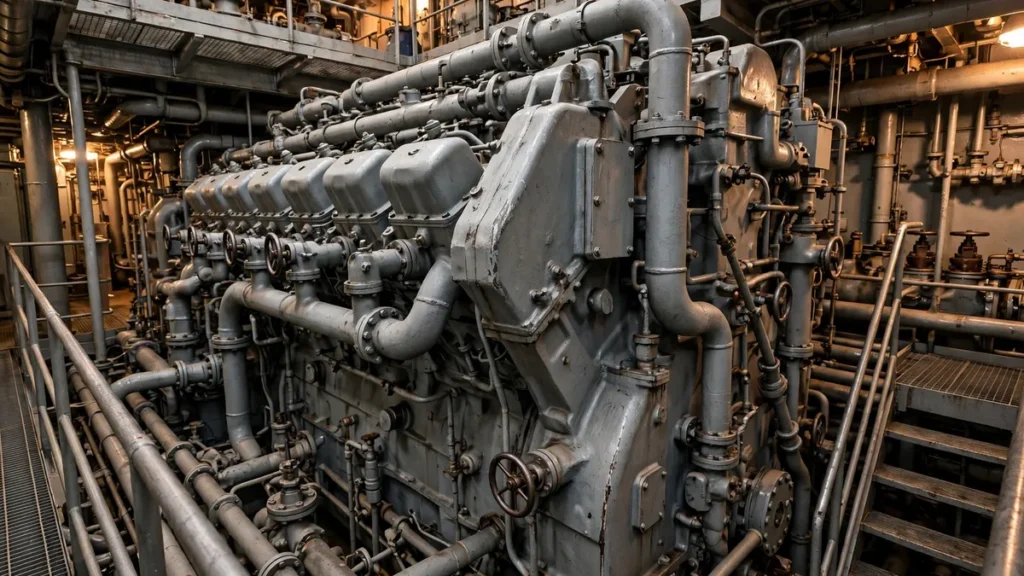
Stand next to a cruise ship engine for the first time and your first thought is not about power. It is about scale. The engine is three storeys tall, longer than a city bus, and so heavy that the floor it stands on was poured specially to hold it. A single piston is the size of a dustbin, and a single bolt needs a hydraulic wrench the length of a man to tighten it. It will spend its life hidden in the bowels of a floating city, pushing twenty thousand tonnes of steel, glass, and holidaymakers across an ocean.
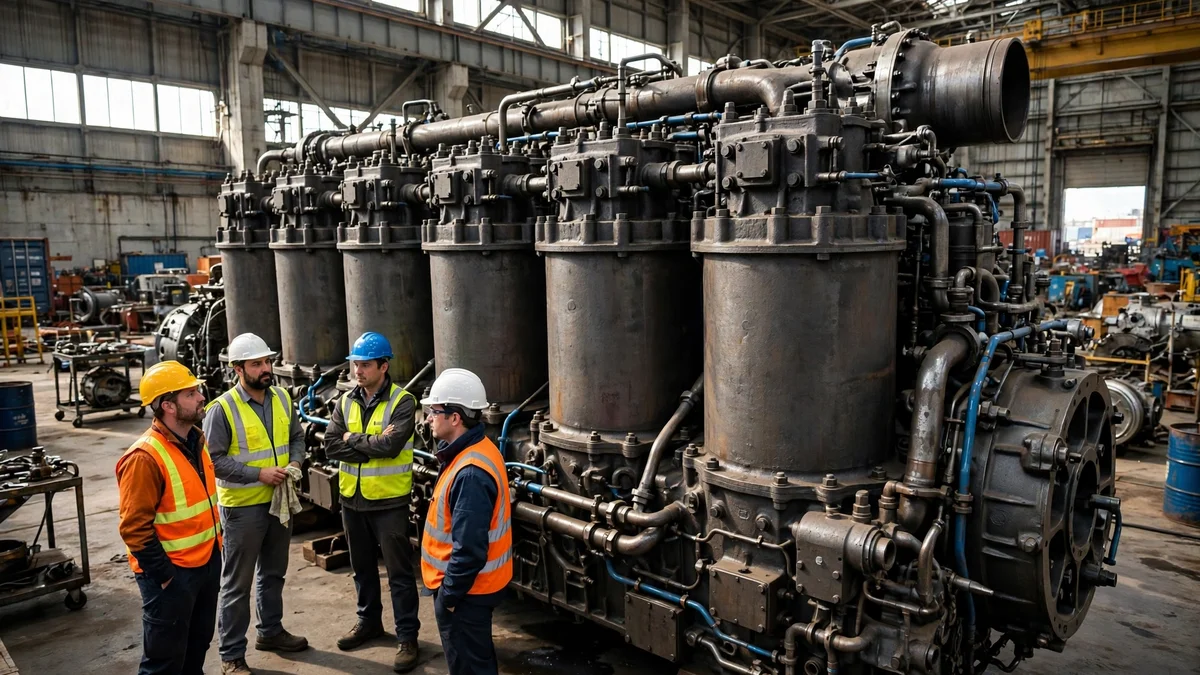
Cruise ship engines are built in factories that look more like shipyards than workshops. Each engine is assembled largely by hand, from castings and forgings that arrive from foundries around the world, and tested for days before it is allowed near a ship. The factory’s job is not to make thousands of identical units, but a handful of enormous ones, perfectly. Here is how the factory builds one.
How It’s Made
Step 1: Casting the engine block and frame
Production starts in a foundry, where the engine’s frame — the bedplate and the columns that will carry everything else — is cast in iron. The castings are enormous, sometimes poured in sections, and left to cool slowly for days, since a casting that cools too fast cracks from the inside. Once cool, each piece is machined flat on giant planers and boring machines, with surfaces finished to tolerances measured in hundredths of a millimetre.
Step 2: Forging and machining the crankshaft
The crankshaft is the soul of the engine, and it starts life as a single forging of alloy steel, heated until it glows and pressed into its cranked shape under a press the size of a house. Then the journals, the polished surfaces the bearings run on, are turned on enormous lathes and ground to a mirror finish, because a rough journal eats bearings and a smooth one can run for decades. A cruise ship crankshaft can weigh more than a hundred tonnes, yet its bearing surfaces are finished to a precision you would expect on a wristwatch.

Step 3: Building the cylinders, pistons, and liners
Each cylinder of a cruise ship engine is a small factory in itself. The liner, a thick steel tube the piston slides inside, is honed to a crosshatched pattern of microscopic grooves that hold oil on the wall, and the piston, a steel crown on an aluminium or steel body, is fitted with rings that seal the explosion above it. The cylinder head, with its fuel injectors and exhaust valves, is assembled separately, with every valve lapped to its seat by hand until it seals. Each piston is fitted into its liner with a clearance measured in tenths of a millimetre, then lowered into the frame by crane.
Step 4: Assembling the engine
With the frame, crankshaft, and cylinders ready, the engine itself comes together. The crankshaft is lowered into its main bearings and aligned with laser instruments. The connecting rods are bolted to the crank and pistons with hydraulic tensioners that stretch each bolt to an exact load, and the timing gear, fuel pumps, and turbochargers are fitted around the outside. Each turbocharger is the size of a small car, spinning at tens of thousands of revolutions per minute, and balanced so precisely it can run for years without a tremor. By the end of this stage, the engine looks complete, but it has never turned under its own power — that test is still to come.
Step 5: Piping, wiring, and control systems
An engine this size is as much plumbing as machinery. Kilometres of pipe carry fuel, cooling water, lubricating oil, and compressed air, and every joint is welded, pressure-tested, and lagged with insulation, because a leak in a fuel line inside an engine room is a fire waiting to happen. Sensors on every cylinder measure temperature, pressure, and vibration, feeding a computer that watches the engine’s health thousands of times a second. The factory’s electricians and pipefitters work around the assemblers for weeks, and the finished engine room looks more like a power station than anything on a road.
Step 6: Testing on the test bed
Before it leaves the factory, the engine is run — hard — on a test bed. It is bolted to a massive concrete foundation, connected to a water brake or generator that absorbs its power, and run through its full range, from ticking over to full load, for days at a time. Engineers measure fuel consumption, vibration, oil pressure, and emissions on every cylinder, and tune the fuel injection until each cylinder pulls its weight evenly. Any fault found here is far cheaper to fix in the factory than in a ship at sea. Only when the engine has run cleanly at full power, for hours on end, is it stripped down for inspection, reassembled, preserved against corrosion, and shipped to the shipyard in pieces for installation in the hull.

Specs
| Specification | Typical figure |
|---|---|
| Engine type | Large low-speed or medium-speed diesel |
| Engine height | Up to three storeys tall |
| Engine weight | Several hundred tonnes |
| Power output | Tens of thousands of kilowatts per engine |
| Cylinders | Commonly 6–16 per engine |
| Piston size | Roughly the size of a dustbin |
| Crankshaft weight | Over 100 tonnes on the largest engines |
| Testing | Days of full-load running on a test bed |
| Service life | Decades, with regular overhauls |
Price
A cruise ship engine is a custom industrial product, so any price is an estimate. As an estimate, a single large cruise ship engine costs roughly $10 million to $30 million, depending on its size and power, and a big cruise ship carries four or five of them, so the engine plant alone can cost well over $100 million. That is before the propellers, the generators, and the fuel systems that go with them. What the shipowner is buying is not just power but reliability: the engines must run for weeks without stopping, in salt air, thousands of miles from the nearest workshop, and that kind of trust is the most expensive part of the bill.
A Rare Fact
The largest cruise ship engines are so efficient that they burn less fuel per unit of power than a car engine — and they can burn almost anything. Many are designed to run on heavy fuel oil, and the newest ones can switch to liquefied natural gas or even methanol. But the strangest fact is their speed: the biggest engines turn at barely a hundred revolutions per minute, so slowly you can watch the crankshaft go round. It feels less like a machine and more like a heartbeat — slow, enormous, and utterly relentless, pushing a floating city across the sea one giant breath at a time.
The materials behind these giants are covered in cruise ship engine materials engineering, and the hull they push through the water is explained in how a container ship hull works. The propeller that turns all that power into motion is covered in how a ship propeller is made. The next time a cruise ship glides out of port, remember the foundry and the days on the test bed behind the slow heartbeat below the waterline.