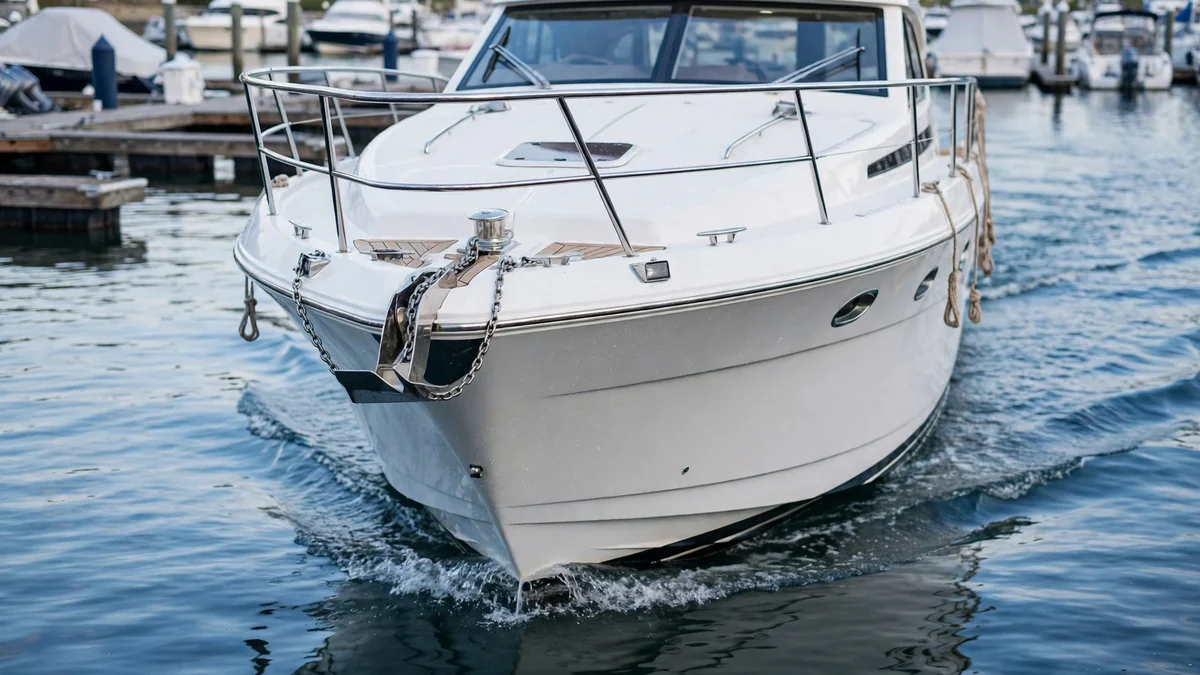
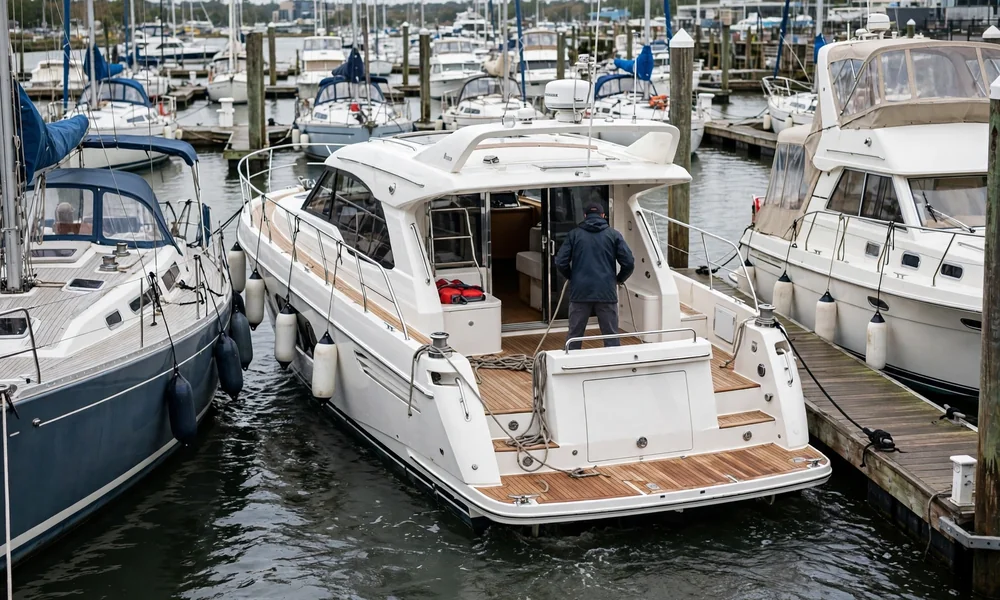
The wind is pushing the yacht sideways, the berth is barely wider than the boat, and there is a very expensive yacht on either side. The captain does not panic. He nudges a small joystick, and the bow of the yacht slides sideways — not forward, not back, but directly sideways, as if the boat were on rails. No rope, no fender, no shouting. The bow simply steps over, and the yacht glides into its berth.
The part that made that move possible is hidden below the waterline, inside a tunnel through the bow: the bow thruster. It is a small propeller that pushes water sideways, and it turns docking from a test of nerve into a quiet piece of engineering. Here is how it works, step by step.
How a Yacht Bow Thruster Works
Step 1: The helm asks for sideways push
It starts with the captain. On most modern yachts the bow thruster is driven from a small joystick or a pair of buttons at the helm, and the control is proportional: push gently and the thruster pushes gently, push hard and it pushes hard. The control sends a signal to the thruster’s motor controller, which decides how much power to deliver. On larger yachts the thruster is tied into a joystick docking system, where one stick controls the engines, the bow thruster and the stern thruster together, and the boat simply moves in the direction the stick is pushed. The captain asks; the thruster answers in less than a second.
Step 2: The motor spins up
That signal reaches the thruster’s motor, which on most yachts is electric, powered by the boat’s battery bank. The motor spins a shaft that runs down into the tunnel, and it must deliver its full thrust almost instantly — there is no gentle warm-up when the wind is pushing you toward a neighbouring yacht. Electric thrusters are rated by their thrust in kilograms, and a typical 15-metre yacht carries one rated at 100 to 200 kilograms of thrust. On bigger yachts the motor is hydraulic, driven by the boat’s main engines, because hydraulics can sustain full thrust for longer without overheating. The way the whole unit is built is covered in how a yacht bow thruster is made, from the casting of the tunnel to the fitting of the motor.
Step 3: The propeller pushes water through the tunnel
At the end of the shaft, inside a tunnel that runs straight through the bow from one side to the other, sits the propeller. When the motor spins it, the propeller drives a jet of water out of one side of the tunnel and draws water in from the other. The reaction to that jet is what moves the boat: push water to port, and the bow swings to starboard. The propeller is small — often no wider than a dinner plate — but it spins fast, and the tunnel focuses its thrust so that almost all of the energy goes into moving the bow sideways rather than churning water in every direction. It is a simple idea, and it is the whole secret of the device.

Step 4: The bow steps sideways
The sideways push acts on the bow, which is the end of the boat furthest from the propeller and the rudder. That long lever arm is why a small thruster can move a heavy boat: a modest force at the bow produces a large turning effect. The bow slides sideways while the stern stays more or less where it is, letting the captain rotate the boat in its own length or slide it bodily sideways into a berth. Used with a touch of engine power, the thruster can even hold the bow against the wind while the stern is walked in with a line. It does not make the boat faster — it makes the boat obedient at the one speed where boats are hardest to control: almost stopped.
Step 5: Bow and stern work together
Many yachts carry a second thruster at the stern, and the two work as a pair. Push the bow one way and the stern the other, and the boat rotates on the spot. Push both the same way, and the whole boat slides sideways, crab-like, into a berth with no forward motion at all. Modern joystick systems coordinate all of this automatically, blending bow thruster, stern thruster and main engines so the captain only has to point the stick. The same principle of a big engine doing heavy work at sea is told in how a cruise ship engine works, where the scale is vastly larger but the job — turning fuel into controlled motion — is the same.
Step 6: The thruster rests — and has limits
A bow thruster is a docking tool, not a steering system, and it has firm limits. Most electric thrusters are rated for only a few minutes of continuous use before the motor overheats, and they lose effectiveness as boat speed rises, because water rushing past the tunnel disrupts the jet. In rough conditions the tunnel can also suck in air, a problem called ventilation, which makes the propeller spin uselessly in foam. Good captains use the thruster in short bursts and switch it off once the boat is moving. The full story of what these units cost is in why a yacht bow thruster is so expensive, from the tunnel installation to the motor and controls.
Yacht Bow Thruster Specifications
| Specification | Typical figure |
|---|---|
| Thrust | 100–200 kgf (15 m yacht) |
| Motor type | Electric (or hydraulic on larger yachts) |
| Tunnel diameter | Around 185–250 mm |
| Propeller | Single, 4–5 blades |
| Control | Joystick or push buttons at helm |
| Continuous use | A few minutes before overheating |
How Much Does a Yacht Bow Thruster Cost?
A bow thruster for a mid-sized yacht typically costs an estimated $3,000 to $8,000 for the unit itself, with professional installation — cutting the tunnel through the hull, fitting the motor and wiring the controls — adding an estimated $2,000 to $5,000 more. These are estimates, not list prices. For a retrofit the tunnel work is the expensive part, because it means cutting a hole through the bow below the waterline and making it watertight again. Most owners who have one say it is the best money they ever spent on the boat.
A Rare Fact About the Yacht Bow Thruster
Here is something few people realise: the bow thruster tunnel is a compromise that costs the boat speed. A hole through the bow disturbs the flow of water along the hull, adding drag whenever the boat is under way — which is almost all the time. Naval architects shape the tunnel openings and fit fairings to minimise the loss, and some owners fit retractable thrusters that fold away flush with the hull when not in use. Every docking season, the thruster earns its keep; every mile under way, the boat quietly pays for the hole.
So the next time a yacht slides sideways into a berth as if it were on rails, remember the quiet engineering below the waterline: a joystick asking, a motor spinning, a small propeller pushing water through a tunnel, and a bow that steps sideways on command — all so that docking, the most stressful minute of a day at sea, feels like nothing at all.


