The wind picked up after midnight, the way it does in an open anchorage, and by three in the morning the yacht was swinging on its chain in gusts that shook the rigging. Below deck, the crew slept. Nobody was on watch, nobody was worried, and nobody needed to be — because forty metres down, on a seabed nobody could see, a piece of shaped steel the size of a small table had dug itself in and refused to move. That is the entire job of a yacht anchor system: to hold a floating hotel still, in the dark, in weather, with no one watching.
An anchor system is far more than the anchor itself. It is the anchor, the chain, the windlass that hauls it, the bow roller it rides on, and the locker it lives in — all of them working together, all of them built to survive salt water, shock loads and years of neglect. Building the system is heavy industry with fine tolerances, and every part is tested harder than it will ever be used.

Inside the Factory
Step 1: Forging and casting the anchor
A yacht anchor starts as steel — either forged from a solid billet or cast in a sand mould, depending on its design. Forging squeezes the metal under huge presses, aligning its grain and making it stronger; casting lets designers shape the flukes and shank into curves that would be impossible to forge. The anchor’s shape is the result of decades of testing in sand, mud, weed and rock, and the foundry works from patterns that have been refined again and again. The steel and the shape are chosen together, and the reasoning behind both is set out in yacht anchor system materials engineering, from the foundry to the seabed.
Step 2: The chain
The chain is made link by link, each one bent from steel bar, welded shut, and then proof-tested — pulled to a load far beyond anything it will ever carry — before it is allowed into a batch. The weld is the weakest point of every link, so it is inspected, and the whole chain is calibrated so that each link is the same size, allowing it to run smoothly through the windlass gypsy. After testing, the chain is hot-dip galvanised, dipped in molten zinc so that every surface, inside and out, is coated against rust. A galvanised chain can spend years in salt water and still come up bright.

Step 3: The windlass
The windlass is the machine that hauls the anchor and chain back aboard, and it has to lift hundreds of kilograms of steel plus a mud-caked anchor, often while the yacht is pitching. Its motor, gearbox and gypsy — the notched wheel that grips the chain — are built from bronze, stainless steel and hardened gear steel, and assembled on benches where each unit is run under load before it leaves. The gearbox is the heart of the machine: it turns a fast-spinning motor into slow, enormous pulling force, and it is filled with oil and sealed against salt water.
Step 4: The bow roller and deck hardware
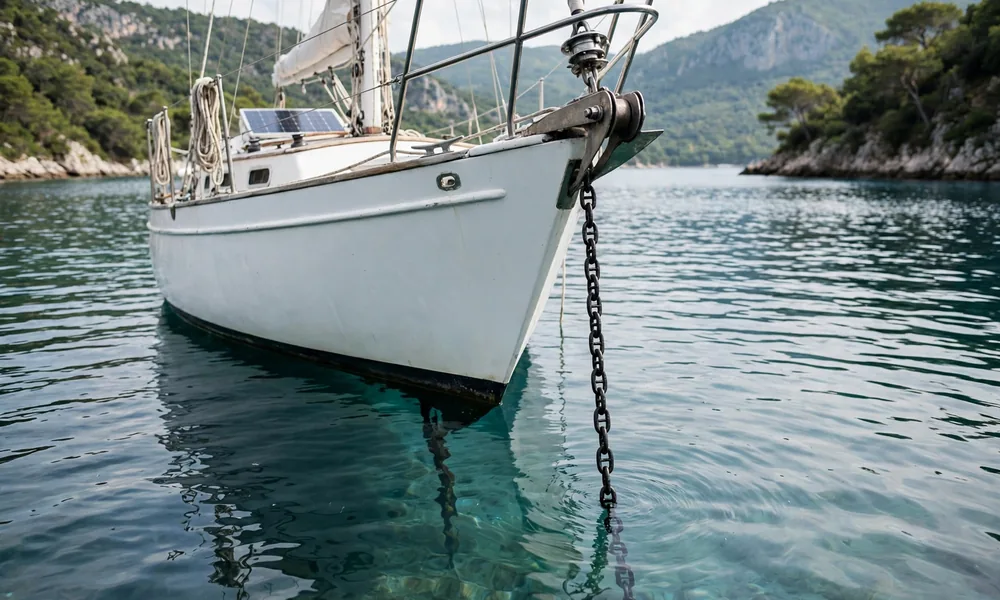
The anchor lives on the bow roller, a heavy fitting that guides the chain over the bow and holds the anchor snug against the stem while the yacht is under way. The roller is machined from stainless steel or a tough marine plastic, and it is mounted on a reinforced section of deck, because the loads it carries are enormous — the whole weight of the yacht pulling against the anchor passes through it. The chain stopper, the fitting that locks the chain when the yacht is anchored, is built just as strongly. How the roller, stopper and windlass share the load is part of how a yacht anchor system works, from the seabed to the bow.
Step 5: Galvanising and finishing
Almost every part of an anchor system is galvanised or made from stainless steel, because salt water eats unprotected steel with frightening speed. Anchors and chain are hot-dip galvanised, a process that coats them in a thick layer of zinc that corrodes first, protecting the steel beneath. Stainless parts are passivated, a chemical treatment that rebuilds the invisible oxide layer that keeps them bright. The finish is not cosmetic — it is the difference between a system that lasts twenty years and one that rusts through in five.
Step 6: Load testing and the final check
No anchor system leaves the factory without being proved under load. Anchors are pull-tested in sand and mud beds to prove they set and hold at their rated load; chains are proof-tested link by link; windlasses are run at full load until their motors are hot. Only after that does the system get its rating, and the rating on the box is always the one the weakest part of the system could survive. The full journey from raw steel to a rated system is laid out in how a yacht anchor system is made, step by step from the foundry to the test frame.
Yacht Anchor System at a Glance
| Specification | Detail |
|---|---|
| Anchor materials | Forged or cast steel, hot-dip galvanised |
| Chain | Calibrated steel links, welded, proof-tested, galvanised |
| Windlass | Electric or hydraulic motor, bronze gypsy, sealed gearbox |
| Bow roller | Stainless steel or marine plastic, deck-reinforced mounting |
| Typical anchor weight | Roughly 10–40 kg for yachts, more for larger vessels |
| Chain size | Commonly 8–12 mm for cruising yachts |
| Key test | Proof load on every chain, pull tests on anchors, full-load windlass runs |
| Main weakness | Corrosion, and anchors that cannot set in weed or hard sand |
What Does It Cost?
A complete anchor system for a cruising yacht typically costs around $2,000 to $6,000, while a full system for a larger yacht — heavier anchor, longer chain, more powerful windlass — usually runs to roughly $8,000 to $25,000 or more. The anchor itself is often the cheapest part; the windlass and the chain are where the money goes. The price climbs with the size of the yacht, because a heavier boat needs a heavier anchor, a thicker chain and a stronger windlass, and each of those is tested harder. Those figures are estimates, not quotes, and they do not include installation or the cost of the anchor locker and deck reinforcement.
A Rare Fact
The oldest anchors ever found were simply stones with a hole through them, dropped on a rope. By the time of the ancient Greeks, anchors had grown wooden arms tipped with lead, and the basic shape — a shank with flukes that dig in — has barely changed in two thousand years. What has changed is the engineering: modern anchors are designed with computer models of how soil flows around a fluke, and some can hold a yacht in a storm with a holding power many times their own weight.
The anchor system is the part of a yacht that does its work while nobody is looking, in the dark, at the bottom of the sea. Engines get the attention, sails get the glory, and the anchor gets forgotten — until the wind picks up at three in the morning.


