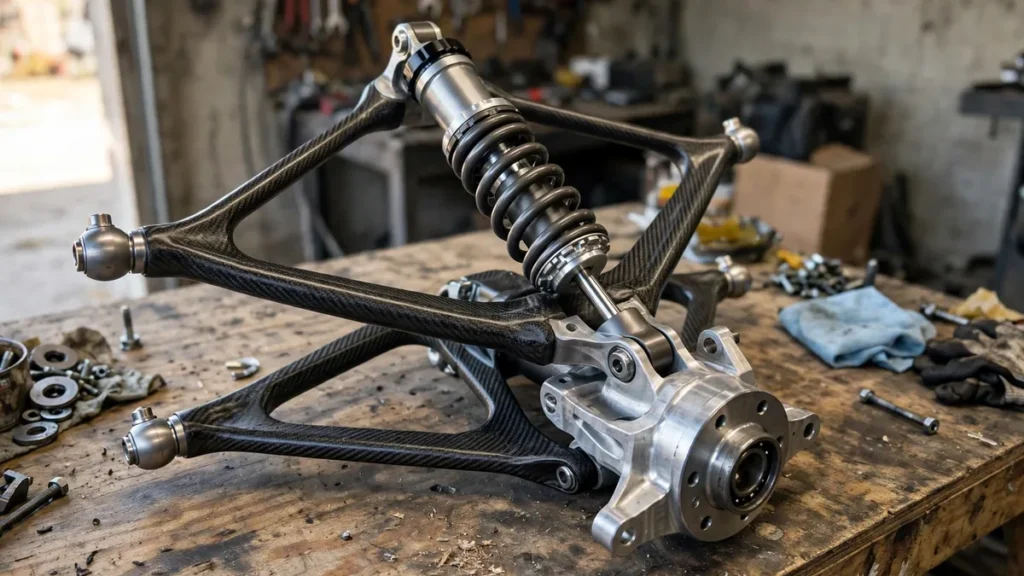
Watch a hypercar take a fast corner and something looks wrong, in the best possible way. The body stays almost perfectly level while the wheels underneath it rise and fall over the bumps, the car leaning a few degrees where an ordinary sports car would roll like a boat. In the wheel arches there is just springs, dampers and arms like any other car, but the numbers they work to are very different. The suspension is not reacting to the road. It is reading the road, predicting it, and cancelling it out before you feel it.
That is active suspension, one of the most expensive systems on a modern hypercar. A conventional suspension is a compromise set in steel: springs and dampers chosen once, at the factory, to be soft enough for comfort and stiff enough for cornering, and never quite right for either. An active system breaks that compromise by changing its behaviour hundreds of times a second. The technology began in Formula 1 in the early 1990s, when Williams ran a system so effective it was banned for making the racing too easy.
How It Works
Step 1: Sensing the road and the car
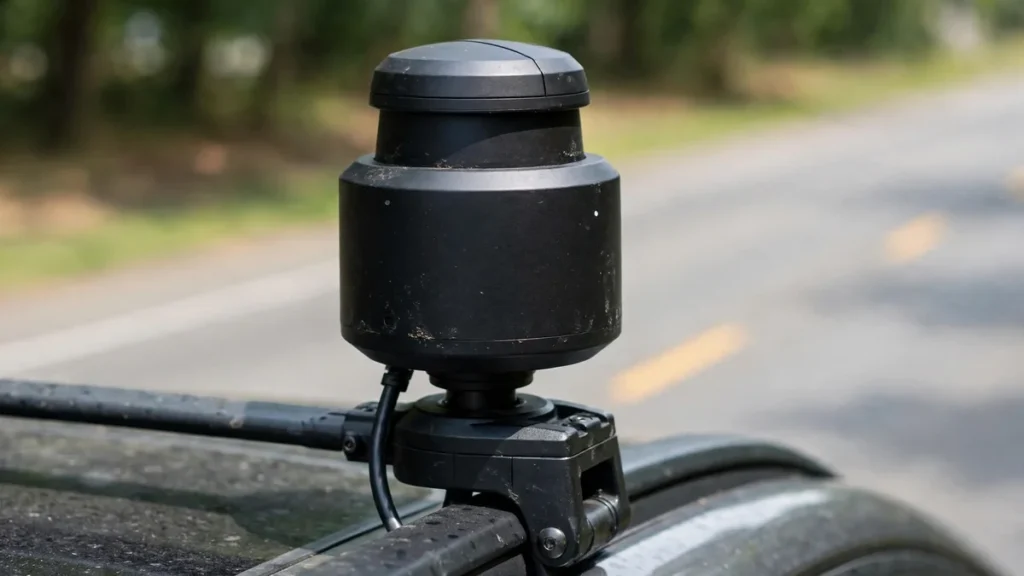
Everything starts with sensors. Accelerometers on the body measure how the car is pitching under braking, rolling in corners and heaving over bumps. Wheel and travel sensors report what each wheel is doing, and some cars add cameras that scan the road ahead for bumps before the tyres reach them. A top system samples them hundreds of times a second.
Step 2: Deciding what to do
That picture flows to a control unit, a dedicated computer that decides how each corner of the car should respond. If the car is braking hard, the computer stiffens the front to stop the nose diving. If it is turning left, it stiffens the right-hand side to cancel body roll. If a wheel is about to hit a pothole the camera spotted, it can soften that corner early.
Step 3: Moving the wheels with hydraulics
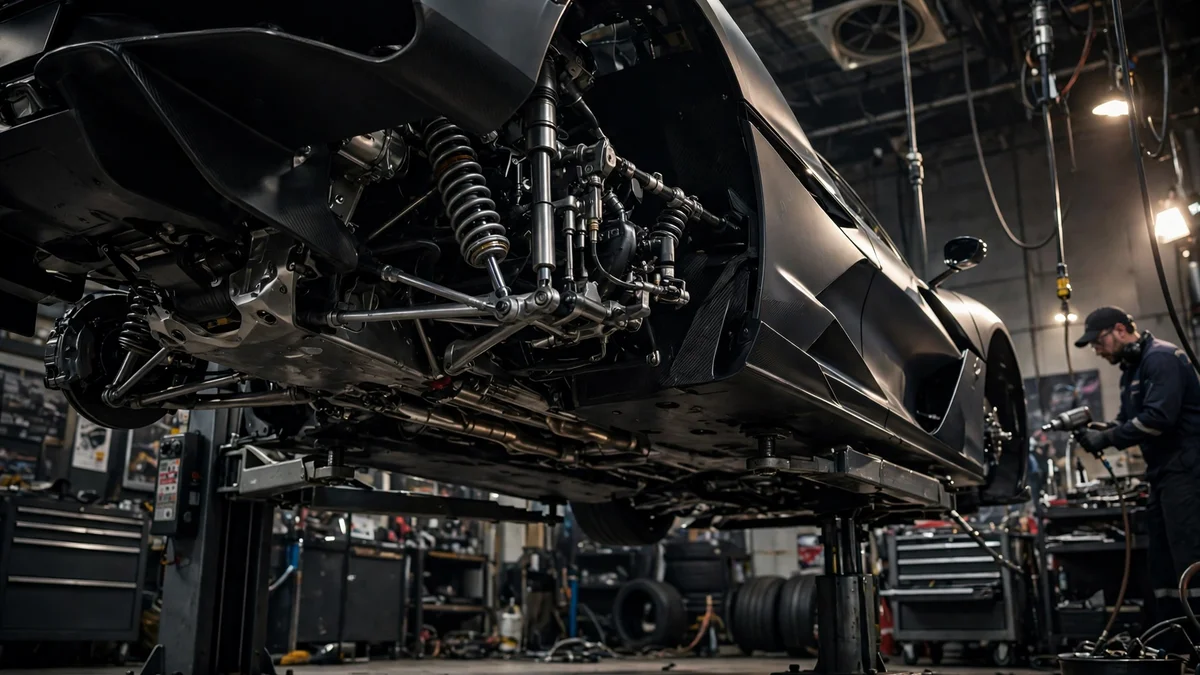
The decisions become action through hydraulic actuators, one at each wheel, replacing or working alongside the conventional spring. A high-pressure pump, running at around 200 bar, pushes fluid into the actuator to lift or press down a corner of the car with forces of several thousand newtons. Unlike a spring, an actuator can push with any force the computer asks for, holding the body level while the wheels dance underneath it.
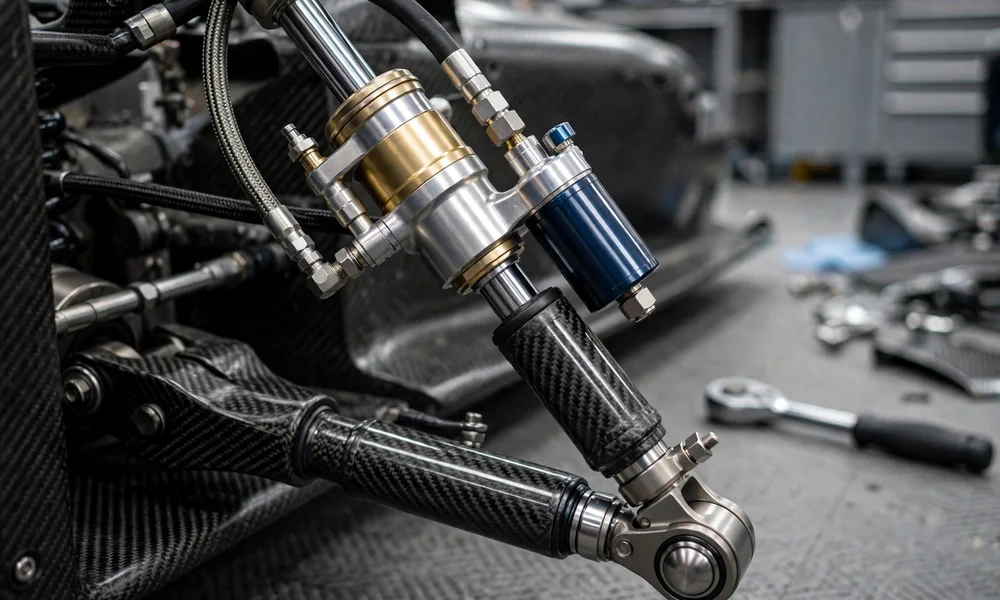
Step 4: Controlling roll, pitch and heave separately
A clever part of active suspension is that it treats the three ways a body moves as separate problems. Roll is the lean in corners, pitch is the dive under braking and the squat under acceleration, and heave is the up-and-down motion over bumps. A passive suspension couples all three, so stiffening against roll also makes the ride harsher. An active system controls each one independently, which is why a hypercar can corner flat and still ride smoothly. The same separation of jobs appears in how hypercar suspension works.
Step 5: Linking the corners together
In the most advanced systems, the four corners are hydraulically linked, so fluid can move from one side of the car to the other. When the car rolls into a right-hand corner, pressure shifts from the left to the right automatically, resisting the lean without any stiffening of the ride. McLaren’s system works this way, with no conventional anti-roll bars at all.
Step 6: Failing safe
A system this complex has to be designed to fail gracefully. If a sensor dies or the pump loses pressure, the suspension defaults to a safe, moderately stiff setting, and the car warns the driver rather than collapsing onto its bump stops. Redundant sensors watch each other, and the control unit runs constant self-checks. It is the same philosophy that governs active aerodynamics, where a failed wing must default to a safe position.
The Specs, Explained
The specification sheet for an active suspension reads like a mix of hydraulics and computing. Response time is the headline number: how fast the system can change force at a wheel. Actuator force tells you how hard it can push. The table below shows typical figures for a modern hypercar system, against a conventional sports car suspension.
| Property | Hypercar active system | Adaptive dampers | Conventional sports suspension |
|---|---|---|---|
| Response time | 2–5 ms | 10–20 ms | Fixed, no response |
| Actuator force per corner | 8,000–15,000 N | Damper only | Spring only |
| System pressure | 180–250 bar | Not applicable | Not applicable |
| Body roll in a 1 g corner | 0.5–1.0° | 2–3° | 3–5° |
| Sensor sampling rate | 500–1,000 Hz | 100–200 Hz | None |
| Road-scanning camera | Yes, up to 15 m ahead | Rare | No |
| Weight penalty | 25–40 kg | 5–10 kg | 0 kg |
| Ride height adjustment | Up to 80 mm | Up to 40 mm | None |
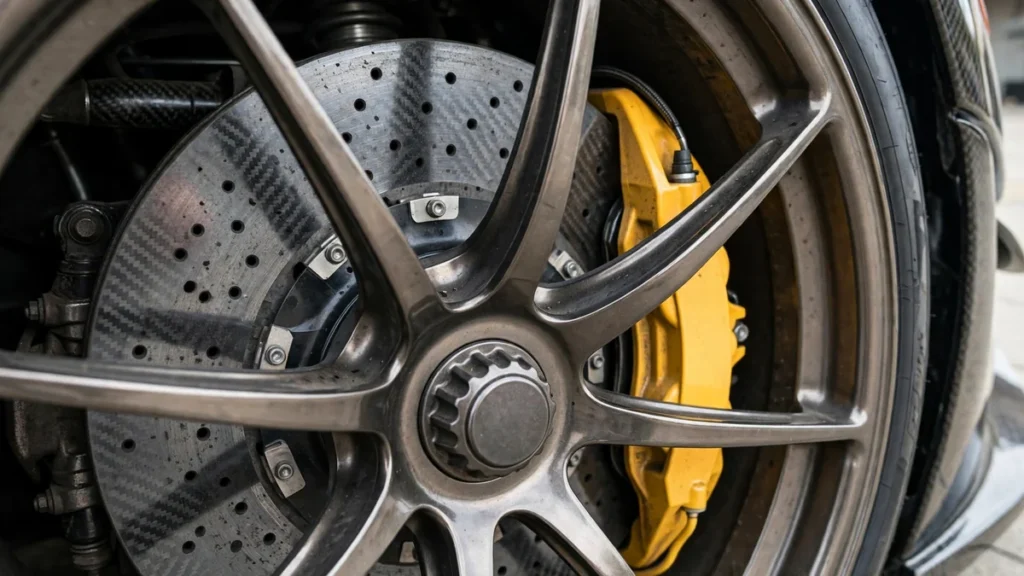
The number that matters most is response time. At two to five milliseconds, a full active system can react to a bump in the time it takes the wheel to move a few millimetres, fast enough to cancel the bump before the body feels it. Adaptive dampers, fitted to many sports cars, are slower and can only change damper stiffness, not push the wheel up or down. The body roll figure tells the same story: half a degree of lean against five degrees for a conventional car. That flatness lets a hypercar carry more speed through a corner, keeping the tyres loaded evenly. Braking benefits from the same control, which is why these cars so often pair active suspension with carbon-ceramic brakes.
What It Costs
Active suspension is one of the dearest systems on any car that offers it, and on a hypercar it is usually standard equipment rather than an option. The hardware alone, pump, accumulators, actuators, sensors and control unit, typically costs the manufacturer $8,000–$20,000 per car, before tuning costs that can run into millions for a single model.
For the owner, the numbers that matter are the repair bills, and these are estimates. A single hydraulic actuator replacement typically runs $2,000–$5,000 including labour, a high-pressure pump $3,000–$6,000, and a full system overhaul after a decade of use can reach $10,000–$15,000. That sounds steep, but it is a small fraction of a hypercar’s price, and the system is what makes a 1,000-horsepower car drivable on a public road rather than just a racetrack.

A Rare Fact
The most famous active suspension ever built never raced under its own name for long. In 1992, the Williams FW14B Formula 1 car used a system so advanced that it could keep the car at a constant ride height at all times, which kept its aerodynamics working perfectly and made it nearly unbeatable. Nigel Mansell won nine races and the championship that season, and Alain Prost won seven more the next year. It was banned for 1994, not because it was dangerous but because it was too good. Road cars inherited the technology the racetrack was not allowed to keep, which is why the cleverest suspension in motorsport history now lives in cars you can buy.
That is the strange career of active suspension: invented for racing, banned from racing, and perfected for the road. It turned the oldest compromise in car design, comfort against handling, into a problem a computer solves hundreds of times a second. The next time a hypercar glides over a rough road without a shudder, remember that underneath it four hydraulic rams are working like a team of weightlifters, lifting and lowering each corner in perfect time, and the driver never feels a thing.