An e-bike battery looks simple from the outside: a slim black case that slides onto the frame, a button, a few lights. Inside that case is one of the most carefully built parts on the whole bicycle. Dozens of individual cells must work together perfectly, charge after charge, through rain, heat, vibration, and years of daily use. If one cell is weak, the whole pack suffers. If one weld is poor, the bike can cut out on a hill.
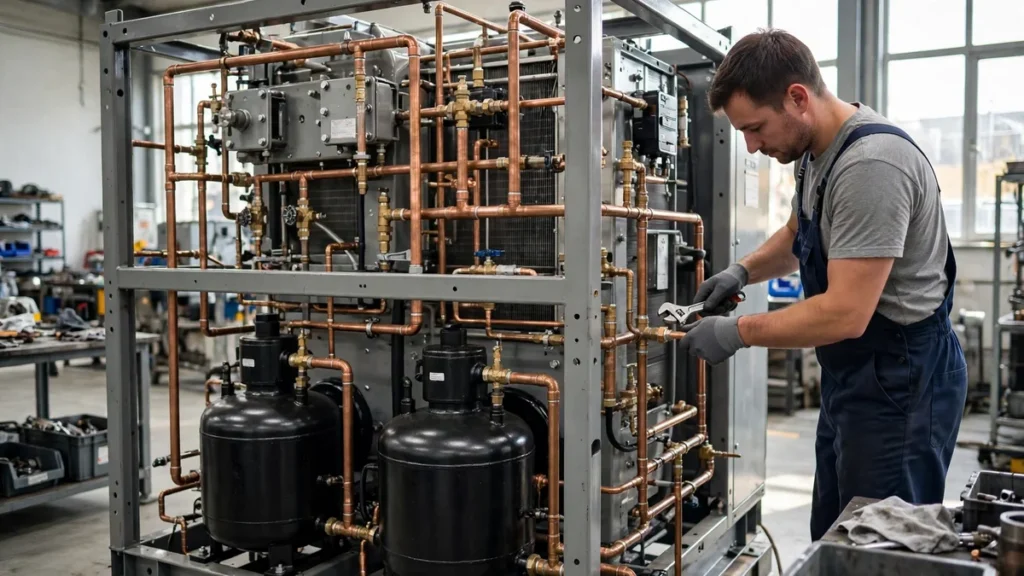
Inside the factory that builds the e-bike battery, the work is a careful balance of automation and human hands. Machines do the fast, repetitive jobs — sorting cells, spot-welding tabs, testing voltages — while people do the jobs that need judgement: inspecting, fitting, and checking the finished pack. The floor is clean, dry, and quiet, and every battery that leaves it has already been charged, discharged, and tested at least once.

Inside the Production
Step 1: Testing and sorting the cells
Production begins with the cells, usually cylindrical lithium-ion cells about the size of a large finger. They arrive in huge batches from a cell maker, and no cell goes straight onto the line. Each one is measured for voltage, capacity, and internal resistance, and any cell outside a narrow range is rejected. The survivors are sorted into matched groups, because a pack built from mismatched cells would age unevenly: the weakest cell would wear out first and limit the range of the whole battery. Sorted cells are stored in dry, temperature-controlled rooms until they are needed.
Step 2: Building the cell block
Matched cells are placed into a plastic holder that keeps them in neat rows, with small gaps between them for air to circulate. The holder also protects the cells from vibration, which matters on a bicycle that is ridden over potholes and rough tracks every day. Thin nickel strips are laid across the tops and bottoms of the cells, connecting them in series and parallel to reach the right voltage and capacity. Each strip is spot-welded to the cell ends with a brief pulse of current — a weld that takes a fraction of a second and must be strong enough to carry the full current of the motor without ever coming loose.

Step 3: Fitting the battery management system
Once the cell block is welded, a small circuit board is fitted: the battery management system, or BMS. This is the brain of the battery. It watches the voltage of every group of cells, stops charging when the pack is full, cuts power if a cell gets too hot, and balances the cells so they all stay at the same level. The BMS is connected to the cell block with thin sensing wires, one for each group, and each wire is checked by hand. A single loose sensing wire would leave the BMS blind to one group of cells, so this stage is inspected twice — once by the person who fitted it, and once by a second checker.
Step 4: Sealing the case
The finished cell block and BMS are lowered into the battery case, usually a tough plastic or aluminium shell shaped to fit a particular bike frame. Foam pads and brackets hold the block firmly so it cannot rattle, and the power cables and charge port are fitted through sealed openings. The case lid is then closed with a gasket and screws, and the whole battery is checked for water resistance. The way the case and the cells come together is part of what how an e-bike battery is made describes, and the sealing stage is where a collection of cells becomes a product a rider can trust in the rain.
Step 5: First charge and balancing
No battery leaves the factory without being charged. Each finished pack is connected to a test rig and charged slowly to full, while the BMS records the voltage of every cell group. If one group charges faster than the others, the BMS bleeds off a little energy to bring it back in line — a process called balancing. The pack is then left to rest, and its voltage is checked again after several hours. A pack that loses voltage while resting has a faulty cell or a hidden short, and it is opened up, repaired, and tested again from the start.
Step 6: Discharge, load, and final testing
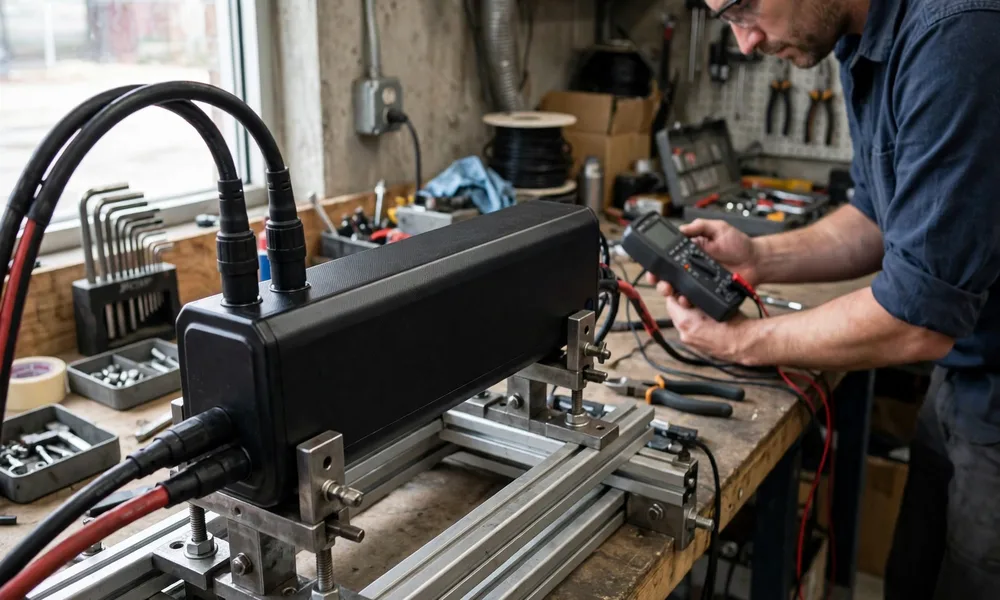
The last test is the hardest one. The pack is discharged under load, as if it were powering a motor up a long hill, and its capacity is measured: it must deliver at least its rated energy. The pack is also shaken on a vibration table and checked for loose connections, and its temperature is watched throughout. Only a pack with a clean test record — full capacity, balanced cells, steady voltage, no faults — is cleared for the bike factory, where it will be fitted to a new e-bike and ridden away.
Specs
| Specification | Typical figure |
|---|---|
| Battery capacity | 400–750 Wh for a typical e-bike |
| Cell type | Lithium-ion, cylindrical 18650 or 21700 |
| Number of cells | 20–60 cells per pack |
| Pack voltage | 36 or 48 volts |
| Management | Battery management system on every pack |
| Charging time | 3–5 hours from empty to full |
| Typical range | 40–120 km per charge, depending on assist level |
| Pack weight | 2.5–4 kg |
| Testing | Full charge, discharge, and vibration test |
Price
An e-bike battery is the most expensive single part of the bike, and its price is usually given as an estimate. As an estimate, a replacement battery costs roughly $400 to $900, depending on capacity and brand, with larger 750 Wh packs at the top of that range and smaller 400 Wh packs at the bottom. These are estimates, and the real figure varies with chemistry, size, and the bike maker — but the rule holds: a bigger battery costs more, and it is the part worth spending money on, because it decides how far the bike will go on every ride.
A Rare Fact
An e-bike battery factory dries the air in its cell rooms so thoroughly that workers can feel it on their skin. Lithium-ion cells are sensitive to moisture: even a small amount of water vapour inside a cell can cause unwanted chemical reactions that shorten its life. Some factories dry the air to a dew point below minus forty degrees, colder and drier than a winter day in the Arctic, and workers pass through airlocks to enter. It is a strange detail for a bicycle part — a room that feels like a desert, built to protect batteries that will spend their lives bolted to a bike frame in the rain.
The battery is the heart of the e-bike, but it only makes sense alongside the motor it powers. The way the pack works on the bike is explained in how an e-bike battery works, and the numbers behind its capacity and range are laid out in the e-bike battery specs explained guide. The next time an e-bike glides past on a hill, remember the sorted cells, the spot welds, and the pack that was charged and discharged before it ever turned a wheel.