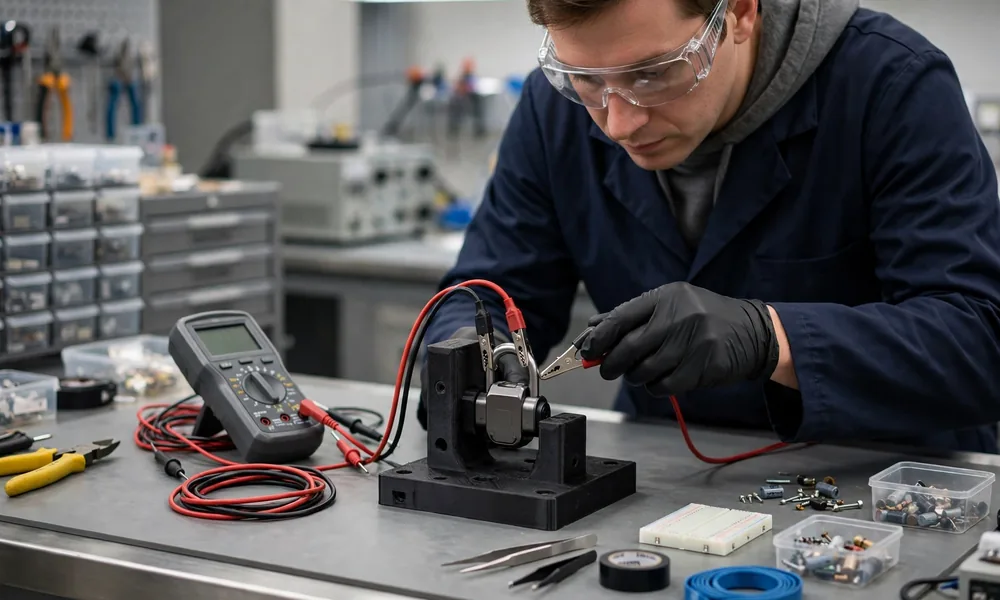
An e-bike is easy to steal and hard to keep. It is light enough to carry, valuable enough to want, and usually parked outside, where a thief with a pair of bolt cutters needs less than a minute. A smart lock is the industry’s answer: a lock that knows its owner, talks to a phone, and screams, or at least sends an alert, the moment someone tampers with it. It looks like a simple piece of metal, but inside it is a small computer, a motor, a battery and a radio, all packed into a case the size of a fist.
Making one is a balancing act. The lock must be strong enough to resist cutting and prying, small enough to carry on a bike, and clever enough to run for months on a tiny battery. It must work in rain and frost, survive being dropped on concrete, and still unlock in a second when its owner walks up. The factory that builds it is a quiet hall of tiny parts, where workers in blue coats assemble circuit boards under magnifiers and test every lock before it is allowed out of the door.

How an E-Bike Smart Lock Is Made
Step 1: Designing the lock and its brain
Design starts with the threat: what tools will a thief use, and how long must the lock resist them? Engineers choose a hardened steel shackle or a folding bar, then design the case around it, leaving room for the motor that throws the bolt, the circuit board, the battery and the antenna. The electronics are designed at the same time as the metal, because a lock that is strong but cannot hear its owner’s phone is useless. Prototypes are cut, sawn and frozen in testing, and the design is changed until the weak points are gone.
Step 2: Making the metal parts
The shackle is cut from hardened steel bar, bent to shape, and heat-treated until it resists saws and bolt cutters. The case is die-cast from aluminium alloy or moulded from glass-filled nylon, then machined so the lid, the bolt and the seal meet exactly. Every metal part is checked for hardness and for burrs, because a rough edge can jam the bolt or cut the seal that keeps rain out. The parts are then coated or anodised, so they resist rust through years of wet commutes.
Step 3: Building the circuit board
The brain of the lock is a printed circuit board smaller than a matchbox. A pick-and-place machine sets dozens of tiny components onto it: a Bluetooth chip, a processor, an accelerometer that feels vibration, and a motor driver. The board is soldered in a reflow oven, then inspected by a camera that checks every joint at high magnification. A board with a single dry joint could fail to unlock on a rainy night, so the inspection is unforgiving, and any board that fails is reworked or scrapped.

Step 4: Assembling the lock
Assembly is done by hand, because the parts are too small and too varied for a fully automatic line. A worker fits the circuit board into the case, connects the motor and the battery, seats the shackle and the bolt, and closes the lid with a gasket that seals out water. Screws are driven with a torque-controlled driver, so each one is tight enough to hold and loose enough not to crack the case. The worker then checks the bolt by hand: it must slide smoothly, with no catch and no rattle, before the lock moves on.
Step 5: Loading the software
Each lock is connected to a programming jig that loads its firmware and gives it a unique identity. The firmware controls the Bluetooth handshake, the motor, the tamper alarm and the battery management, and it is tested as it is loaded. The lock is paired with a test phone, locked and unlocked dozens of times, and the accelerometer is shaken to check that the alarm triggers. A lock that fails any of these tests is pulled from the line and diagnosed, because a software fault that ships is far harder to fix than one caught on the bench. The e-bike battery in the bike it protects uses the same discipline: every cell tested, every connection verified.
Step 6: Testing against water, cold and thieves
Finished locks go through a torture test. They are sprayed with water, frozen overnight, dropped onto concrete, and attacked with saws and levers in a test rig. The battery is run flat and recharged, the Bluetooth range is measured, and the lock is left locked for weeks to prove the battery really lasts. Locks are also tested for false alarms: a lock that screams every time a bus rumbles past will be switched off by its owner, so the accelerometer must tell the difference between a thief and a passing lorry.
Step 7: Final check and packaging
Before packaging, each lock is unlocked and locked one last time with the test phone, its serial number is scanned, and its battery level is recorded. The lock is then packed with its mount, its charging cable and a quick-start card, and the box is sealed. A sample from every batch is kept back for long-term testing, so that if a fault appears in the field, the factory can trace it to the exact day and the exact batch. The mid-drive motor that powers the bike and the lock that guards it are made in different factories, but they share the same rule: test everything, trust nothing.
Specifications
| Feature | Typical value |
|---|---|
| Shackle material | Hardened steel, about 13 to 16 mm thick |
| Case material | Aluminium alloy or glass-filled nylon |
| Connectivity | Bluetooth Low Energy |
| Battery life | About 3 to 6 months per charge |
| Charging | USB-C, about 2 to 3 hours |
| Water resistance | IP65 or better |
| Weight | About 700 g to 1.2 kg |
| Alarm | Accelerometer-triggered, about 100 dB |
What It Costs
A good e-bike smart lock typically costs between 150 and 350 dollars, with premium models that add GPS tracking reaching an estimated 400 dollars or more. That is far more than a basic chain, but it is a small fraction of the price of the e-bike it protects, which often costs several thousand dollars. Some makers also charge a small subscription for GPS tracking and theft alerts, usually an estimated few dollars a month. The hub motor inside the wheel may be the most expensive part of the bike, but the lock is the part that decides whether the bike is still there in the morning.
A Rare Fact
The earliest smart locks had a flaw nobody predicted: thieves learned to steal the bike by stealing the phone signal, not the bike. They used a relay to copy the Bluetooth handshake from the owner’s pocket to the lock, tricking it into opening. Modern locks fixed this by measuring how long the signal takes to travel: a relayed signal arrives a fraction of a millisecond late, and the lock refuses to open. It is the same trick used to protect keyless cars, shrunk into a lock the size of a fist, and it is why a good smart lock now checks not just who you are, but how close you really are.