A swimming pool on land is a hole in the ground with water in it. A swimming pool on a superyacht is something else entirely: a watertight steel box, bolted to a moving ship, that must survive storms, rolling seas, and salt air without leaking a single drop into the cabins below. It is one of the most demanding things a shipyard ever builds, and one of the most delightful — a private sea, carried on the sea.
Inside the yard that builds these pools, the work mixes heavy shipbuilding with fine finishing. Welders shape stainless steel shells, tilers lay mosaics by hand, and engineers fit pumps and heaters that must work while the whole ship is pitching in a swell. Every pool is made to order for one yacht, and no two are ever quite the same.

Inside the Production
Step 1: Designing the pool for the ship
Production starts with the yacht itself. Naval architects decide where the pool can sit without upsetting the ship’s balance, because several tonnes of water sloshing from side to side can change how a yacht handles in rough weather. The pool is usually placed low and near the centre of the ship, or on a deck where its weight can be carried by the structure below. Designers also plan for a moving floor — a platform that can rise to cover the pool and turn it into extra deck space — and for the water to be emptied quickly if the weather turns. Nothing about the design is left to chance, because water on a ship is both a luxury and a hazard.
Step 2: Building the steel shell
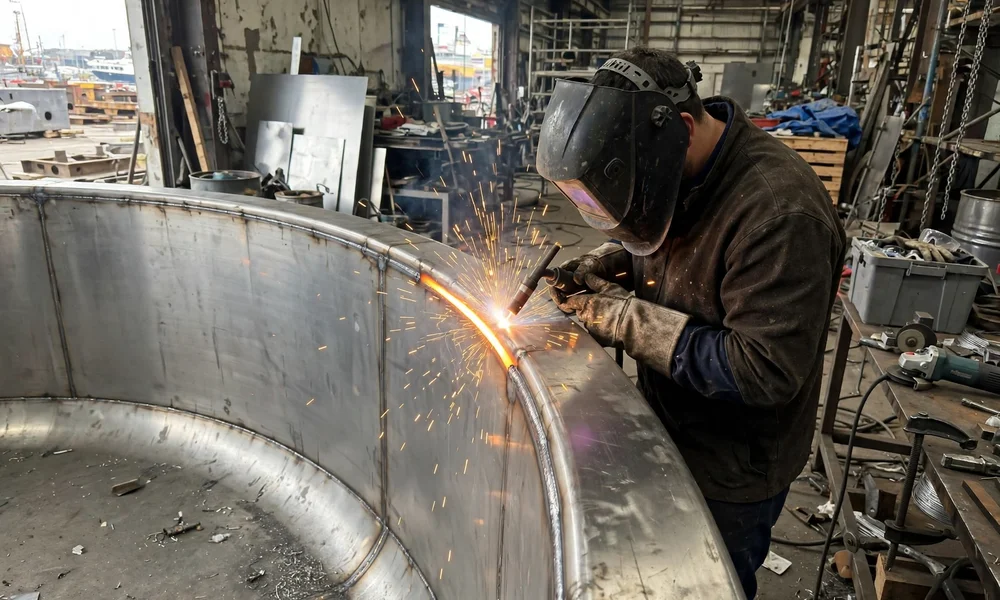
The heart of the pool is its shell, usually made from marine-grade stainless steel. Sheets of steel are cut, rolled, and welded into a single watertight box, with every seam ground smooth and tested for leaks. The shell is stiffened with ribs and frames so it cannot flex as the yacht moves, and it is fitted with a drain, an overflow channel, and the pipework for the filtration system. The welding is done by specialists, because a weld that looks fine but leaks will only reveal itself once the pool is full — and by then, fixing it means tearing the deck apart.
Step 3: Waterproofing and insulation
Once the shell is leak-tested, it is waterproofed and insulated. A flexible membrane is applied to the inside of the steel, so that even if the shell moves slightly with the ship, the waterproof layer stretches rather than cracking. Insulation is fitted around the outside to keep the water warm and to stop condensation forming on the steel, which would drip into the cabins below. The pipework is lagged the same way, and every penetration through the shell — for lights, jets, and drains — is sealed with gaskets and flanges rated for constant immersion in chlorinated or salt water.
Step 4: Tiling and finishing
With the shell sealed, the pool gets its face. Mosaic tiles — often glass, sometimes stone — are laid by hand, one small square at a time, following a pattern chosen by the yacht’s owner. The adhesive and grout are flexible marine-grade products that can move with the ship without cracking, and the tiles are sealed against constant immersion. Underwater lights are set into the walls, water jets are fitted for a current to swim against, and the coping stones around the edge are shaped and polished. This is the slowest part of the build, and the most visible: a badly tiled pool is obvious the moment it is filled.
Step 5: Fitting the filtration and heating plant
Below deck, in the engine room, the pool’s machinery is installed. Pumps circulate the water through filters that trap dirt and debris, heaters hold it at a comfortable temperature, and dosing units add the chemicals that keep it clean and safe. The system is sized to turn the whole volume of the pool over several times a day, and it is built with spares — duplicate pumps and filters — so the pool can keep running even if one part fails at sea. The pipework runs from the engine room to the pool through the ship’s structure, and every joint is pressure-tested. The machinery spaces that house this plant are built to the same standard as the superyacht engine room, where every system must earn its place.
Step 6: Filling, testing, and sea trials
The final step is filling the pool and proving it works. The pool is filled slowly while surveyors watch the shell and the cabins below for any sign of a leak. The water is heated, the jets are run, the moving floor is raised and lowered, and the filtration plant is run for days to prove it holds the water clear. Then the yacht goes to sea, and the pool is tested while the ship rolls — the real test, because a pool that behaves in the yard can still slosh badly in a swell. Only when the water stays where it belongs, in all weathers, is the pool signed off for its owner.

Specs
| Specification | Typical figure |
|---|---|
| Shell material | Marine-grade stainless steel |
| Pool length | Five to ten metres on a large yacht |
| Water volume | Ten to forty cubic metres |
| Finish | Glass or stone mosaic tiles, hand laid |
| Filtration | Full turnover several times a day |
| Heating | Heat exchangers from the engine plant |
| Moving floor | Hydraulic platform, deck level when raised |
| Testing | Leak test, heat test, and sea trial |
Price
A superyacht swimming pool is a small project inside a very large one, and it is priced like one. As an estimate, building a pool into a superyacht costs roughly $500,000 to $2,000,000, depending on its size, its moving floor, and the finish the owner chooses. These are estimates, and the real figure varies with the yard, the yacht, and the materials, but the scale is honest: a watertight steel box, hand-tiled, with its own filtration plant and a floor that rises to become a deck, is a serious piece of engineering disguised as a place to swim.
A Rare Fact
Some superyacht pools are fitted with a moving floor that can be raised until it is flush with the deck, turning the pool into a dance floor or a helicopter landing area — and the floor itself is a watertight lid that must seal perfectly while it moves. The mechanism is hydraulic, the guides are machined to fractions of a millimetre, and the floor must hold the weight of people, furniture, or even a small aircraft without flexing enough to break its seal. It is one of the few pieces of engineering that has to be both a swimming pool and a floor, and it has to be good at both.
A pool is only one of the systems that make a superyacht work. The hull it sits in is built as described in the superyacht steel hull guide, and the joinery and finishing around it follow the same craft as the superyacht interior joinery work. The next time a yacht glides into harbour with a pool glittering on its deck, remember the steel shell, the hand-laid tiles, and the yard that built a swimming pool to survive the open sea.