A submarine that never needs to surface for fuel can stay hidden for months, and the machine that makes that possible is its nuclear reactor — a steel vessel, smaller than a bus, that produces heat steadily for years without refuelling. It is one of the most carefully built machines in the world, because it works in a sealed steel tube, hundreds of metres underwater, with no room for error and no workshop to call.
Inside the factory that builds these reactors, the work is slow, quiet, and obsessive. Huge steel forgings are machined to perfection, fuel assemblies are put together by hand in clean rooms, and every weld is X-rayed and checked again. This article stays at a general, educational level: how the parts are made, how they fit together, and how they are tested — the craft of building a reactor, not the details of its fuel.

Inside the Production
Step 1: Forging the pressure vessel
Production starts with the pressure vessel, the thick steel container that holds the reactor. It begins as a huge steel forging — a single piece of steel, heated until it glows and pressed into shape under thousands of tonnes of force, so that it has no seams or weak points where a weld would be. The forging is then machined on enormous lathes and boring machines, inside and out, until its walls are smooth and true to within fractions of a millimetre. It is heat-treated to relieve internal stresses, then inspected with ultrasound for any flaw hidden inside the steel.
Step 2: Building the fuel assemblies
While the vessel is machined, the fuel assemblies are built in a separate clean facility. A fuel assembly is a bundle of long, thin metal rods held in a precise grid by spacer frames, designed so that water can flow freely between the rods and carry heat away. The rods are loaded, sealed, and checked in clean rooms by workers in protective clothing, following strict procedures throughout. Each assembly is measured, weighed, and inspected, and its identity recorded so its history can be traced for its whole life.
Step 3: Making the steam generators
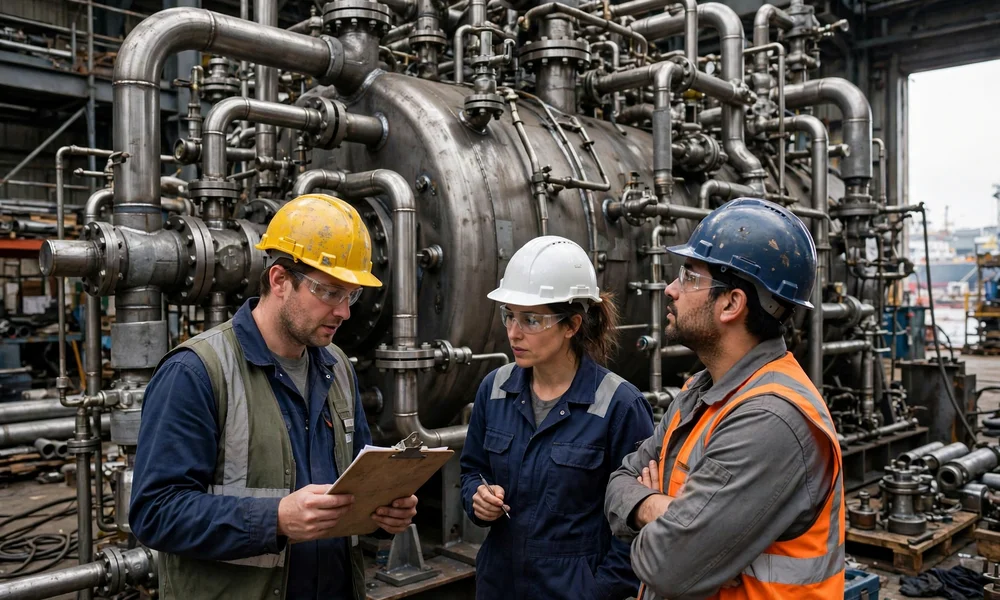
The heat from the reactor is carried away by water to the steam generators, which turn that heat into steam for the turbines. A steam generator is a large steel vessel filled with thousands of thin tubes, bent into U-shapes and fitted into tube sheets with extraordinary precision. The tubes are made from a corrosion-resistant alloy, expanded and welded into place, and every tube is tested — often with eddy-current probes run through the inside — to make sure none is cracked or thinned.

Step 4: Fitting the shielding
A reactor is surrounded by shielding — layers of steel, water, and other dense materials that absorb radiation and protect the crew. Shielding is fitted as the reactor is assembled, in panels and tanks placed with millimetre accuracy around the vessel. The layout is planned so the spaces where the crew works and sleeps are best protected, and the shielding is checked and measured as installed, because it cannot be adjusted once the submarine is built around it.
Step 5: Assembling the reactor
The parts come together in a clean assembly hall. The fuel assemblies are lowered into the vessel, the internal structures that hold them fitted, and the vessel head — a heavy steel lid with the control mechanisms mounted through it — bolted down with a ring of massive studs, each tightened in a set sequence to a precise torque. Pipes connect the vessel to the steam generators, pumps, and valves, and every joint is welded, X-rayed, and pressure-tested. The whole assembly is then checked for leaks with helium, a gas so light it escapes through the smallest gap, and the test is repeated until the reactor is proven tight. The hull that will carry this reactor is built to the standard described in the submarine pressure hull guide, and the propeller it will eventually drive is covered in the submarine propeller guide.
Step 6: Testing before delivery
Before a reactor leaves the factory, it is tested as a complete system. The vessel is filled with water, pressurised, and heated, while engineers watch temperatures, pressures, and flows through the circuit. Pumps are run, valves cycled, and control mechanisms moved through their full range to prove they work smoothly. Tests run for days, sometimes weeks, and every result is recorded and reviewed by independent inspectors. Only when the reactor has passed every test is it cleared for installation in the submarine, where it is tested again — first in the yard, then at sea — before the boat is handed to its crew.
Specs
| Specification | Typical figure |
|---|---|
| Pressure vessel | Forged steel, seamless, machined inside and out |
| Fuel assemblies | Bundles of rods in a precision grid |
| Steam generators | Thousands of thin alloy tubes per unit |
| Shielding | Layered steel and water around the vessel |
| Coolant | Pressurised water, circulated by pumps |
| Refuelling interval | Many years between refuellings |
| Weld inspection | X-ray and ultrasound on every pressure weld |
| Testing | Pressure, heat, leak, and full-system trials |
Price
A submarine reactor is not sold on the open market, so its price is never published — but its cost can be understood in scale. As an estimate, the reactor plant of a modern nuclear submarine is a large share of the boat’s cost, and a complete nuclear submarine costs roughly $2,000,000,000 to $4,000,000,000 to build, with the reactor, its shielding, and its testing accounting for a substantial part of that figure. These are estimates, and the real figure depends on the country, the class of submarine, and what is counted, but the message is clear: building a reactor that must work flawlessly underwater for decades, is among the most expensive manufacturing tasks in the world.
A Rare Fact
The steel for a submarine reactor pressure vessel is forged as a single piece, and the forging press that shapes it is one of the largest machines in its country — capable of pressing with a force of thousands of tonnes. The reason is simple: a vessel made from one forging has no welded seams in its most stressed parts, and a seam is always the weakest place in a pressure vessel. The forging takes months to make, from the first heating of the steel to the final machining, and the vessel it becomes will outlast the submarine it powers — built to be the most reliable part of the most demanding machine at sea.
The reactor is only one part of a submarine, and it makes sense alongside the rest of the boat. The engines that carry the power of a large ship are covered in the cruise ship engine specs explained guide, and the hull and propeller that the reactor serves are described in the submarine guides linked above. The next time a submarine slips beneath the surface and does not come up for months, remember the forged vessel, the hand-built fuel assemblies, and the factory that tested the whole machine until nothing was left to doubt.