A submarine spends most of its life blind. Deep underwater there is no light, no GPS, and no radio signal. What it has instead is sound — and the sonar array is the organ that listens. Hundreds of small sensors, called hydrophones, are spread across the bow of the boat in a great curved panel, each one listening for the faintest noise in the water: a distant propeller, a whale, the hum of another ship. Together they build a picture of the ocean that no single sensor could see.
Inside the factory that builds the submarine sonar array, the work is quiet, clean, and exact. The sensors are delicate, the wiring is dense, and the whole array must survive crushing pressure, salt water, and years without maintenance. A single faulty sensor would leave a blind spot in the submarine’s hearing, so every part is tested more than once — and the final test happens underwater, in a huge concrete tank, before the array ever meets the sea.
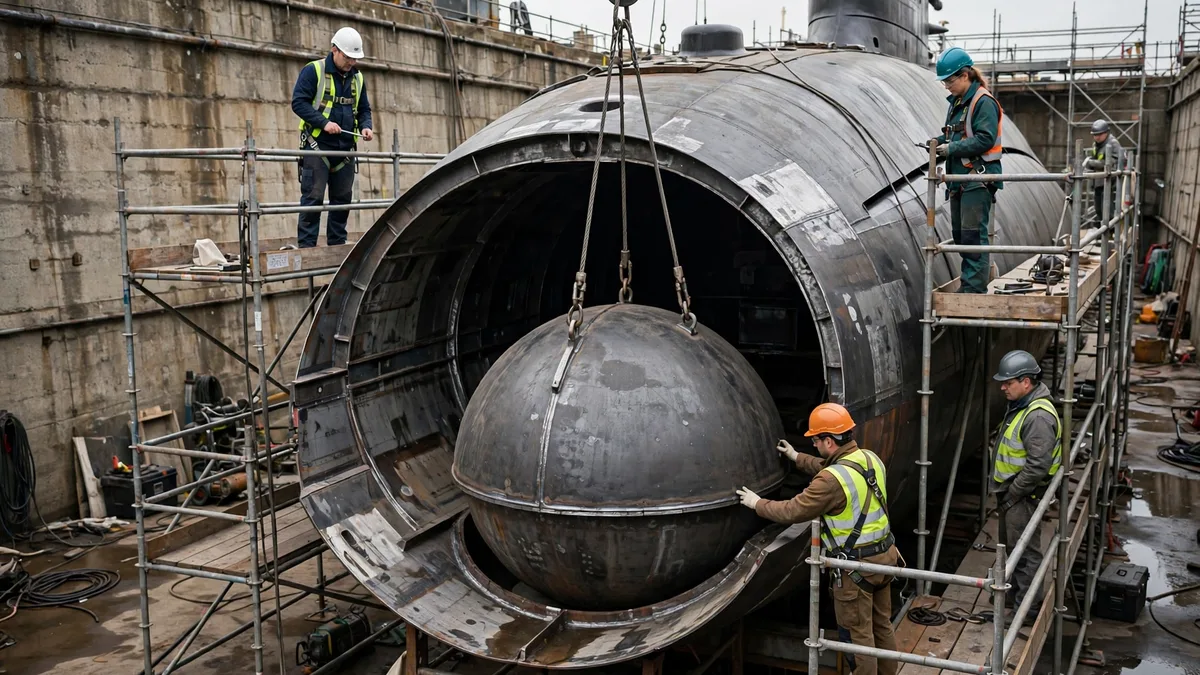
Inside the Production
Step 1: Building the hydrophones
Production begins with the hydrophones themselves — small cylindrical sensors, each one about the size of a finger, that turn sound pressure into an electrical signal. They are made from special ceramic materials that generate a tiny voltage when squeezed by a sound wave. Each hydrophone is sealed in a waterproof coating, wired, and tested in a small water tank before it is allowed near the array. Any sensor whose response is even slightly different from the others is rejected, because the array only works when hundreds of sensors behave as one.
Step 2: Assembling the array panel
Matched hydrophones are mounted in rows on a curved frame shaped to fit the bow of the submarine. The frame is built from strong, lightweight materials that will not block sound, and each sensor is fixed in exactly the right position: a sensor a millimetre out of place would distort the picture the array builds. Cables run from every sensor back through the frame to a central junction, and the whole panel is labelled and photographed so that any fault years later can be traced to one exact sensor.

Step 3: Wiring and sealing
Once the sensors are mounted, the wiring begins. Hundreds of thin cables are bundled, routed, and connected to waterproof plugs that will carry the signals through the pressure hull into the submarine. Every connection is soldered, sealed, and tested for leaks, because salt water finding its way into a cable would corrode it from the inside. The whole panel is then coated and sealed against the sea, leaving only the listening faces of the hydrophones exposed to the water.
Step 4: Fitting the sonar dome
The finished array is fitted behind a dome at the bow of the submarine — a large, smooth, acoustically transparent cover that protects the sensors while letting sound pass through. The dome is made from special rubber and composite materials, and it is fitted with great care: any air bubble or wrinkle in the dome would scatter sound and deafen the array. Workers check the dome by hand and with instruments, smoothing and refitting until it sits perfectly over the panel. The dome is the part of the submarine the sea touches first, and it must be flawless.
Step 5: Pressure testing
Before the array goes to sea, it is tested under pressure. The whole panel is placed in a pressure chamber and squeezed to the pressure it will face at depth — many times the pressure at the surface — and held there while engineers watch for leaks, cracks, or changes in the sensors. Any sensor that changes its behaviour under pressure is replaced. The way the array is built to survive that pressure is part of what how a submarine pressure hull is made describes, and the sonar panel must be just as strong as the hull that carries it.
Step 6: Testing in the acoustic tank
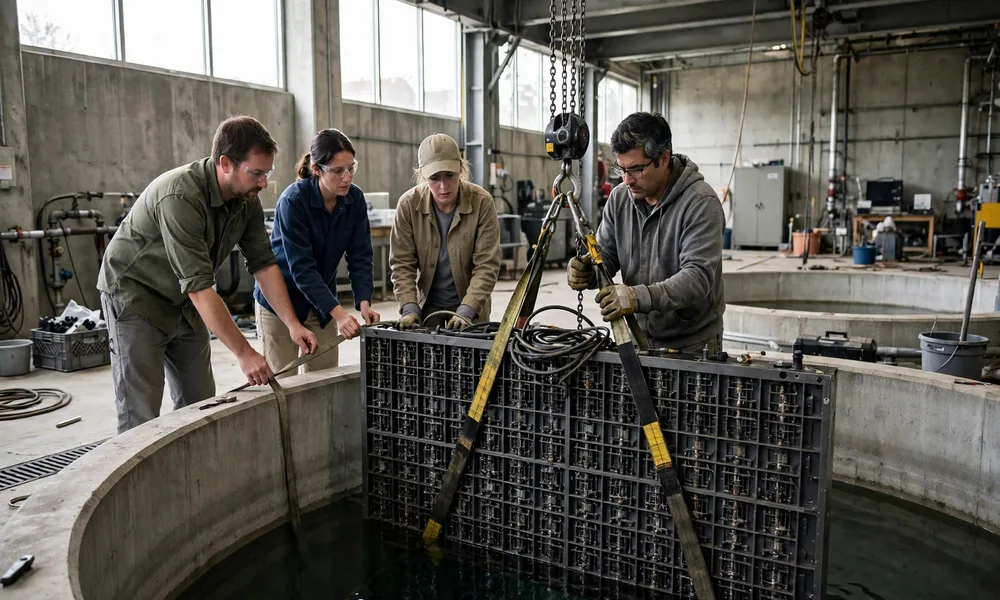
The final test happens in water. The array is lowered into a huge concrete tank, and engineers play known sounds at it from different directions — tones, clicks, and recorded propeller noise — while the array listens. The results are compared against what the array should have heard, and any sensor that is too loud, too quiet, or pointing the wrong way is found and fixed. Only when the array can locate every test sound correctly is it cleared for fitting to the submarine, where it will become the boat’s ears for the rest of its life.
Specs
| Specification | Typical figure |
|---|---|
| Number of hydrophones | Several hundred per bow array |
| Sensor type | Piezoelectric ceramic hydrophones |
| Array shape | Curved panel fitting the submarine bow |
| Dome material | Acoustically transparent rubber and composite |
| Operating depth | Several hundred metres |
| Cabling | Hundreds of sealed cables to the pressure hull |
| Pressure testing | Full depth pressure in a chamber |
| Acoustic testing | Known sounds in a water tank before fitting |
| Maintenance | Designed to work for years without servicing |
Price
A submarine sonar array is military equipment, and its price is rarely published — so any figure here is an estimate. As an estimate, a modern bow sonar array costs roughly $10 million to $50 million, depending on size, the number of sensors, and the processing electronics that go with it, with the full sonar system of a large submarine costing far more. These are estimates, and the real figure is classified in most navies — but the scale is clear: the array is one of the most expensive single systems on the boat, because a submarine that cannot hear is a submarine that cannot survive.
A Rare Fact
A submarine sonar array can hear a ship from tens of kilometres away — and the quietest submarines can be heard only when they make a mistake. The array listens for sounds so faint that the engineers who test it work in tanks built to be quieter than the ocean itself, with walls that absorb echoes and water kept still for hours before a test. Some arrays are so sensitive that they can pick up the sound of a dropped tool on a distant ship. It is one of the strangest facts in naval engineering — a listening device built in silence, tested in silence, so that it can hear almost anything in the noisiest place on Earth: the sea.
The sonar array is the submarine’s ears, but it only makes sense alongside the hull and the propeller it listens past. The numbers behind its sensors are laid out in the submarine sonar array specs explained guide, and the quiet propeller it must hear around is explained in how a submarine propeller works. The next time a submarine slips beneath the waves, remember the hundreds of small sensors in its bow, listening to an ocean no human ear could ever hear.