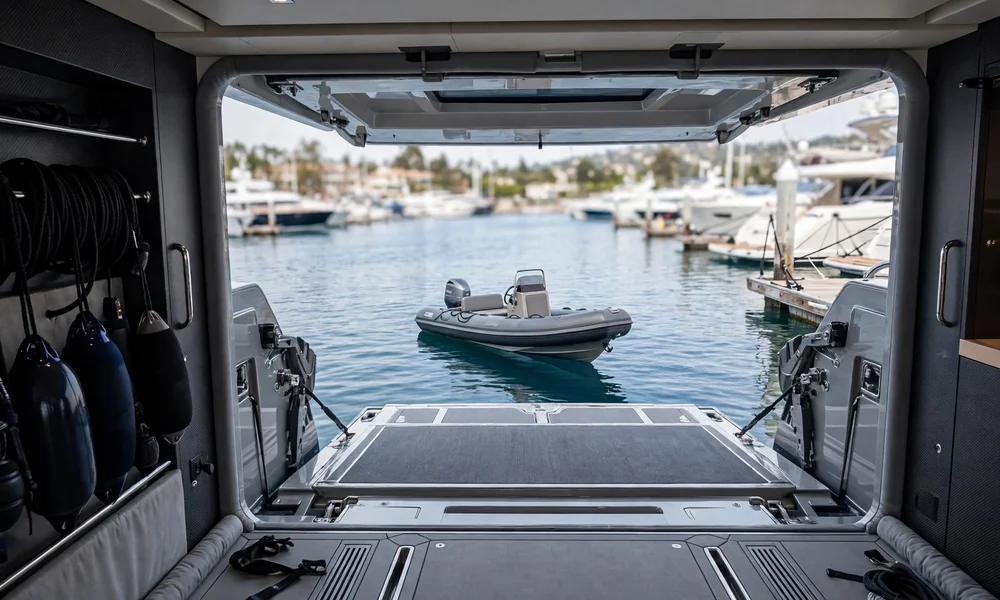
Walk the dock at any superyacht marina and you will see the same quiet trick played over and over again. A gleaming white yacht sits at the quay, her stern closed up like a solid wall of paint and chrome, and nothing about her gives away the secret inside. Then, with a low hydraulic hum, a whole section of the transom swings open, a ramp slides out over the water, and a tender boat glides out of a hidden garage as if the yacht had opened a drawer.
A tender garage is a strange thing to manufacture. It is a room that must be bone dry and watertight at the same time, strong enough to hold a tonne of boat and launching gear while the yacht rolls in a seaway, and yet so precisely fitted that its door disappears into the lines of the hull when it closes. There is no catalogue part for that. Every garage is shaped around one yacht and one tender, and the factory treats the job more like building a submarine hatch than a boat shed. Here is how it is made.
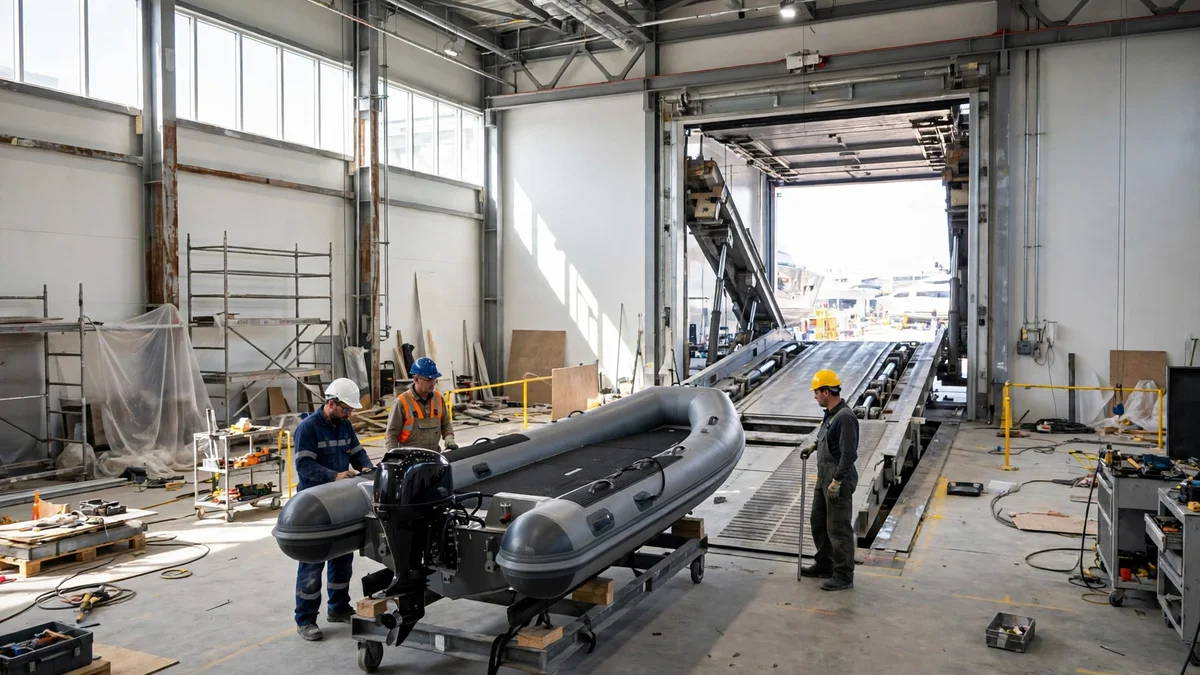
How It’s Made
Step 1: Designing the garage around the tender
Production starts long before any metal is cut, with a simple question: which tender has to live here? The yard measures the tender down to the millimetre — length, beam, height with the outboard tilted, the swing of its console, even the arc of its tubes when they flex under load. Then the designers work backwards, drawing a garage that swallows the boat with only a few centimetres to spare on each side, because wasted space inside a yacht is space stolen from cabins and fuel tanks. The door opening, the ramp angle, the cradle height and the winch positions are all settled on paper and in three-dimensional models before the first plate is ordered,
Step 2: Building the garage shell
The shell of the garage is built as part of the hull structure, not bolted in afterwards. Steel or aluminium frames are welded into the stern section while the hull is still open, forming a box that is part of the yacht’s backbone. The walls are stiffened with ribs and brackets, because a big empty box in the stern is where a hull flexes most. The shell is measured against the design with laser trackers before work continues. Once the shell is true, it is coated inside with a tough, waterproof lining that can survive years of salt water, fuel drips, and a tender being dragged across it.

Step 3: Fitting the door and its hinges
The transom door is the most visible part of the whole job, and the hardest to get right. It is usually a sandwich of aluminium or composite panels, stiff enough to carry the weight of the ramp and the tender, yet light enough for its hydraulics to move smoothly. The hinges are massive stainless steel assemblies, machined to tolerances of a fraction of a millimetre and fitted by hand, because a door this size has no room for play: if it sags by even a few millimetres, it will not seal, and a garage that leaks is a garage that sinks a tender. Fitters shim and adjust it for days until it swings true and sits flush with the hull lines.
Step 4: Installing the launch and recovery system
With the door hung, the factory installs the machinery that moves the tender. A cradle, shaped to the exact curve of the tender’s hull, sits on rails or a tilting frame, and a winch with a braided synthetic line pulls the boat in and out. The ramp, often the door itself folded down, is fitted with rollers and non-slip surfaces, and its angle is checked against the tender’s keel so the boat slides cleanly instead of catching. Hydraulic cylinders, pumps, and valves are mounted in dry compartments above the waterline, and every line is pressure-tested.
Step 5: Sealing, electrics, and safety systems
Next comes the part nobody sees and everybody depends on: keeping the water out. Rubber seals are fitted around the door in a continuous run, with no joins at the corners where leaks love to start, and the door is closed against them under hydraulic pressure while technicians spray the outside with hoses, looking for a single drip inside. Bilge pumps, high-water alarms, and flood sensors are wired in, along with lighting, ventilation fans to clear petrol fumes, and fire suppression for the fuel stored nearby. The electrics are marine-grade throughout, with cables sealed where they pass through the shell.
Step 6: Testing the launch, again and again
The final step is repetition. The factory launches and recovers the tender dozens of times, timing each cycle and watching for hesitation in the hydraulics, a wobble in the cradle, or a rub mark on the tender’s tubes. The door is opened and closed under load, the seals are checked after every cycle, and the system is run in simulated failure modes — a dead pump, a jammed winch — to prove the manual backups work. Only when the launch is boring, the same smooth motion every single time, is the garage signed off.
Specs
| Specification | Typical figure |
|---|---|
| Garage location | Transom, at the stern of the yacht |
| Tender size carried | 4–7 metres, depending on the yacht |
| Tender weight | Roughly 500–1,500 kilograms |
| Door construction | Aluminium or composite sandwich panels |
| Door operation | Hydraulic, with manual backup |
| Sealing | Continuous rubber seals, pressure-tested |
| Launch system | Cradle, rails, and winch |
| Safety systems | Bilge pumps, alarms, ventilation, fire suppression |
| Build approach | Custom-built for one yacht and one tender |
Price
A tender garage is never sold on its own, so any price is an estimate. As an estimate, the garage structure, door, hydraulics, and launch system together cost roughly $500,000 to $2 million, depending on the size of the yacht and how much of the system is custom-made. The tender itself is extra, and on a large superyacht the garage can account for a noticeable share of the build cost, because so much of it is hand-fitted work.
A Rare Fact
Some of the largest superyachts carry not one tender but two, in garages on opposite sides of the stern, and the reason is not luxury but weather. A tender launched from the sheltered side of the yacht, away from the wind and waves, is far safer to board than one launched into the weather side, so the crew can always choose the calm side. It is a small detail that tells you everything about how these boats are designed: the garage is not a cupboard, it is a working dock that happens to live inside the yacht.
The garage is only half the story of the tender itself, and how the boat it holds is put together is covered in how a superyacht tender garage is made, while the tender’s own systems are explained in how a superyacht tender works. The cost of all that hidden engineering is explored in why a superyacht tender garage is so expensive. The next time a transom swings open at a marina and a boat glides out of nowhere, remember the hand-fitted hinges, the pressure-tested seals, and the dozens of practice launches that made the trick look effortless.