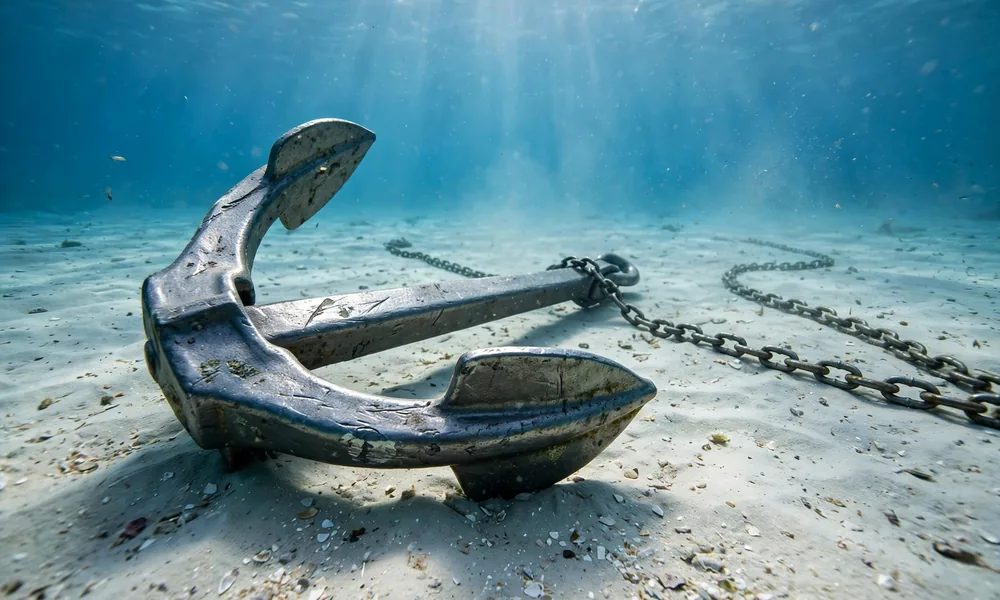
Ask a yacht owner what keeps them awake at night, and the answer is rarely the engine or the sails. It is the anchor. Out in a quiet bay at two in the morning, with the wind rising and the shore a dark line astern, the only thing between a yacht and the rocks is a lump of metal on the seabed and a length of chain. The anchor system is the most humble equipment on a yacht, and the one that matters most when it matters.
A modern yacht anchor system is not just an anchor. It is a chain of materials, each one chosen for a different job: the anchor itself, the chain that connects it, the windlass that hauls it, and the fittings that hold it all to the boat. The materials behind it are older than the yacht itself, and they have been refined by centuries of sailors learning what fails.

The Materials Behind the Yacht Anchor System
The heart of the system is the anchor, and the heart of the anchor is its steel. Most modern anchors are made from high-tensile steel, often galvanised, or from stainless steel on yachts where looks matter as much as strength. The steel must be tough enough to be dropped onto rock, strong enough to hold a yacht in a gale, and resistant enough to rust that it survives years of immersion. The windlass that hauls the chain is a mix of bronze, stainless steel, and cast alloy.
Step 1: Forging the anchor from high-tensile steel
A modern anchor is not cast in one lump. Its parts are cut from high-tensile steel plate, or forged from steel bar, then welded and assembled into the familiar shape of shank, flukes, and roll bar. High-tensile steel lets the anchor be lighter for the same holding power, which matters on a yacht where every kilogram in the bow affects how the boat sails. After assembly, the anchor is usually hot-dip galvanised, dipped in molten zinc so that the zinc coats every surface, inside and out, and sacrifices itself to protect the steel beneath.
Step 2: Galvanising and the zinc shield
Galvanising is the oldest trick in the book for steel in seawater, and it works because zinc corrodes before steel does. The zinc coating is not paint; it is a metallurgical bond, a layer of zinc-iron alloy that is part of the surface itself. When the coating is scratched, the zinc around the scratch still protects the exposed steel, because the zinc is more reactive and corrodes first. Stainless steel anchors skip the zinc, relying instead on chromium to form a protective oxide skin, but they cost several times more and can suffer from crevice corrosion where the metal is starved of oxygen.
Step 3: The chain, link by calibrated link
The chain is where the anchor system earns its keep. Each link is made from steel wire, bent, welded shut, and then calibrated so that every link is the same size and fits the windlass gypsy exactly. The chain is proof-tested, with each length pulled to a load well above its working limit, and the weakest link is the one that sets the strength of the whole rode. The weight itself is part of the design: a heavy chain lies along the seabed and keeps the pull on the anchor horizontal, which is how an anchor digs in and holds. This balance of weight and strength is what the anchor system depends on, and skimping on chain is the most common mistake new owners make.
Step 4: The windlass, bronze and stainless steel at work
Hauling a heavy anchor and chain by hand is back-breaking work, so almost every yacht above a modest size has a windlass, an electric or hydraulic winch on the foredeck. The parts that touch the chain, the gypsy and the stripper, are usually bronze or stainless steel, because they must resist wear from the chain and corrosion from salt water at the same time. The drum and casing are often cast aluminium alloy, anodised or painted, to keep the weight down.

Step 5: Shackles, swivels, and the small parts that fail first
Between the anchor and the chain sits a shackle, and between the chain and the yacht sits a swivel, and these small parts cause more failures than the anchor itself. A shackle must be at least as strong as the chain, and it must be made from the same family of metal, or galvanic corrosion will eat the weaker one. Stainless steel shackles on galvanised chain are a classic mistake: the stainless steel drives corrosion in the zinc, and the chain fails at the joint. The swivel lets the anchor turn without twisting the chain, and it is usually made from stainless steel or bronze, with a breaking load stamped on the side so there is no guessing.
Step 6: The bow roller and the fittings that take the load
The anchor lives on a bow roller, a fitting that must hold the full weight of the anchor while the yacht pounds through waves. The roller itself is often made from a hard plastic such as nylon or Delrin, which will not scratch a stainless anchor, while the cheeks and brackets are stainless steel, bolted through the deck with a backing plate below. The chain runs from the windlass into a locker below, where the bitter end is tied to the yacht with a length of rope that can be cut in an emergency. The bow thruster nearby is built to the same standard, because the bow of a yacht is a working space, not a showroom.
Yacht Anchor System at a Glance
| Specification | Detail |
|---|---|
| Anchor material | High-tensile steel, galvanised or stainless steel |
| Chain material | Calibrated galvanised steel, grades G30 or G40 |
| Chain weight | Part of the holding system, keeps the pull horizontal |
| Windlass materials | Bronze or stainless steel gypsy, cast alloy casing |
| Shackles and swivels | Matched metals, galvanised shackle on galvanised chain |
| Bow roller | Stainless steel cheeks, nylon or Delrin roller |
| Corrosion protection | Hot-dip galvanising, chromium oxide on stainless steel |
| Inspection interval | Chain and shackles checked every season |
What Does It Cost?
A complete anchor system for a mid-size yacht is one of the more affordable safety investments on board, though the price rises steeply with size. A good galvanised anchor for a 40-foot yacht typically costs a few hundred dollars (estimate), with the chain adding a similar amount (estimate) and the windlass adding one to two thousand dollars (estimate) for an electric model. The most expensive mistake is buying too small: an anchor that drags in a gale costs far more in hull damage than the anchor itself. Like the teak deck underfoot, it is money spent on parts you hope never to think about.
A Rare Fact
The anchor chain does most of the holding, not the anchor. In a proper anchorage, the chain lies along the seabed in a long curve, and its weight keeps the pull on the anchor almost horizontal, which is what lets the flukes dig in and stay dug in. The anchor is the final grip at the end of that curve, but the chain is the spring that absorbs gusts and keeps the load steady. That is why experienced sailors carry more chain than they think they need.