Step aboard a superyacht on a warm morning and the first thing your feet meet is the deck. That deck is teak, and it is not a veneer or a coating. It is a floor of solid hardwood planks, each one cut, shaped, glued, and sealed by hand, laid over a steel or composite hull in a job that can take a team of craftsmen months to finish on a large yacht.
A teak deck is one of the oldest features of a yacht and one of the hardest to make well. The wood must survive salt water, blazing sun, freezing winters, and thousands of bare feet, without warping, leaking, or lifting. This is how a yacht teak deck is produced.
How It’s Made
Step 1: Choosing and seasoning the teak
Production begins with the timber itself, and not every teak log will do. The best deck teak comes from mature trees grown slowly, with tight straight grain and a high natural oil content, because the oil is what lets the wood survive constant wetting and drying without rotting. The logs are sawn into planks and then seasoned, left to dry slowly for months so the moisture inside the wood falls to a stable level. The seasoned planks are graded by hand: the clearest, straightest pieces are kept for the wide open areas of deck where every flaw would show, while planks with more figure go to smaller areas or are cut around their knots. Only a small share of each log ends up on a yacht deck.
Step 2: Cutting, planing, and numbering the planks
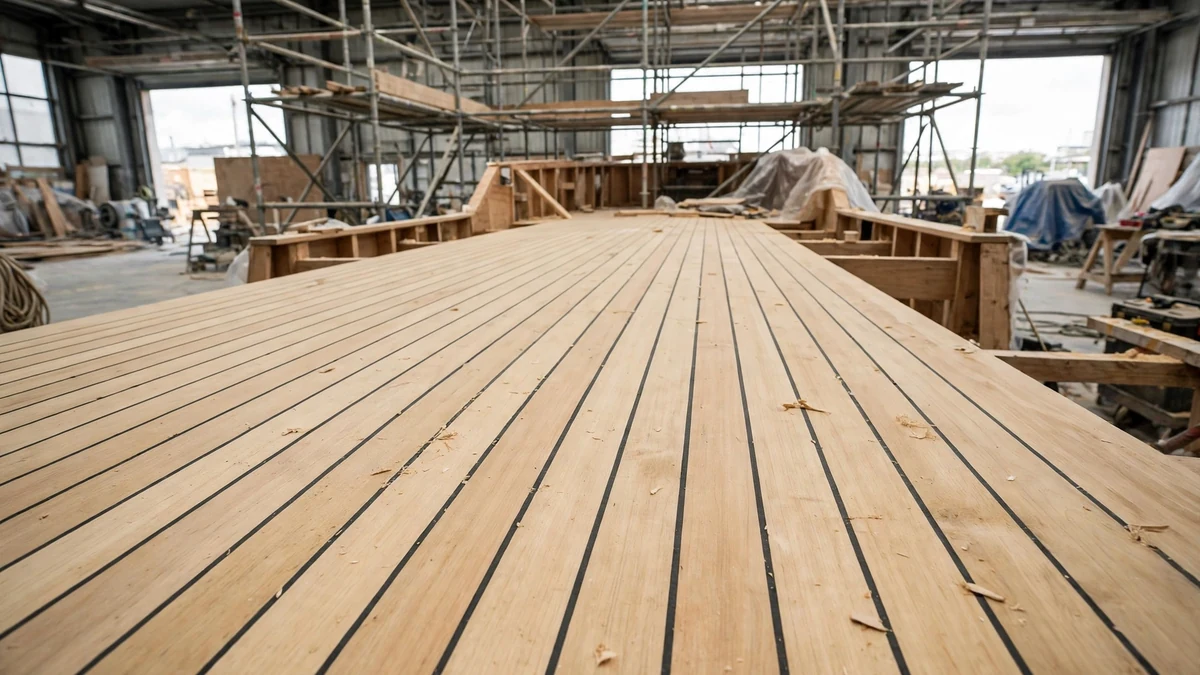
Each plank is cut to length and planed to an exact thickness, usually between 9 and 12 millimetres for a glued deck, and the edges are machined with a small groove that will later hold the black caulking seam. The planks are then laid out dry on the workshop floor in the exact pattern they will take on the deck, a process the craftsmen call dry-fitting. Every plank is numbered on its underside, so the team knows precisely where it belongs, and the pattern is adjusted until the seams run fair and parallel across the whole deck, with the joints staggered so no two plank ends line up.

Step 3: Preparing the deck beneath
Before any plank is glued down, the deck beneath it must be prepared. On a modern yacht this is usually a steel, aluminium, or composite sub-deck, and it is cleaned, sanded, and primed so the adhesive will grip it firmly. Any unevenness is filled and faired, because a bump in the sub-deck would telegraph through the thin teak planks above it. The sub-deck is then coated with a primer matched to the adhesive that will be used, and the team waits for it to cure fully. The adhesive itself is chosen for the job, a flexible compound that can move with the wood as it swells and shrinks, rather than a rigid glue that would crack under the strain.
Step 4: Gluing the planks down
Gluing is done a section at a time, with the numbered planks laid in order and pressed firmly onto a bed of flexible marine adhesive. The adhesive is spread with a notched trowel so the layer is even, and each plank is tapped into place against its neighbour, leaving a narrow even gap for the caulking seam. The team works quickly but without hurry: the adhesive has a limited working time, and a plank laid after it has begun to set will never bond properly. The full story of how the finished deck is put together on the yacht is told in how a yacht teak deck is made, and the gluing stage is the point of no return: once the adhesive has cured, a plank can only be removed by cutting it out.
Step 5: Caulking the seams
When the glue has cured, the gaps between the planks are filled with a black flexible compound, the dark seams that give a teak deck its classic striped look. The seams are first cleaned out and primed, then the compound is gunned in and tooled smooth, slightly proud of the wood so it can be sanded flush later. The caulking must stay flexible for years, expanding and contracting with the wood as it wets and dries, and it must bond to the sides of the planks without sticking to anything else.
Step 6: Sanding, finishing, and inspection
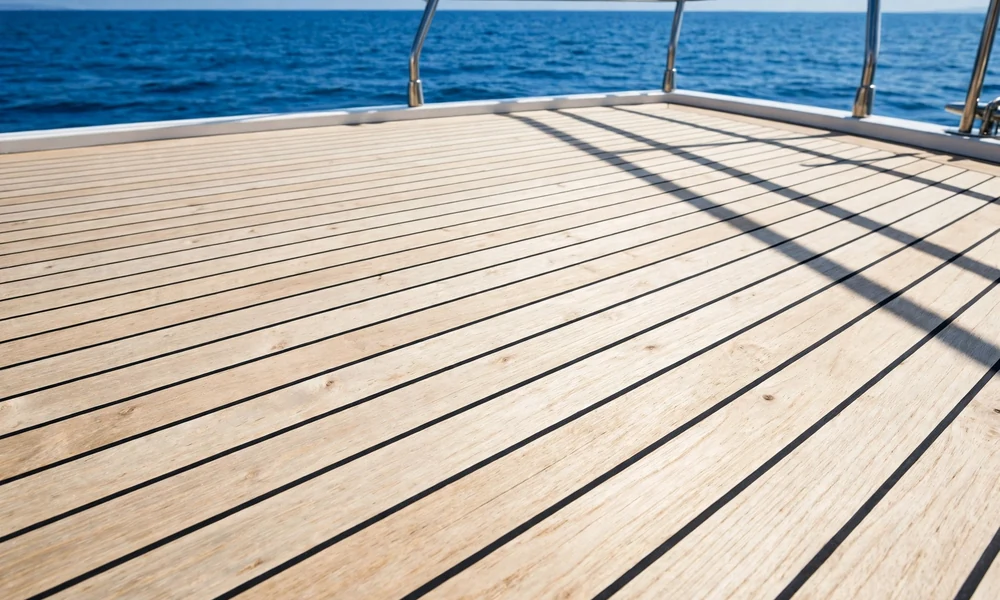
The finished deck is sanded flat in stages, starting with coarse paper and working down to fine, until the planks and seams form one smooth surface that feels even under bare feet. The sanding dust is vacuumed away, and the deck is washed and left to dry, when the teak takes on its pale silvery-gold colour in the sun. No varnish is applied: a working teak deck is left bare, because varnish would peel in the sun and make the surface dangerously slippery when wet. Finally the whole deck is inspected plank by plank, with the team walking it, tapping it, and checking every seam and fitting, before the yacht is handed over.
Specs
| Specification | Typical figure |
|---|---|
| Plank thickness | Roughly 9 to 12 millimetres, glued decks |
| Plank width | Roughly 40 to 60 millimetres |
| Seam width | Roughly 4 to 6 millimetres |
| Timber seasoning | Months of slow drying before cutting |
| Adhesive type | Flexible marine polyurethane adhesive |
| Caulking compound | Black flexible marine seam compound |
| Finish | Left bare, sometimes lightly oiled |
| Expected service life | Twenty years or more with regular washing |
Price
A professionally laid teak deck is estimated to cost roughly $400 to $800 per square metre, including timber, adhesive, caulking, and labour, and a full deck on a large yacht can run to tens of thousands of dollars. Replacing a worn deck is estimated at a similar figure, and the cost rises with the size of the yacht and the complexity of the deck shape, since every hatch and fitting must be worked around by hand.
A Rare Fact
Teak was once the deck timber of the great sailing ships and warships because it does not splinter when struck, unlike oak or pine. In battle, a wooden deck that splintered sent deadly shards flying across the ship, while teak dented and held together, and that same toughness is why it is still chosen for yacht decks today.
A teak deck is the part of a yacht its crew touches every day, and the numbers behind it are set out in the yacht teak deck specifications, while how a yacht teak deck works explains how the planks, seams, and drainage keep the deck below dry. The next time you step onto a pale gold deck in the morning sun, remember the months of seasoning, the numbered planks, and the careful caulking that went into the floor beneath your feet. A deck laid this carefully rewards its owners every day, under bare feet in the morning and under the glare of the midday sun.