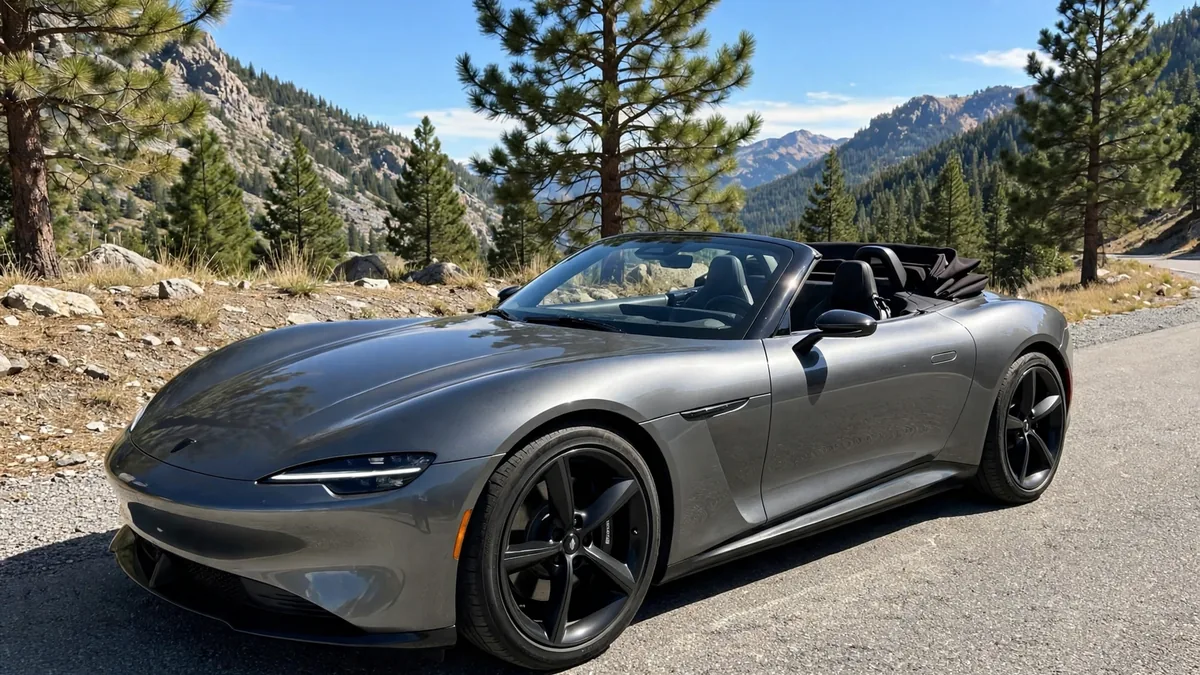
The mountain road was empty just after sunrise, and the little two-seater that came around the bend made almost no sound at all. There was no engine roar, no exhaust note, just the rush of wind over the open cockpit and the faint whine of tyres on smooth tarmac. The driver lifted a hand from the wheel and waved, grinning, as the car slipped past and disappeared into the next curve.
That silence is the first thing people notice about a luxury electric roadster, and the spec sheet is the second thing they misunderstand. The numbers look familiar — power, range, acceleration — but they mean something different when the car has no roof, no petrol engine, and no back seats. This guide translates every figure into plain English.
Power: quiet, but not gentle
Power in a luxury electric roadster is usually quoted in horsepower or kilowatts, and most offer between 400 and 700 horsepower from one or two electric motors. That is a large figure for such a small car, and it is the reason the acceleration times look so extreme. A single motor usually drives the rear wheels, while a second motor on the front axle adds all-wheel drive and even more push.
What the power figure hides is how the power arrives. An electric motor gives its full twisting force the instant it spins, so there is no waiting for revs and no gear changes to interrupt the push. The guide to luxury roadster specs explained covers the same power numbers on a petrol roadster, and the contrast shows why the electric version feels faster than its figures suggest.
Range: how far the fun lasts
Range is the number every electric roadster buyer asks about first, and it is usually between 350 and 500 kilometres on a full charge. That is less than a big electric saloon, because a roadster is small and there is simply less room underneath for batteries. The range figure is measured in gentle test conditions, so real driving on a twisty road with the top down will use the battery faster.
Battery size: the hidden compromise
Battery size is measured in kilowatt-hours, and a luxury electric roadster usually carries between 70 and 85 kilowatt-hours. That is a mid-sized battery by electric car standards, and the size is a deliberate compromise. A bigger battery would give more range, but it would also add weight, and weight is the enemy of everything a roadster is supposed to be: quick to turn, quick to stop, and quick to change direction.
Engineers hide the battery low in the floor, between the axles, which keeps the centre of gravity close to the ground. That low weight is why an electric roadster can corner so flatly, even though the battery makes it heavier than a petrol roadster of the same size. The guide to how a luxury roadster works explains how the chassis and suspension are tuned around that low, heavy floor.
0 to 100: the launch that surprises everyone
Acceleration is quoted as 0 to 100 kilometres per hour, and a luxury electric roadster usually does it in 3.5 to 4.5 seconds, with the quickest models dipping under 3 seconds. The electric motors are the reason: full torque from a standstill, no gears to change, and all of it delivered in silence. Passengers often laugh the first time it happens, because the speed arrives without any of the noise they expected.
Weight: the roadster’s oldest enemy
Weight is the number that worries roadster engineers most. A luxury electric roadster usually weighs between 1,700 and 1,900 kilograms, which is heavy for a small two-seater, and almost all of the extra weight is the battery. A petrol roadster of the same size might weigh 300 kilograms less, and every one of those kilograms changes how the car turns and stops.
Manufacturers fight back with aluminium and carbon fibre in the body and chassis, and with clever suspension that hides the weight in normal driving. The power-to-weight ratio is the fairest comparison: divide the power by the weight, and a figure near 350 horsepower per tonne tells you the car will still feel lively, whatever the scales say.

Charging speed: minutes, not hours
Charging speed is measured in kilowatts, and a luxury electric roadster usually accepts between 150 and 250 kilowatts from a fast charger. That is the peak rate, and the car only holds it for part of the charge, but it is the number that decides how long a stop takes. At full speed, a roadster can add roughly 300 kilometres of range in about half an hour.
The roof: the spec nobody quotes
The roof is the one roadster feature the spec sheet barely mentions, yet it shapes the whole car. A soft fabric roof folds away in about 10 seconds and weighs very little, while a folding hard roof takes longer and adds weight but seals better against noise and weather. The roof mechanism is a piece of engineering in its own right, with motors, linkages and seals that have to work perfectly thousands of times.
With the roof down, the wind changes everything. Engineers add small wind deflectors behind the seats and shape the windscreen to keep the cabin calm at speed, and the difference between a good deflector and a bad one is the difference between a conversation and a shouting match. The guide to luxury convertible specs explained covers roof mechanisms on a bigger open car, and the same ideas apply here.
The numbers at a glance
| Specification | Typical electric roadster | Top electric roadster |
|---|---|---|
| Power | 450 hp | 700 hp |
| Battery | 75 kWh | 85 kWh |
| Range | 400 km | 500 km |
| 0 to 100 km/h | 4.0 seconds | 2.9 seconds |
| Top speed | 200 km/h | 250 km/h |
| Fast charging | 150 kW | 250 kW |
| 10 to 80% charge | 35 minutes | 25 minutes |
| Weight | 1,800 kg | 1,700 kg |
What a luxury electric roadster costs
A luxury electric roadster costs an estimated 80,000 to 150,000 dollars, and the quickest and most exclusive models cost an estimated 200,000 dollars or more. The battery is the largest single cost, followed by the motors and the lightweight body. Running costs are gentler than a petrol roadster: electricity is cheap, there is no oil to change, and the brakes last longer because the motors do much of the slowing.
A rare fact
Some luxury electric roadsters play a soft artificial sound at low speed to warn pedestrians, because the car is so quiet that people step out in front of it without looking. The strangest detail is that engineers spent months tuning that sound, testing dozens of tones, because a warning noise that sounds like a spaceship amuses owners, while one that sounds like a washing machine does not.
The next time an electric roadster spec sheet lists its numbers, read them as a balance. The power buys the launch, the battery buys the range, and the weight is the price paid for both. A roadster was always a compromise between speed and simplicity, and the electric version simply changes what is being compromised. The silence is not a missing feature. It is the point.