The showroom was quiet on a Tuesday morning, and the supercar in the middle of the floor looked like it was parked there by accident, low and wide and finished in a deep green that changed shade as the lights moved across it. A small plaque beside the front wheel listed numbers that read like a riddle: a petrol engine, two electric motors, a battery, and a combined power figure bigger than any of the parts added together.
The salesman smiled when he was asked how the numbers worked together. He said the car had two hearts, and the trick was knowing when each one did the work. A luxury hybrid supercar is exactly that: a petrol engine and electric motors sharing one car, and the spec sheet only makes sense once you know which heart is beating at any given moment.
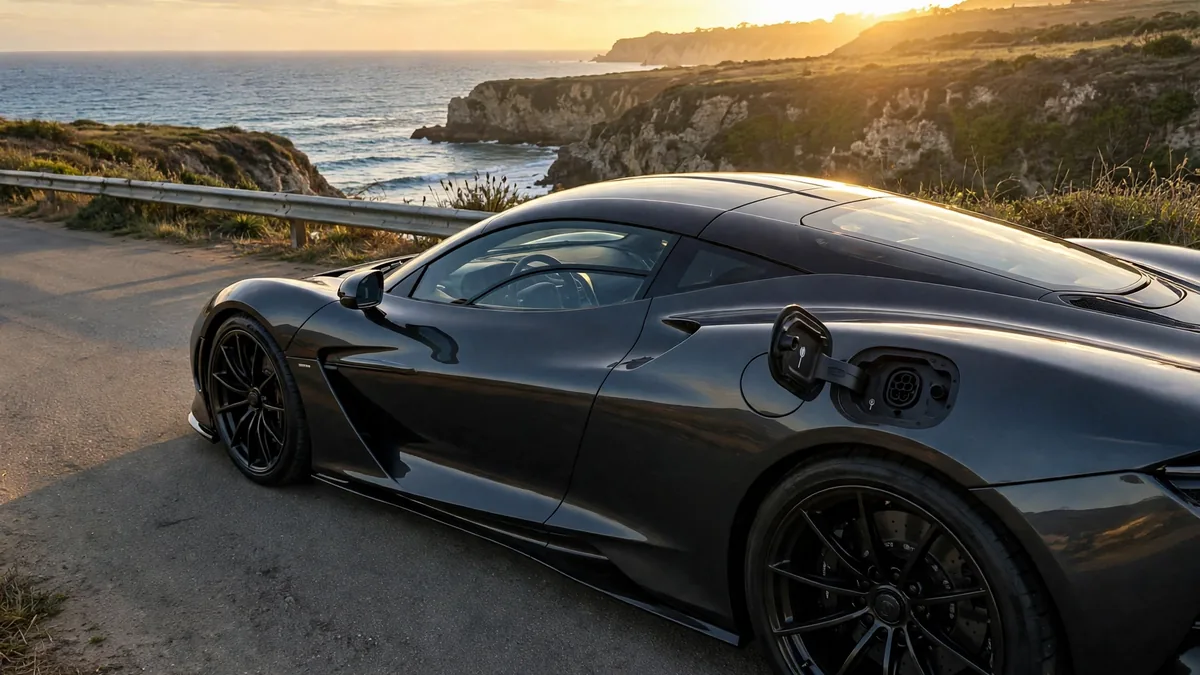
Combined power: the headline number
Combined power is the headline figure on every hybrid supercar spec sheet, usually quoted in horsepower. A luxury hybrid supercar typically offers between 800 and 1,100 horsepower combined, far more than a petrol engine of the same size could manage alone. The number is the sum of the engine and the motors working together at full effort, and it decides the acceleration times everyone quotes.
The important detail is that the two power sources peak at different moments. An electric motor gives its full push the instant it spins, while a petrol engine needs revs to reach its best. Put together, the motors fill the gap while the engine wakes up, which is why a hybrid supercar can feel violent off the line and still keep pulling hard at high speed. The guide to luxury supercar specs explained covers the same power numbers on a petrol-only car, and the comparison shows exactly what the electric motors add.
The petrol engine: smaller than you expect
The petrol engine in a luxury hybrid supercar is often smaller than the engine in the car it replaced. Many use a twin-turbocharged V6 or V8 of between 3.0 and 4.0 litres, where an older supercar would have used a much larger engine. The engine is smaller because it no longer has to do all the work alone, and a smaller engine is lighter, which matters enormously in a car built around weight.
Electric motors: instant push
Electric motors are measured in kilowatts, and a hybrid supercar usually carries one, two or three of them. A common layout puts one motor on the front axle and one or two at the rear, and together they add between 150 and 300 kilowatts. The front motor often drives the front wheels on its own, which gives the car all-wheel drive without a heavy driveshaft running through the middle.
The magic of an electric motor is torque, the twisting force that pushes the car forward. A petrol engine builds torque slowly as it revs, but an electric motor delivers its maximum torque from a standstill. That is why the acceleration figures of hybrid supercars look so extreme, with 0 to 100 kilometres per hour in under 2.5 seconds becoming almost routine at the top of the range.
The battery: small, powerful, and busy
The battery in a hybrid supercar is small compared with a pure electric car, usually between 6 and 8 kilowatt-hours, roughly a tenth of what a long-range electric car carries. That sounds like a weakness, but the battery has a different job here. It is not meant to carry the car for hundreds of kilometres; it is meant to deliver huge bursts of power for seconds at a time, over and over again. The guide to luxury electric car specs explained explains battery numbers on a pure electric car, where capacity matters far more.
Electric-only range: the quiet miles
Most luxury hybrid supercars can drive on electricity alone, usually for between 20 and 30 kilometres. That is enough to leave a neighbourhood silently in the morning or to glide through a city centre without waking anyone, and it is a party trick a petrol supercar could never manage.
Weight: the number that fights the power
Weight is the figure every hybrid supercar engineer loses sleep over. A luxury hybrid supercar usually weighs between 1,500 and 1,700 kilograms, heavier than a petrol supercar of the same size, because the battery, the motors and the extra cooling all add mass. The power-to-weight ratio ties it all together: divide the combined power by the weight, and a figure above 500 horsepower per tonne tells you the car will be brutally fast.
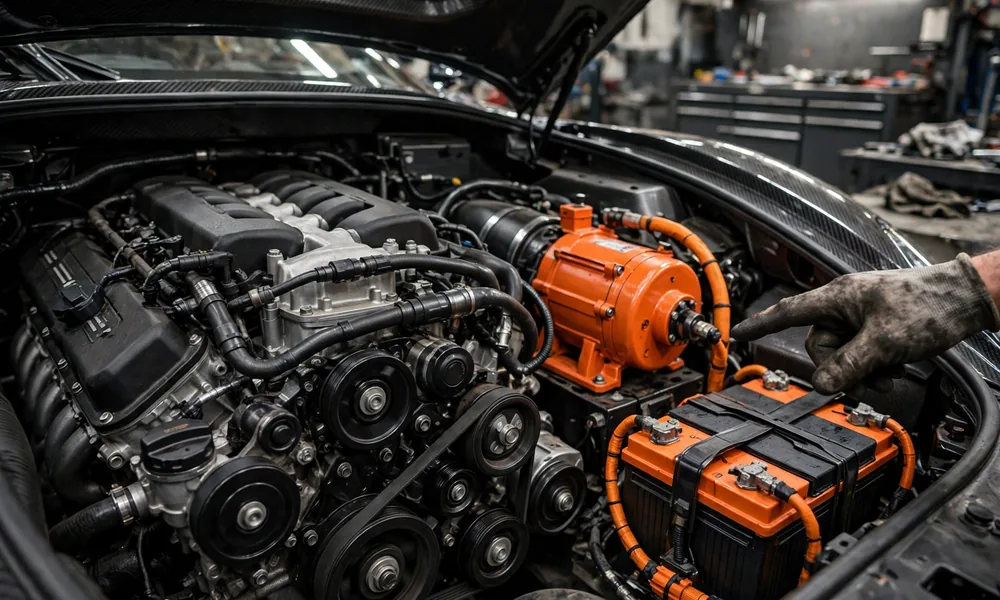
0 to 100 and top speed
Acceleration is quoted as 0 to 100 kilometres per hour, and a luxury hybrid supercar usually does it in 2.5 seconds or less. The electric motors are the reason: they give full torque from a standstill, so the car launches like it has been fired from something. Top speed is usually between 330 and 350 kilometres per hour, and it is often limited electronically rather than by the power available. The guide to why a luxury supercar is so expensive explains why chasing those last few tenths costs so much money.
Regenerative braking: free power
Regenerative braking is the system that turns slowing down into electricity. When the driver lifts off the accelerator or touches the brakes, the electric motors run in reverse and act as generators, feeding energy back into the battery instead of wasting it as heat in the brake discs. On a fast lap, the car can recover a surprising amount of energy this way, and the battery is topped up again for the next straight.
The numbers at a glance
| Specification | Typical hybrid supercar | Top hybrid supercar |
|---|---|---|
| Combined power | 800 hp | 1,100 hp |
| Petrol engine | 3.0-litre twin-turbo V6 | 4.0-litre twin-turbo V8 |
| Electric motors | 2 motors, 160 kW | 3 motors, 300 kW |
| Battery | 6 kWh | 8 kWh |
| Electric-only range | 20 km | 30 km |
| 0 to 100 km/h | 2.8 seconds | 2.3 seconds |
| Top speed | 330 km/h | 350 km/h |
| Weight | 1,650 kg | 1,500 kg |
What a luxury hybrid supercar costs
A luxury hybrid supercar costs an estimated 400,000 to 700,000 dollars, and the most exclusive models cost an estimated 1 million dollars or more. The hybrid system itself is a large part of the price: the battery, the motors, the inverters and the cooling are expensive to develop and to build, and they have to survive heat and vibration that would destroy ordinary electric car parts. Running costs are heavy too, and a single damaged battery pack can cost an estimated tens of thousands of dollars to replace.
A rare fact
Some luxury hybrid supercars can reverse silently on electric power alone while the petrol engine stays asleep. The strangest detail is that engineers sometimes pipe a fake engine note into the cabin, because the electric motors are so quiet that drivers complained the car felt slower than it was, even when it was the fastest car they had ever driven.

The next time a hybrid supercar plaque lists its numbers, read them as a partnership. The engine gives the top speed and the sound, the motors give the launch and the silence, and the battery is the go-between that lets them share the work. It is a machine where the spec sheet only makes sense when the two hearts are read together.