There is a moment on a fast circuit when a hypercar stops feeling like a car and starts feeling like something pressed into the road by an invisible hand. That hand is the air itself, shaped by the bodywork into downforce, and on the McLaren W1 it is the whole point of the car. The W1 is McLaren’s flagship hypercar, successor to the P1, and its aerodynamics are not a styling exercise — they are a system of wings, ducts and a floor that work together to hold the car down at speeds where most cars would be trying to take off.
Aerodynamics on a road car is measured in numbers that sound abstract — kilograms of downforce, drag coefficients, airflow in cubic metres per second — but each one answers a simple question: how hard does the air push the car into the road, and what does it cost in speed? Here is what the spec sheet means.

Downforce: The Headline Number
Downforce is the vertical force the air pushes down on the car, and the W1 produces up to 1,000 kilograms of it (estimate) in its most aggressive mode — roughly the weight of the car itself pressing down again. That means at high speed the tyres are loaded as if the car weighed twice as much, which doubles the grip available for cornering and braking. The figure is quoted at a specific speed, usually near the car’s top speed, because downforce grows with the square of speed: at 100 km/h the W1 makes only a fraction of what it makes at 300 km/h.
The Active Longtail Rear Wing
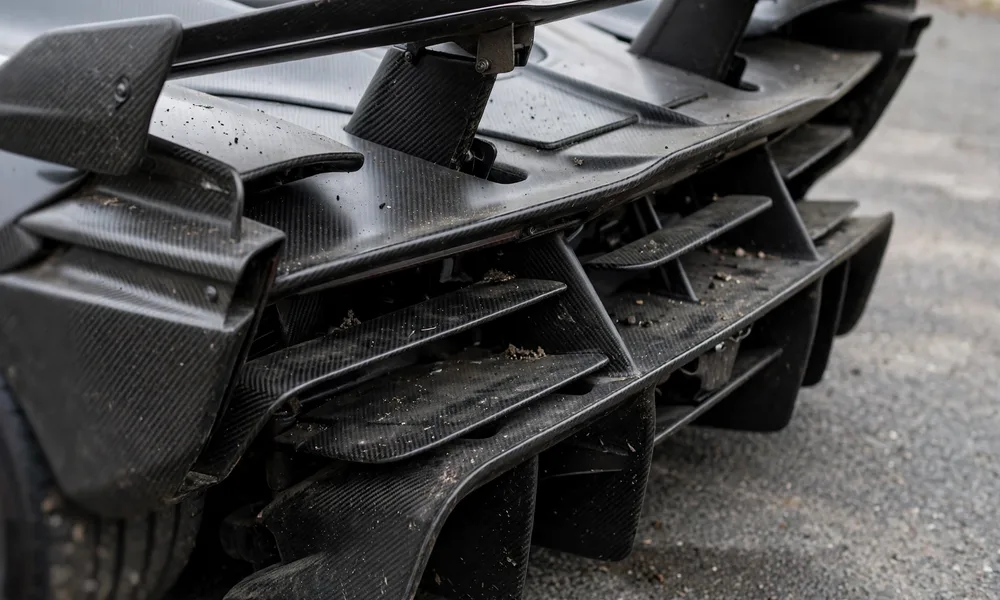
The W1’s most visible aero device is its active rear wing, which extends rearwards and tilts to change the car’s shape. In its extended “Longtail” position the wing sits further back, increasing the lever arm that pushes the rear axle down, and it can also act as an airbrake, standing upright under hard braking to add drag and slow the car. The wing also works with the rear deck: air flowing over the roof is guided down to the wing’s leading edge, so the wing sees clean, fast air rather than the turbulent wake of the cabin. For the full story of the system in motion, see how the McLaren W1 aerodynamics works.
Ground Effect and the Floor
Half the W1’s downforce comes from underneath, where you cannot see it. The flat floor and the rear diffuser accelerate air under the car, creating a low-pressure zone that sucks the car toward the road — the same ground effect that Formula 1 cars exploit, tamed for a road car. The floor’s spec is its ride height: the W1 runs lower in its track mode, closing the gap to the road and strengthening the effect, then raises itself for speed bumps and driveways. That adjustable height is why the car can be both a track weapon and a road car, rather than one or the other.
Drag Coefficient
Drag is the air’s resistance to the car’s forward motion, expressed as the drag coefficient, Cd — the W1’s is around 0.32 (estimate) in its low-drag mode, which is slippery for a car with this much downforce. The tension is the point: downforce and drag are usually bought with the same currency, and a wing that pushes the car down also holds it back. McLaren’s answer is to make the aero active, so the car is slippery on a straight — wing retracted, drag low — and planted in a corner, with the wing extended and the floor working hardest.

Front Aerodynamics and the S-Duct
The front of the car has its own job: to feed the floor cleanly and to keep the front tyres pressed down. Air entering the nose is split: some goes through the radiators, and some passes through an S-duct that vents it over the bonnet, reducing lift at the front axle. The front splitter, the blade at the very bottom of the nose, is the first surface the air meets, and its angle sets up everything behind it. The build sequence shows this clearly in how the McLaren W1 aerodynamics is made, from wind tunnel model to finished bodywork.
Cooling Airflow
Aerodynamics is not only about grip — it is also about breathing. The W1’s hybrid V8 and its battery need enormous cooling, measured in airflow of thousands of litres per second at speed, and every cooling duct is a compromise: air taken in for cooling is air that is not making downforce. The side intakes feed the engine, the roof intake feeds the airbox, and hot air exits through vents in the rear deck, shaped so the exiting air helps the wing rather than disturbing it. Cooling airflow is the hidden spec behind the visible one: the car must stay cool for a full lap at full throttle, not just for a single corner.
Race Mode and Active Aero Modes
The W1 changes its aerodynamics with its driving mode. In road mode the wing stays tucked, the ride height is higher, and the car is civilised; in track mode the car drops, the wing extends into its Longtail position, and the full 1,000 kilograms of downforce becomes available. The active system means the spec sheet has more than one line: downforce, drag and ride height are all quoted per mode, and the car a buyer drives to the shops is aerodynamically a different machine from the one they drive on a circuit. That duality is the real engineering achievement — not the peak number, but the range between the two extremes.
The Specs at a Glance
| Maximum downforce | Up to 1,000 kg (estimate), in track mode |
| Drag coefficient | Around 0.32 (estimate), low-drag mode |
| Rear wing | Active Longtail, extends and acts as airbrake |
| Ground effect | Flat floor and diffuser, about half of downforce |
| Front aero | Splitter and S-duct, feeds floor and cuts lift |
| Ride height | Adjustable, lower in track mode |
| Cooling | Side and roof intakes, rear deck exits |
What Does It Cost?
The McLaren W1 costs around £2 million before options (estimate), with production limited to 399 cars, all of which were allocated before the car was publicly revealed. The aerodynamics are a meaningful part of that price: the active wing, the carbon fibre bodywork and the wind tunnel programme behind them are among the most expensive systems on the car, which is why the McLaren W1 aerodynamics is so expensive to develop and to build. For a car built in the hundreds, there is no economy of scale to hide behind.
A Rare Fact
The “Longtail” name on the W1’s wing reaches back to the 1997 McLaren F1 GTR Longtail, a racing car whose stretched rear bodywork gave it more downforce and more stability at Le Mans. The W1 revives the idea, but with a wing that moves: where the old Longtail was a fixed shape, the new one extends and retracts, giving the driver the long tail only when it is needed.