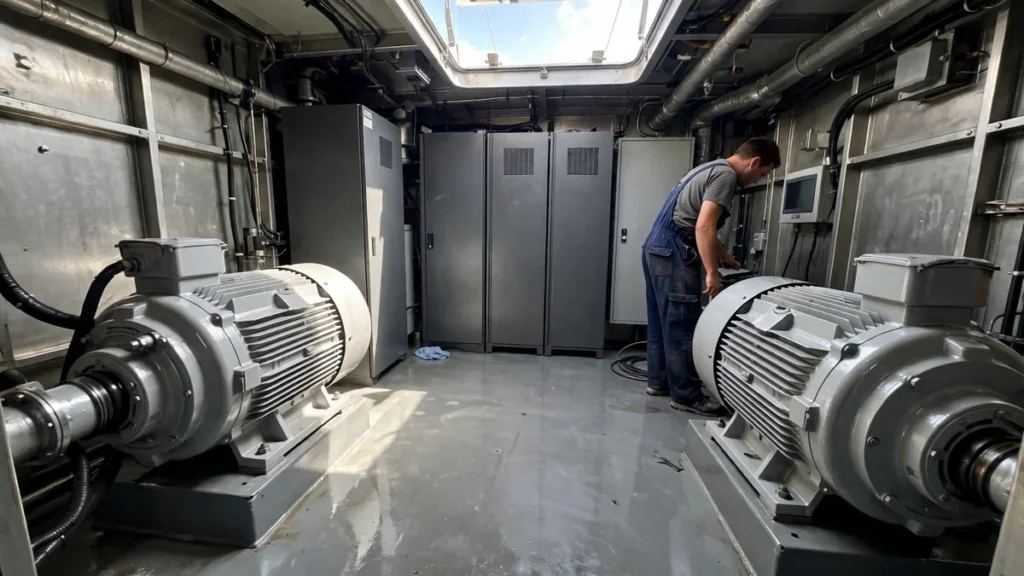
A submarine spends most of its life hidden, but every so often it must reach up and touch the world above the waves. A slender mast rises from the sail, breaks the surface, and for a few minutes the boat can send and receive messages, fix its position, and listen to the sky. Then the mast slides back down, the sea closes over it, and the submarine is gone again.
That brief moment is the hardest job in the boat. The communications mast must be strong enough to punch through waves at speed, slim enough to leave almost no trace on the surface, watertight under crushing pressure, and transparent to radio waves at the same time. Steel alone cannot do it, and plastic alone cannot survive it. The answer is a careful stack of materials, each one chosen for a single job and each one ready to fail in its own way.
Here are the materials inside a submarine communications mast, why engineers chose them, how they are shaped, and what happens when they give up.
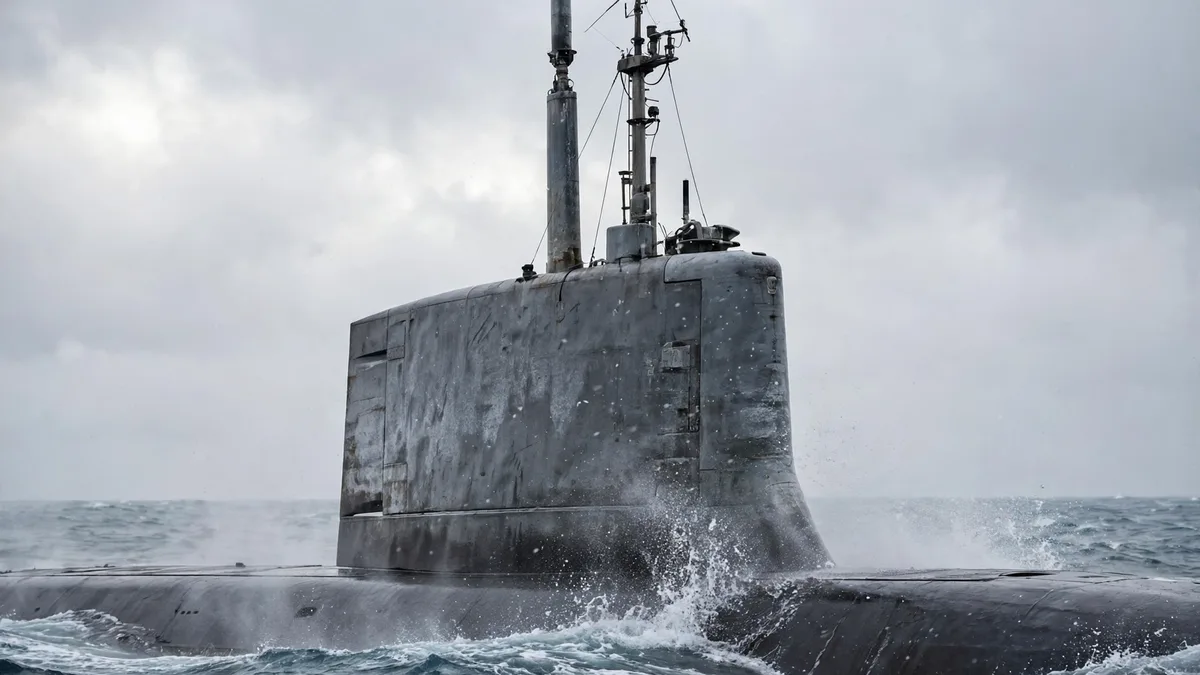
The Materials Behind the Submarine Communications Mast
1. High-strength steel, the spine of the mast
The mast itself is built around a tube of high-strength steel, the same family of steel used in the submarine’s pressure hull. Engineers choose it because it can carry the bending loads of a mast pushing through waves at speed without buckling, and because it survives the shock of the boat diving and surfacing again and again. The steel is rolled into a tube, welded, and machined to a smooth finish so that it slides cleanly through its seals. When this steel fails, it is usually fatigue: thousands of small flexes open a crack at a weld or a bolt hole, and seawater finds its way inside the mast housing.
2. Glass-reinforced plastic, the window for radio waves
The top of the mast, where the antennas live, is hidden inside a fairing made of glass-reinforced plastic, often called GRP or fibreglass. Steel would block radio signals, but GRP lets them pass through almost untouched, so the antennas can work while staying dry. Engineers choose GRP because it is strong for its weight, resists salt water, and can be moulded into the smooth, low-drag shape the mast needs. The fairing is laid up by hand or in a mould, layer by layer, then cured and polished. When GRP fails, it usually delaminates: water creeps between the layers, the fairing softens, and in the worst cases the layers peel apart under the force of a wave.
3. Aluminium alloy, the light fittings inside
Inside the mast, the frames, brackets and antenna mounts are made from marine aluminium alloy. Aluminium is chosen because it is light, which keeps the top of the mast from becoming top-heavy, and because it does not rust the way steel does. The parts are cut from plate, milled to shape, and anodised so the surface resists salt spray. When aluminium fittings fail, the trouble is usually galvanic corrosion: where aluminium touches steel in salty water, the aluminium is eaten away first, and a bracket that looked solid can snap under load.
4. Copper and brass, the antenna elements
The antennas themselves are made from copper and brass. Copper is chosen because it conducts radio signals better than almost any other common metal, and brass is used for fittings and elements that need copper’s conductivity with more strength. The elements are drawn into rods and tubes, bent to precise lengths, and polished before they are sealed inside the fairing. When copper antenna elements fail, it is usually corrosion: salt air turns the surface green with verdigris, the electrical connection weakens, and the antenna slowly goes deaf.
5. Ceramic and PTFE insulators, the parts that keep signals separate
Wherever a live antenna element passes through metal, it is held by insulators made from ceramic or PTFE, the slippery plastic better known as Teflon. These materials are chosen because they block electricity completely while surviving heat, salt water and vibration without breaking down. Ceramic insulators are pressed and fired in a kiln; PTFE parts are machined from solid blocks. When insulators fail, it is usually a crack or a tracking path: moisture and salt form a conductive film across the surface, the signal leaks away, and the mast starts transmitting into its own steel instead of into the sky.
6. Neoprene seals, the watertight skin
Everywhere the mast slides, turns or meets the hull, it is sealed with neoprene rubber. Neoprene is chosen because it stays flexible in cold water, resists oil and salt, and springs back after being squeezed thousands of times. The seals are moulded into rings, fitted into grooves, and compressed when the mast is assembled. When neoprene seals fail, they harden and shrink with age, or they are nicked by grit during a dive. A single failed seal lets a thin jet of seawater into the mast housing, and if it is not caught, the water reaches the electronics below.
Submarine Communications Mast Materials
| Material | Where it is used | Why it is chosen |
|---|---|---|
| High-strength steel | Mast tube and spine | Carries bending loads, resists shock |
| Glass-reinforced plastic | Antenna fairing | Lets radio waves through, resists salt |
| Marine aluminium alloy | Frames, brackets, mounts | Light, keeps the mast top from being heavy |
| Copper and brass | Antenna elements | Excellent conductivity for radio signals |
| Ceramic and PTFE | Insulators | Block electricity, survive heat and salt |
| Neoprene rubber | Seals and gaskets | Flexible, watertight, resists oil and salt |
Submarine Communications Mast Specifications
| Specification | Typical value |
|---|---|
| Mast structure | High-strength steel tube, welded and machined |
| Antenna fairing | Glass-reinforced plastic, moulded and cured |
| Internal fittings | Marine aluminium alloy, anodised |
| Antenna elements | Copper and brass rods and tubes |
| Insulators | Ceramic or PTFE, pressed or machined |
| Seals | Neoprene rings, moulded and compressed |
| Operating environment | Salt water, pressure, vibration and shock |
| Service life | Fairing and seals replaced on a regular schedule |
The way the whole mast is assembled is described in how a submarine communications mast is made, and the tall spar on a very different kind of vessel is covered in the materials behind the yacht carbon mast. The steel deck that carries the heaviest loads at sea is explored in the materials behind the aircraft carrier flight deck.
A Rare Fact
Early submarines had no retractable masts at all. Their radio antennas were wires strung between the conning tower and the bow, and the crew had to surface, rig the wires, and hope the sea stayed calm long enough to send a message. The first masts that could be raised and lowered from inside the boat were a quiet revolution: the submarine could now listen and speak while barely breaking the surface, and the thin mast left a wake so small that lookouts often missed it entirely.
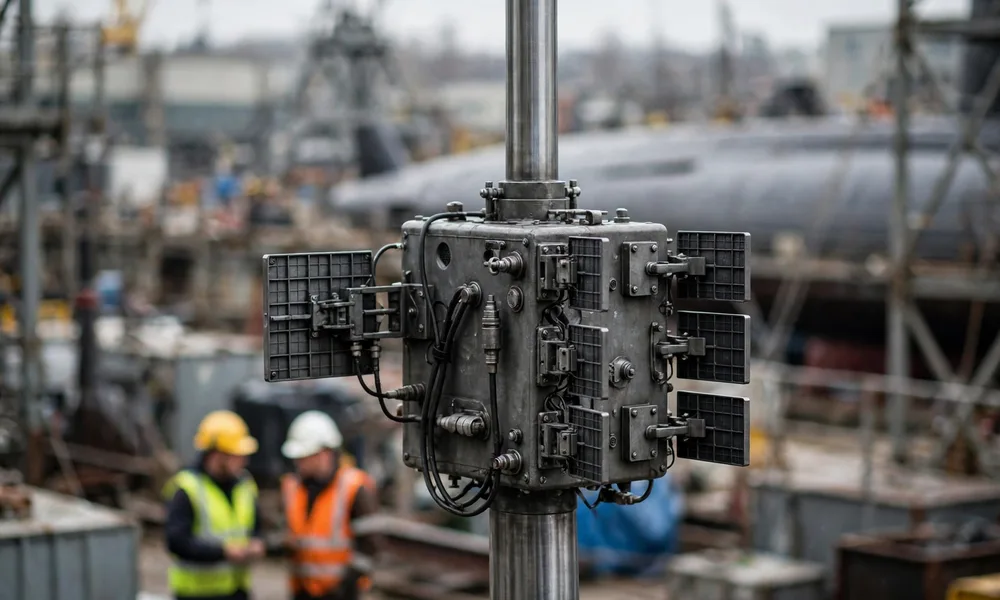

A submarine communications mast looks like a simple steel pole, and that is exactly the trick. High-strength steel carries the load, glass-reinforced plastic lets the signals through, aluminium keeps the weight down, copper and brass do the talking, ceramic and PTFE keep the signals where they belong, and neoprene keeps the sea out. When every material does its one job, a boat that spends its life underwater can still reach the sky.