A superyacht under sail is a strange sight: a floating palace, heavy as a building, driven across the ocean by a single tall pole and a few acres of cloth. That pole is the mast, and it carries loads that would crush an ordinary structure — the full force of the wind, levered through fifty metres of height, pulling at the hull with hundreds of tonnes. Yet the mast itself weighs less than the furniture in the saloon below.
A superyacht mast is one of the most demanding structures in the world: it must be stiff enough not to bend, light enough not to capsize the boat, and tough enough to survive storms, salt and decades of flexing. Aluminium used to be the standard, but carbon fibre has taken over at the top end, and the engineering behind it is closer to aerospace than to shipbuilding.
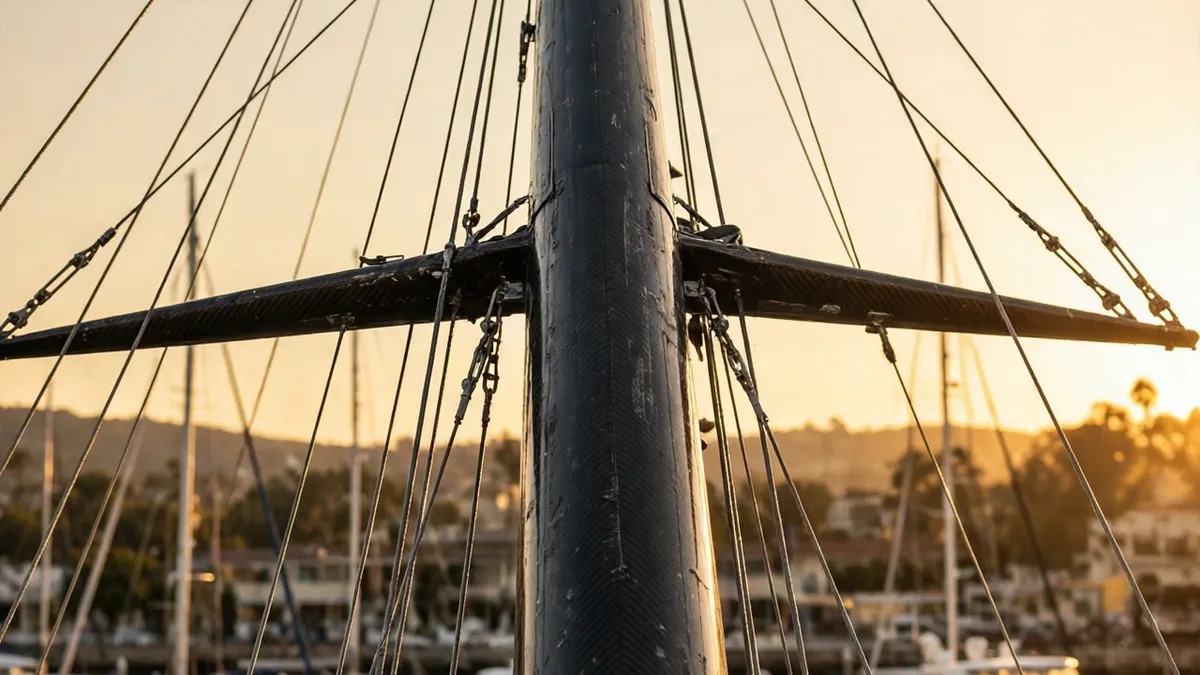
The Materials Behind the Superyacht Mast
At the heart of the mast is carbon fibre prepreg: cloth woven from carbon tows and impregnated with epoxy resin, laid up ply by ply around a mould and cured in an autoclave. Around it, the standing rigging is made from Dyneema — an ultra-strong polyethylene fibre — or from stainless steel and, on racing yachts, from PBO, a fibre stronger than steel by weight. The fittings are machined from aluminium and titanium, and the sail track is lined with low-friction materials so the sails can be raised and lowered under load. Every gram is counted, because weight aloft is the enemy of stability.
Step 1: Laying up the carbon tube
A mast begins as a mould, often a long steel or composite mandrel shaped to the mast’s tapering profile. Technicians lay carbon fibre prepreg onto it in layers, each ply turned to a different angle — some running along the mast for bending strength, some wrapped around it for crush resistance, some at 45 degrees to carry twisting loads. The layup schedule is designed by engineers and followed exactly, ply by ply, because the mast’s strength depends on fibre direction as much as on fibre quantity.
Step 2: Curing in the autoclave
Once laid up, the mast goes into an autoclave — a giant pressurised oven — where heat and pressure cure the epoxy resin and bond the plies into a single rigid tube. The temperature is controlled to the degree and the pressure to the bar, because the resin must flow just enough to fill every gap without squeezing out. When the mast comes out, it is a single piece of composite, lighter than its aluminium equivalent by as much as half, and stiffer. Ultrasound inspection checks for voids hidden inside the wall, the same way aircraft wings are checked.
Step 3: Rigging that holds the sky up
A mast cannot stand alone: it is held upright by standing rigging, the wires and ropes that run from the masthead to the deck. On modern superyachts these are often made from Dyneema, a polyethylene fibre so strong that a rope as thick as a finger can hold tens of tonnes — and it floats, does not corrode, and is far lighter than steel wire. Traditional stainless steel rod rigging is still used where durability matters more than weight. The choice of rigging decides how much the mast can bend, and therefore how the sails can be shaped. Learning how a superyacht mast works means learning the language of tension: every wire is tuned like a guitar string.

Step 4: Spreaders, fittings and titanium
The mast’s spreaders — the horizontal arms that push the rigging out sideways — are themselves made from carbon fibre, and they carry enormous compression loads. The fittings that join them to the mast are machined from aluminium or titanium: titanium where the loads are highest, because it is stronger than steel at half the weight and never corrodes in salt water. The hardware alone can cost as much as a family car.
Step 5: The sail track and the working mast
A mast is not just a pole: it has to work. Sails are raised and lowered along a track on its aft face, and that track is lined with low-friction materials so a sail weighing hundreds of kilograms can slide up fifty metres of mast without jamming. Halyards — the ropes that hoist the sails — run inside the mast, emerging through exit boxes fitted with rollers to stop them chafing on the carbon. Building the mast is one job; making it work is another, and how a superyacht mast is made covers both.
Step 6: Stepping the mast
Stepping a superyacht mast — lifting it upright and lowering it onto the boat — is a day of careful choreography. A crane lifts the mast, sometimes horizontally at first, while the crew guides it over the deck and down through the partners to its step on the keel. The rigging is attached, the mast is tuned with a tension gauge, and the bend is checked with a straight edge: a mast that is bent the wrong way will never let the sails set properly.
Step 7: Tuning and the first sail
Once stepped, the mast is tuned: the rigging is tensioned until the mast is straight and the bend matches the sailmaker’s design, and then the boat goes sailing. On the first sea trial, the crew watches the mast bend under load, checks that the rigging stays taut on the leeward side, and adjusts the tension until the sails set cleanly. The same attention to weight and structure shapes the superyacht aluminium superstructure below deck — but it is the mast, high above, that does the hardest work of all.

Superyacht Mast at a Glance
| Specification | Detail |
|---|---|
| Mast material | Carbon fibre prepreg, epoxy matrix |
| Typical height | Around 40–60 metres on a large sailing superyacht |
| Weight vs aluminium | Roughly half the weight of an aluminium mast |
| Standing rigging | Dyneema, PBO or stainless steel rod |
| Fittings | Machined aluminium and titanium |
| Curing | Autoclave, heat and pressure |
| Inspection | Ultrasound for voids in the laminate |
What Does It Cost?
A carbon fibre mast for a large sailing superyacht typically costs one to several million dollars (estimate), with the rigging adding hundreds of thousands more (estimate). The price reflects weeks of hand layup, autoclave time, titanium fittings and the sheer scale of the tooling: the mould alone can cost as much as a house. A replacement mast after a dismasting — when a rig comes down at sea — can cost even more, because the boat must be towed, the wreck cleared, and a new mast built and stepped. Owners insure the rig as a separate item, and riggers inspect it every year, because a small crack found early is a repair, while one found late is a catastrophe.
A Rare Fact
The tallest masts in the world belong to the sailing yacht A, whose three carbon masts rise around 100 metres above the water — taller than Big Ben and higher than a thirty-storey building. Yet for all their size, those masts are still lighter, relative to their height, than the wooden masts of the great sailing ships — a reminder that carbon fibre has done for masts what steel did for bridges: made the impossible ordinary.


