Every year, electric scooters get bigger batteries. The marketing tells the story: more range, more kilometres, more freedom. And every year, the scooters themselves get heavier, more expensive, and harder to carry up a flight of stairs. The case for smaller electric scooter batteries is that the industry has mistaken a number on a spec sheet for what riders actually need. Most scooter trips are short. Most riders charge at home. And most of the weight they push around every day is battery they will never use.
Think about a typical scooter journey. The average ride in a city is a few kilometres: to the station, to the office, to the shops. A battery that delivers forty kilometres of range is already more than most riders need in a day, and a battery that delivers eighty is carrying twice the cells for journeys that never happen. Those extra cells are not free. They add kilograms to a machine that a rider has to lift onto a train, carry into a flat, and fold into a hallway. They add cost to a purchase that is already a stretch for many buyers. And they add risk, because a bigger battery is a bigger fire to manage if something goes wrong. Smaller batteries are not a compromise. They are a better match for the job.

Weight is the enemy of a scooter
A scooter is supposed to be light. That is the whole point of it. It is a machine you can fold, carry, and tuck away, and every kilogram of battery takes away from that promise. A heavy scooter is a scooter that stays on the street instead of coming indoors, a scooter that is hard for an older rider to lift, and a scooter that is miserable to carry up the steps to a flat. The irony is that the extra weight also eats into the range it was meant to provide. A heavier scooter needs more energy to move, so some of the extra battery capacity is spent carrying the battery itself. Past a certain point, adding cells is like adding fuel tanks to a car that is already towing a trailer full of fuel: the gains shrink while the burden grows.
The engineering trade is straightforward, and it is one that the rankings already hint at. A lighter scooter accelerates better, brakes shorter, and handles more neatly, and those qualities matter far more in city traffic than an extra twenty kilometres of range that the rider never uses. The best electric scooter batteries ranked show the spread clearly: the top packs are not always the biggest ones, and the ones that riders praise most are often the ones that balance capacity against weight. A battery that is small enough to keep the scooter light is a battery that makes the scooter better at everything else it does.
Swappable packs change the whole calculation
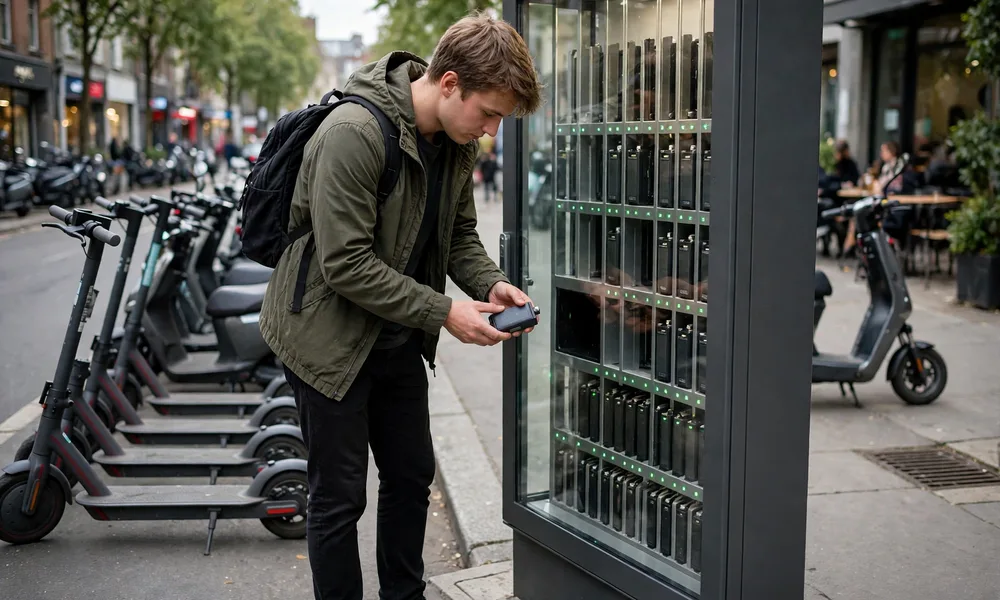
The strongest argument for smaller batteries is not about size at all. It is about swapping. A battery small enough to lift out by hand is a battery that can be swapped in seconds, and a swappable battery changes everything about how a scooter is used. A rider who runs low does not need to find a plug and wait. They swap the pack for a charged one and ride on. A rider who lives in a flat with no outdoor socket does not need to drag a whole scooter up the stairs. They carry the battery inside and charge it in the kitchen. A sharing company does not need to collect scooters from the street to charge them. It swaps the packs where they stand.
This is already how the most successful scooter systems in the world work. In cities where scooters are a real form of transport rather than a toy, the battery is a separate, swappable unit, and the scooter itself is light and simple. The model works because the battery is small enough to handle and the swap is fast enough not to matter. A giant battery bolted into the deck can never be swapped this way. It is too heavy, too hot, and too dangerous to handle casually. The choice is not between a big battery and a small battery. It is between a scooter that you charge and a scooter that you swap, and swapping only works when the battery is small.
The safety case follows the same logic. A smaller pack holds less energy, and less energy means a smaller fire if a cell fails. That is not a small consideration. Battery fires in scooters are rare, but they are frightening, and they are worse when the pack is large. A small pack is easier to design safely, easier to isolate from the rest of the machine, and easier to replace if it is damaged. The argument against giant electric scooter batteries is partly about weight and partly about this: a battery should be a component, not a hazard. Keep it small, keep it swappable, and keep it out of the headlines.
Smaller batteries make scooters cheaper and greener
Cost is the argument that should settle it. Batteries are the most expensive part of an electric scooter, and a smaller battery is a cheaper scooter. A cheaper scooter is a scooter that more people can afford, and more people on scooters means fewer people in cars. The industry has spent years trying to make scooters cheaper by cutting corners on brakes, tyres and frames, while spending more and more on the battery. That is backwards. A scooter with a modest battery and good brakes is a better machine than a scooter with a huge battery and cheap brakes, and it costs less to build. The money saved on cells can go into the parts that keep the rider safe.
None of this means range does not matter. A scooter that cannot get its rider home is a useless machine, and the smallest batteries on the market are too small for many riders. The case is not for tiny batteries. It is for right-sized ones: enough for a day of real riding, small enough to lift out by hand, and light enough that the scooter is still a scooter. The best electric scooters for commuting already show what this looks like in practice, with the most popular commuter models carrying moderate packs rather than the largest ones. Riders have voted with their wallets, and they have voted for enough, not for most.
The verdict
Electric scooter batteries should get smaller, not bigger. A smaller battery makes a scooter lighter, cheaper, safer and easier to live with, and a swappable small battery makes range anxiety disappear without adding a single cell. The industry has been selling range as if it were the only thing that matters, and riders have been paying for it in weight, cost and inconvenience.
The fix is simple, and it is already working where it has been tried. Build scooters around a small, swappable pack. Let riders carry a spare instead of carrying a dead weight. Charge the pack in the kitchen, swap it on the street, and replace it when it wears out without replacing the scooter. That is a scooter designed for the city, not for the spec sheet. The future of scooters is not a bigger battery. It is a smaller one, done properly.


