A single carbon nanotube is a sheet of carbon one atom thick, rolled into a tube so narrow that fifty thousand of them side by side would barely match the width of a human hair. By weight it is stronger than steel and stiffer than diamond, and it conducts electricity better than copper. On paper it is the most remarkable material ever discovered, the kind of thing that should have rebuilt aeroplanes, cars and bridges by now. The reason it has not is not that the material fails. It is that making enough of it, pure enough, and getting it to behave inside a real composite, is one of the hardest manufacturing problems on Earth.
Carbon nanotube composite is not a material you can order by the tonne like steel. It is grown, atom by atom, in furnaces and reactors, sorted and purified, then mixed into resins and laid into structures by hand. Turning that raw soot into a composite a jet or a race car can trust takes years of process, millions of dollars of equipment, and yields measured in grams rather than tonnes.
How Carbon Nanotube Composite Is Made
The journey starts with a catalyst, usually tiny particles of iron, cobalt or nickel, heated in a furnace with a carbon gas such as methane or ethylene. Carbon atoms from the gas assemble on the catalyst particles and grow into tubes, a process called chemical vapour deposition.
Step 1: Growing the nanotubes
The reactor runs at hundreds of degrees Celsius, and the gas, the catalyst and the temperature must be balanced precisely. Change one variable and the tubes come out shorter, dirtier or the wrong diameter. The yield of tubes good enough for structural composites is a small fraction of what the reactor makes, and the rest is waste or fit only for low-grade uses.
Step 2: Purifying the raw material
The raw powder is washed in acids to dissolve the metal catalyst, filtered, and heated to burn off the loose carbon. Each purification step removes contamination but also damages some of the good tubes, so there is a constant trade-off between purity and yield.
Step 3: Untangling and dispersing the tubes
The hardest step of all is getting the tubes apart and spread evenly through a resin. Nanotubes cling together with forces that are enormous at their scale, and a clump of tubes inside a composite is not a reinforcement, it is a flaw, a place where cracks start. Engineers use ultrasound, high-shear mixing and chemical treatments to tease the tubes apart, and then must freeze them in place before they clump again.
Step 4: Laying up the composite
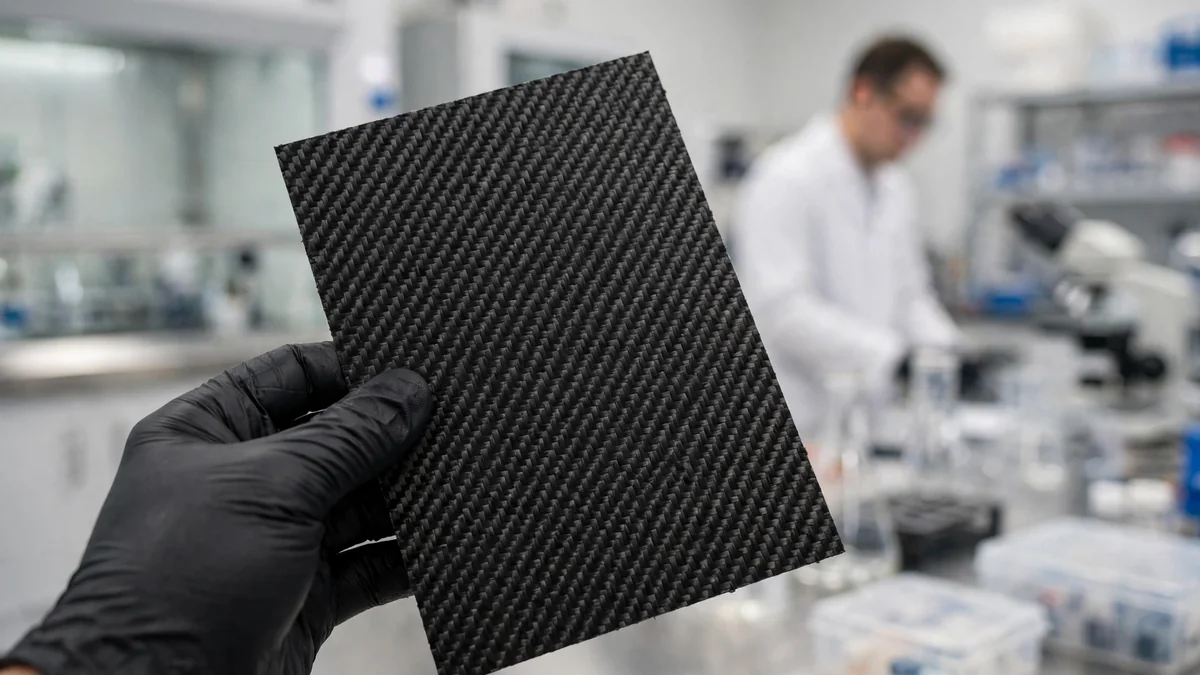
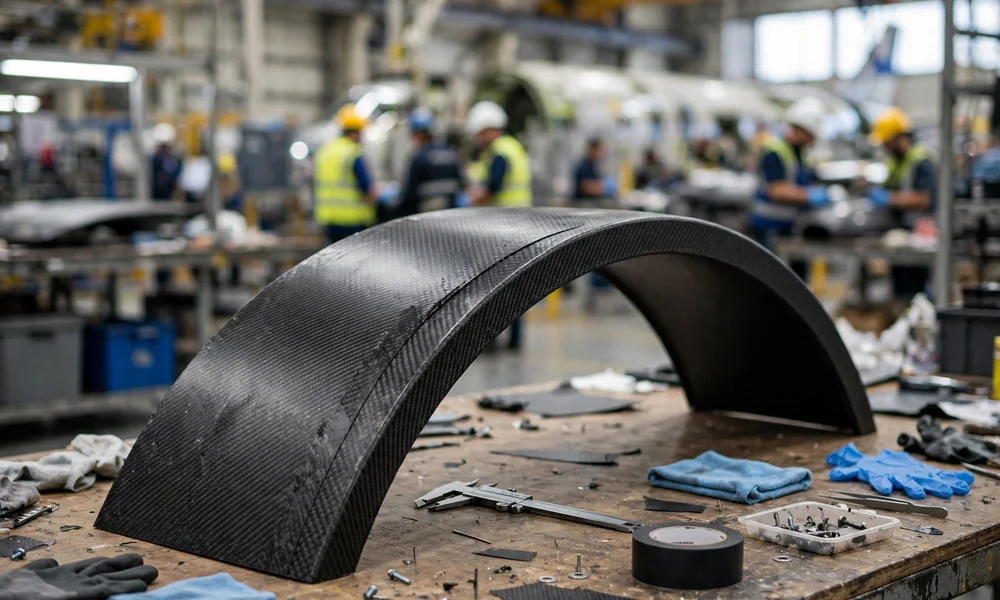
Once dispersed, the nanotube-enhanced resin is combined with carbon fibre cloth and laid into a mould, much like an ordinary carbon composite. The layup is done by hand in a clean environment, and the part is cured under heat and pressure. The closest cousin of this craft is ordinary carbon fibre, and carbon fibre weave specs show how much of the performance of any composite comes from the weave and the layup, not just the fibre itself.
Step 5: Curing under heat and pressure
The mould goes into an oven or autoclave, where heat cures the resin into a solid and pressure squeezes out voids. The cure cycle for a nanotube composite is longer and more closely monitored than for a standard composite, because the tubes can change the way heat moves through the part and create hot spots or under-cured regions. Sensors track the temperature at several points, and the cycle is adjusted for each part geometry.
Step 6: Testing what cannot be seen
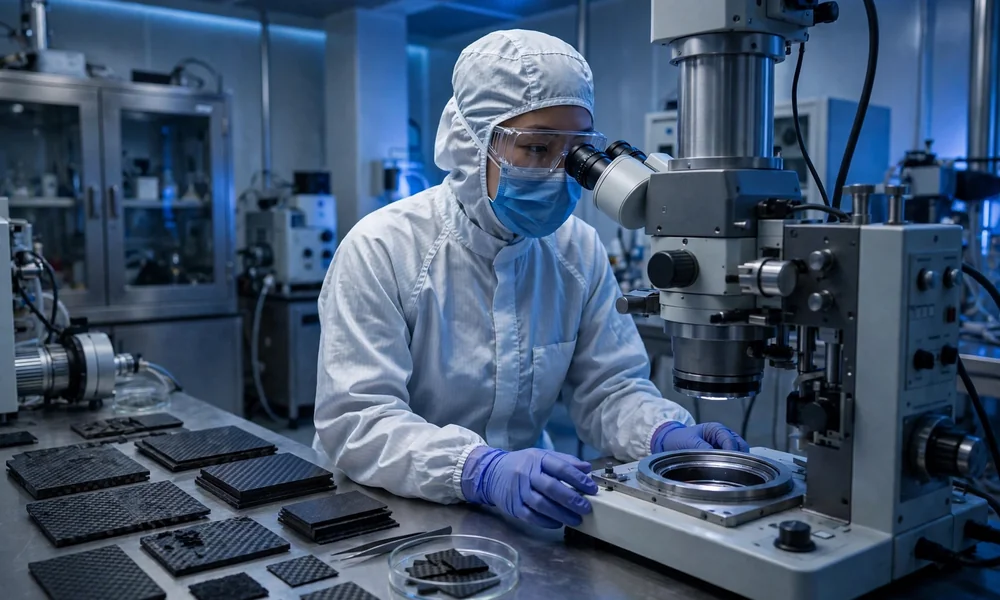
The finished part is inspected with ultrasound, X-ray or microscopy to check that the tubes are dispersed, the resin is fully cured and there are no voids. Samples from each batch are tested to destruction, pulled, bent and fatigued until they fail, so engineers know the real strength of what they made rather than the theoretical strength of a perfect tube. The material science behind that gap is laid out in the materials behind carbon nanotube composite, where the promise and the problems sit side by side.
What the Numbers Say
| Specification | Carbon nanotube composite |
|---|---|
| Tube diameter | About 1 nanometre for single-walled tubes |
| Tube tensile strength | Over 100 times stronger than steel by weight, in theory |
| Electrical conductivity | Better than copper by weight |
| Growth method | Chemical vapour deposition on a metal catalyst |
| Purification | Acid washing and heat treatment to remove catalyst |
| Key challenge | Dispersing tubes evenly without clumping |
| Production scale | Grams to kilograms of high-grade material, not tonnes |
What It Costs, and Why
High-purity carbon nanotubes have sold for an estimated $100 to $500 per gram, and a finished composite part can cost an estimated many thousands of dollars even when it is small. The money goes to the reactor time, the purification, the testing and the waste. Most of what a reactor grows never becomes a high-performance composite, and the purification steps that clean the material also destroy some of it. Then comes the dispersion, the layup and the testing, all done slowly, by specialists, in small batches. There is no mass market yet to spread those fixed costs across, so each part carries the full weight of the process that made it.
Nanotube composite will only beat carbon fibre where its extra performance is worth an enormous premium: a satellite part where every gram matters, a race car component, a piece of military hardware. For everything else, the cheaper material wins, and that keeps the market small, which keeps the price high. It is a circle that only a breakthrough in growing or dispersing the tubes will break. A related frontier is showing the same pattern, and how graphene composite works tells a very similar story of a wonder material waiting for manufacturing to catch up.
Why the Price Stays High
The price stays high because every stage of the process fights against scale. Growing tubes is a batch process with low yield. Purifying them destroys some of the product. Dispersing them is slow and unreliable. Laying them up demands clean rooms and skilled hands. And testing them requires destroying samples, because there is no quick way to prove that the tubes inside a finished part are doing their job. Until someone solves the dispersion problem at scale, or finds a way to grow long, aligned tubes directly into a structure, nanotube composite will remain a material for the few parts where nothing else will do.
That is not a failure. It is the normal life of a new material. Nanotubes are earlier on the same road, and the price today is the price of being early: small batches, hand work, heavy testing and a yield that would bankrupt a mass-market factory.
A Rare Fact
Carbon nanotubes are so strong and so light that engineers have seriously proposed building a space elevator from them, a cable stretching from the Earth’s surface to orbit that no other known material could support. The material that could reach space cannot yet be made long enough to cross a room.


