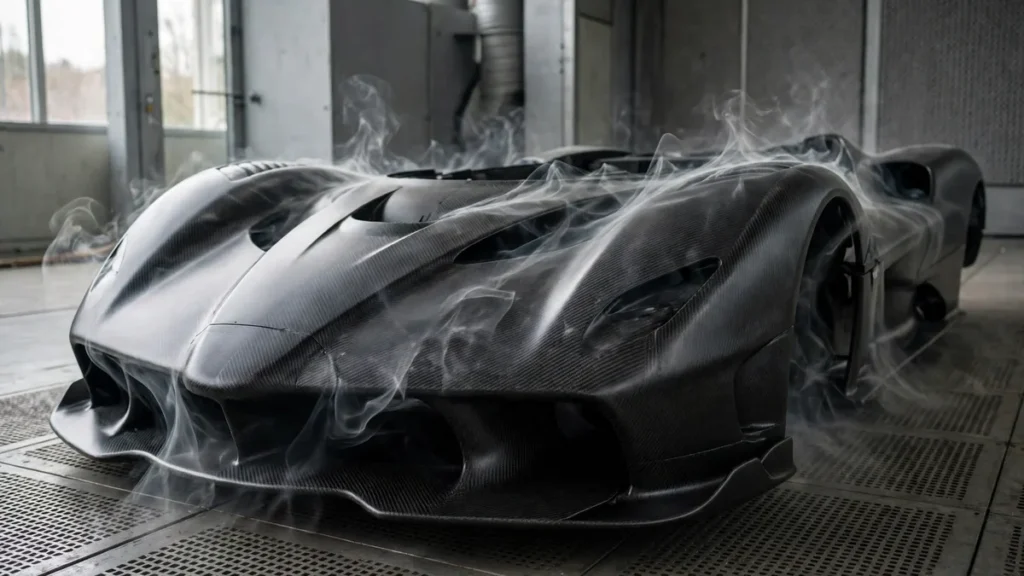
Stand in front of a bare hypercar body shell and the first thing you notice is how little of it there is. No engine, no wheels, no seats, no glass — just a black, sculpted shape on stands, light enough that two people can lift it, yet shaped by months of wind-tunnel work and hundreds of hours of hand labour. It looks like a sculpture that happens to do 350 kilometres per hour — one that must survive a crash and slice through the air.
The body of a hypercar is not a shell bolted onto a frame the way a normal car body is. In most hypercars the body is the structure — a carbon fibre monocoque carrying the engine, the suspension and the driver — and every curve does aerodynamic work. The splitter, the floor channels, the rear wing: each one presses the car into the road or lets the air slip past without drag. Shaping that surface, and building it in carbon fibre, is one of the most expensive jobs in the car industry.

Why the Hypercar Body Costs So Much
A hypercar body is expensive for the same reason a handmade suit is expensive: rare materials, slow work, and almost nothing handed to a machine. A normal car body is stamped from steel in seconds. A hypercar body is laid up by hand, cured in an oven the size of a room, and finished by people who can feel a flaw the eye cannot see. Here are the seven reasons the bill climbs so high.
Reason 1: The carbon fibre itself
Carbon fibre is the starting point, and it is not cheap. The fibre begins as a polymer thread baked until almost nothing is left but pure carbon, then woven into cloth sold by the square metre at prices that make steel look like scrap. A hypercar uses the best grades — high-modulus fibre stiffer than the cloth in a bicycle frame — and it uses a lot of it. Layer upon layer goes into the monocoque, doors, floor and wings. The raw cloth alone runs into tens of thousands of dollars (estimate) for a single car.
Reason 2: Hand layup, ply by ply
Nothing about laying up a hypercar body is fast. Skilled laminators place each sheet of carbon cloth into the mould by hand, smoothing it into every curve, making sure no air is trapped and no fibre is creased. A single body can take hundreds of hours, each ply laid at a precise angle — zero, 45 and 90 degrees — so the part is strong in every direction. A wrinkle in one ply can become a weak spot found only in testing — and then the whole part is scrapped.
Reason 3: The moulds cost more than most cars
Before a single body can be made, someone has to build the moulds — and a set for a hypercar body can cost more than a luxury saloon. Each mould is machined to tolerances measured in fractions of a millimetre, then polished until its surface is perfect, because every mark on the mould appears on the finished body. The moulds must survive repeated autoclave trips without warping, so they are engineered as carefully as the car itself. The cost only makes sense spread across a few hundred cars at most. The same discipline that shapes carbon fibre weave into body panels shapes every panel of the car.

Reason 4: Autoclave curing
Once the cloth is laid up, the mould goes into an autoclave — a giant pressurised oven — where heat and pressure cure the resin and turn soft cloth into rigid composite. A hypercar autoclave is big enough to swallow a whole body shell, and running it is enormously expensive: hours of carefully controlled heat, vacuum and pressure, monitored constantly, with one failed cycle able to ruin a part worth tens of thousands of dollars (estimate).
Reason 5: Wind tunnel time
The shape is not guessed — it is proven in the wind tunnel, and wind tunnel time is one of the most expensive commodities in motorsport. A hypercar maker may spend hundreds of hours testing scale models and full-size bodies, chasing downforce and cutting drag, shaping the floor and diffuser millimetre by millimetre. Each change means a new model, a new test, and fresh analysis. The result is a body that generates real downforce — enough that the suspension, like a hypercar suspension, must carry loads that would flatten a normal car — but the testing costs a fortune before the first customer car is built.
Reason 6: Crash testing and homologation
A hypercar body must pass the same crash tests as any road car, and passing them in carbon fibre is brutally hard. Carbon does not bend the way steel does; it holds, then fails suddenly. Engineers design crush structures into the nose and sides, and every design must be proven by destroying real cars — each worth hundreds of thousands of dollars (estimate) — in a laboratory. A failed test means a redesign, a new mould, and another car sacrificed. With production runs counted in the hundreds, every buyer is paying for the cars crashed on their behalf.
Reason 7: The finish is jewellery, not paint
The final cost hides in the finish. Many hypercar bodies are delivered with exposed carbon weave under a flawless clear coat, and achieving that takes days of sanding, polishing and inspection by hand. A speck of dust in the clear coat, a faint texture, a weave pattern a fraction off line — any of it means starting again. Painted cars are no cheaper: the paint goes on in multiple layers, polished to a depth a factory robot cannot match. It is the same obsession with the visible surface that defines cars like the Aston Martin Valkyrie, where the bodywork is as much a statement as it is engineering.

Hypercar Aerodynamic Body at a Glance
| Specification | Detail |
|---|---|
| Main material | Carbon fibre composite, high-modulus grades |
| Structure | Carbon fibre monocoque with integrated bodywork |
| Body shell weight | Typically 60–100 kg for the bare shell (estimate) |
| Manufacturing method | Hand layup, autoclave cured |
| Mould material | Machined metal or tooling board, polished |
| Curing | Autoclave, high temperature and pressure |
| Downforce at top speed | Over 1,000 kg on some models (estimate) |
| Production volume | Usually a few hundred cars, sometimes fewer |
What Does It Cost?
A replacement carbon fibre body shell for a hypercar can cost several hundred thousand dollars (estimate), and a full monocoque alone is often quoted above $200,000 (estimate) before paint, trim or fitting. The cost is not in any single item: the cloth, the moulds, the autoclave time, the wind tunnel hours, the crash-tested cars and the hand finishing each add a layer. A mass-market car spreads its tooling over a million units; a hypercar spreads it over a few hundred.
A Rare Fact
Some hypercar bodies are so light and so stiff that the finished car can generate more downforce than its own weight — which means, in theory, it could drive upside down on the ceiling of a tunnel at full speed. The maths is real: the aerodynamic shape presses the car down harder than gravity pulls it.