What a luxury hybrid car really costs is a question with two answers, and the expensive one is the honest one. The first answer is the price on the window sticker, which is higher than the petrol version of the same car by a clear margin. The second answer is everything folded into that premium: two power systems in one car, a battery that must last a decade, and engineering that has to make a petrol engine and an electric motor behave like a single machine. A buyer who understands both answers knows what they are paying for. A buyer who only reads the sticker is in for a surprise.
Hybrids are no longer a novelty, but luxury hybrids still surprise people. The technology is mature — the first hybrids are decades old — yet the luxury versions carry a premium that seems out of proportion to the fuel they save. The reason is that a luxury hybrid is not a cheap car with a battery added. It is a car built from the start to be two cars at once, and the cost of that doubling runs through every part of it.
The cost breakdown
| Cost area | Estimated share | What it covers |
|---|---|---|
| Hybrid powertrain | $8,000–$20,000 | Electric motor, inverter and power electronics |
| Battery pack | $5,000–$15,000 | Lithium-ion pack, cooling and management system |
| Engine adaptation | $3,000–$8,000 | Reworking the petrol engine for hybrid duty |
| Transmission | $4,000–$10,000 | Special gearbox blending engine and motor power |
| Software and calibration | $3,000–$7,000 | The control system deciding when each motor works |
| Base luxury car | $70,000–$120,000 | The saloon itself: body, interior, chassis |
| Testing and warranty | $2,000–$5,000 | Long-life battery testing and warranty cover |
| Typical total | $95,000–$185,000 | Estimated showroom price for the class |
The figures above are estimates for the class, not the price of any single car. They show why a luxury hybrid costs an estimated $15,000 to $40,000 more than the petrol version of the same car — the premium is the second powertrain, not a badge.
Two engines, one car
The heart of the cost is duplication. A hybrid carries a full petrol engine and a full electric drive system, and both must be engineered to luxury standards. The electric motor, the inverter that converts battery power to motor power, and the power electronics that manage the flow between them are expensive components in their own right — an estimated $8,000 to $20,000 for the set in a luxury car. They must also be packaged into a car that was designed to be quiet and smooth, which means extra insulation, extra cooling and extra work to keep the two systems from interfering with each other.
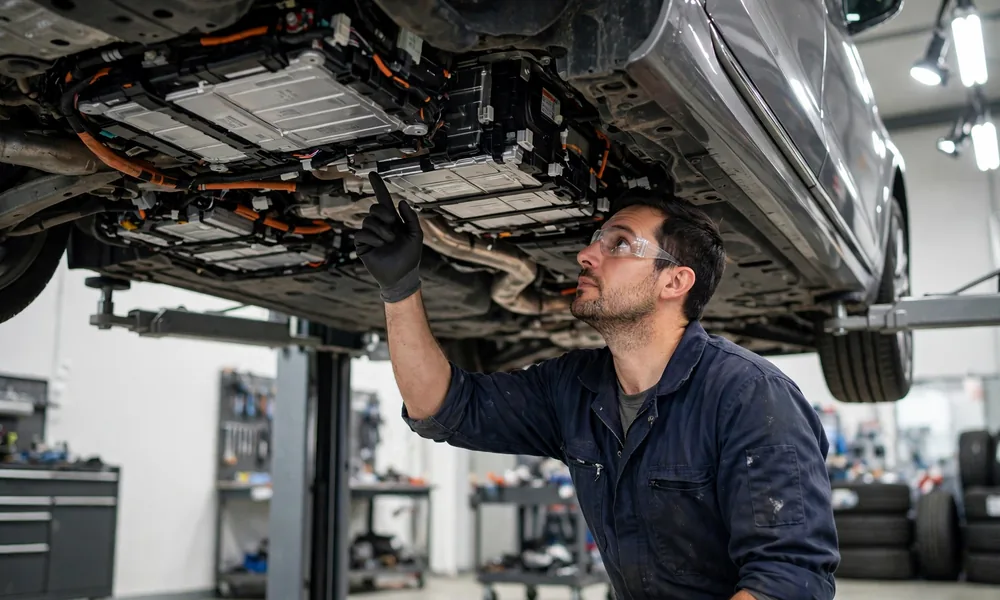
The battery is the second great cost. A luxury hybrid’s battery is smaller than a pure electric car’s — typically 10 to 20 kilowatt-hours in a plug-in hybrid, or one to two in a conventional hybrid — but it must be built to last the life of the car, through thousands of charge cycles and years of heat and vibration. The cells, the cooling system and the management electronics that protect them add an estimated $5,000 to $15,000, and the manufacturer must warranty the pack for eight to ten years. That warranty is a real cost, priced into every car, because a small number of batteries will fail and the manufacturer must replace them.
The transmission is the part buyers never think about and engineers talk about most. Blending a petrol engine and an electric motor into a single smooth drive requires a special gearbox, often a complex planetary or dual-clutch design, that can switch between power sources without a jolt. It is one of the most intricate components in any car, and it costs an estimated $4,000 to $10,000 in a luxury hybrid. Get it wrong and the car shudders every time the engine starts; get it right and the driver never notices the handover at all.
The software that makes it one car
Behind the hardware sits the software, and it is the hybrid’s secret. A control system must decide, many times a second, whether the car should run on electricity, on petrol, or on both — and it must make that decision based on speed, battery charge, temperature, the driver’s demands and the road ahead. The calibration of that system takes years of testing, because a wrong decision wastes fuel or wears the battery. The engineers who build it are specialists, and their work is part of the premium.
The petrol engine itself is also reworked for hybrid duty. It runs in a different pattern from a conventional engine, starting and stopping constantly and operating at its most efficient speeds rather than following the driver’s foot directly. That demands stronger starter systems, different cooling and an engine tuned for efficiency rather than raw power. The battery that makes it possible shares its engineering with the pure electric cars on the road, as explained in how an EV battery pack is made, and the way that battery delivers power is set out in how an EV battery pack works.

Running costs and the long payback
The premium is only half the story. A luxury hybrid typically uses 30 to 40 percent less fuel than the petrol version of the same car, which saves an estimated $1,000 to $2,500 a year for a driver covering average mileage. Over a decade that saving can cover much of the premium, and in cities with congestion charges or low-emission zones the hybrid may also save on fees. Maintenance is mixed: the brakes last longer, because regenerative braking does much of the work, but a battery replacement outside warranty is expensive — an estimated $5,000 to $10,000.
That long payback is why the luxury hybrid makes sense for some buyers and not others. A driver who covers high mileage, especially in town, will recover the premium and enjoy the quiet electric running. A driver who covers few miles on open roads will not, and would be better served by the petrol car. The same judgement applies to the most advanced cars on the road, where whole new systems are layered onto a luxury saloon, as shown in how a luxury autonomous car works.
A rare fact worth knowing
Here is the detail that even many hybrid owners miss: their car’s petrol engine may never have driven the wheels directly at all. In some luxury hybrids — the series hybrids — the engine’s only job is to generate electricity, and the wheels are always turned by the electric motor. The engine is, in effect, a small power station carried in the car, running at its most efficient speed while the electric motor does the driving. It is the quietest trick in the car world, and it is why the hybrid feels so smooth.
The hybrid was the first step toward electrification for the luxury car, and its price tells the story of that step. It costs more because it is more — two systems, one car, and a decade of engineering to make them feel like one. The premium is real, the savings are real, and the buyer who does the sums with open eyes gets a car that is quieter, cleaner and, over time, often cheaper than the petrol car it replaces.