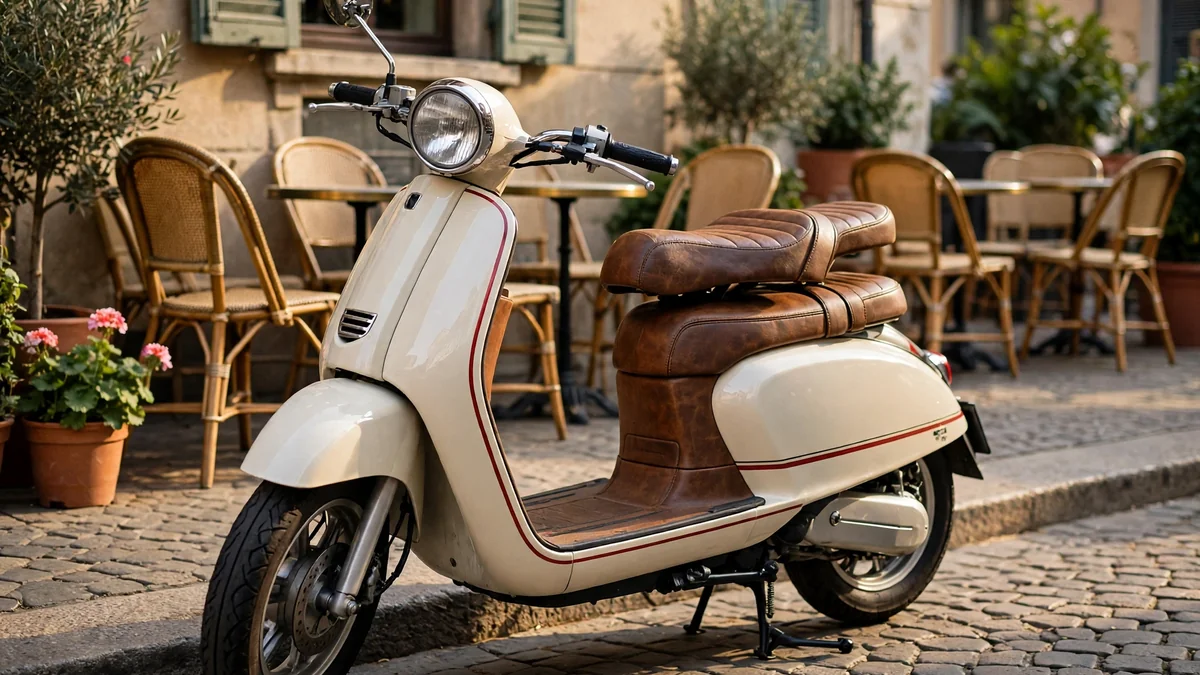
The moped is parked outside a café in Milan, and people keep stopping to look at it. It is small, barely taller than the table beside it, with a round headlamp, a stepped leather seat, and bodywork in a deep cream colour with a thin red stripe along the side. A passer-by asks the owner what it is, and the owner names the price, quietly, and the passer-by laughs, then looks at the moped again, more carefully.
The moped costs more than a large motorcycle. More than some cars. By every practical measure it is the least vehicle money can buy. And yet there is a waiting list for it, and the people on that list are not joking. They know exactly what they are buying.
The luxury moped is a strange machine, and its price is strange only until you understand what it is for. It is not transport in the ordinary sense. It is a piece of design, a piece of history, and a piece of hand craft, all in a package small enough to park in a hallway.
Why a Luxury Moped Costs So Much
The craft: a body built like a sculpture
A luxury moped is built around its bodywork, and the bodywork is where the money goes. The panels are pressed from steel, not moulded from plastic, and they are shaped, fitted, and finished by hand. The paint is applied in multiple coats, with hours of polishing between them, in a colour matched to the buyer’s choice, and the pinstripe along the side is painted by hand, in one continuous stroke, by a painter who has done it for decades. A standard moped is assembled from parts made in the millions. A luxury moped is assembled from parts made in the hundreds, fitted by people who know each machine by its number. The labour is slow, skilled, and impossible to automate, and it is the first reason for the price.
The materials: leather, chrome, and metal that lasts
The materials in a luxury moped are chosen to look good in fifty years, not just on the day of delivery. The brightwork is real chrome, plated onto steel in thick layers and polished until it reflects like a mirror, where a mass-market moped uses plastic coated in a thin metallic film that peels within a few years. The engine, whether a small petrol unit or a modern electric motor, is the least expensive part of the machine, and that is the point. The buyer is not paying for speed. They are paying for materials that age gracefully, and for a machine that will look as good in a collector’s garage in twenty years as it does today. The same logic applies to the smallest electric machines, and the way a small motor earns its keep is described in how an electric scooter motor works, where a tiny unit does a surprising amount of work.
The heritage: a design that cannot be copied
Much of the price of a luxury moped is heritage. The classic moped shape, the stepped seat, the round headlamp, the leg shield, the spare wheel on the back, was drawn in the 1950s and 1960s, and it has never been bettered. A builder who owns that design, or who has licensed it, holds something no competitor can copy without looking like a copy. Buyers pay for the shape itself, for the memory of a summer in Rome or a street in Paris, and for the knowledge that the machine they own is the real thing, not a tribute. The vintage scooter world shows the same forces at work, and why a vintage scooter costs so much follows collectors paying a fortune for machines that are slower and less practical than the cheapest modern scooter.
The rarity: tiny runs and long waiting lists
A luxury moped builder may produce 200 to 500 machines a year, across all models, and some of the most exclusive versions are limited to runs of 50 or fewer. The buyer chooses the colour, the leather, the trim, and the accessories, and the moped is built for them alone. The waiting list stretches for months, and the waiting itself becomes part of the appeal. There is no dealer holding stock, no discount at the end of the model year, and no volume production to spread the cost of the tooling. The owner knows the person who built their machine by name. In a world where most vehicles are anonymous products of a vast factory, that relationship is worth paying for, and it is something a mass-market brand cannot offer at any price.

The electric turn: small battery, large price
The newest luxury mopeds are electric, and the electric versions are often the most expensive of all. The battery is small, usually 1.5 to 3 kilowatt-hours, because the moped is light and only needs a range of 60 to 100 kilometres, but the battery is built from premium cells, managed by a sophisticated controller, and packaged in a case that fits inside the classic steel body without changing its shape. Fitting a modern electric drivetrain into a 1960s design, without a visible wire or a bulging panel, is a piece of engineering that takes years to get right. The range figures matter to the buyer, and they are explained in electric scooter range specs explained, where the numbers show how far a small battery can carry a light machine.
What Does a Luxury Moped Cost?
A luxury moped is estimated to cost roughly $10,000 to $30,000, depending on the builder, the materials, and whether the machine is new or a faithful restoration. A new machine from a boutique builder is estimated at $10,000 to $18,000, while a limited edition or a concours-level restoration of an original is estimated at $20,000 to $30,000 or beyond. The purchase price is only part of the story, because servicing by a specialist is estimated at several hundred dollars a year, the leather and chrome need regular care, and a full restoration, if the machine ever needs one, is estimated at $5,000 to $15,000.
A Rare Fact
Some luxury mopeds are built with a spare wheel mounted on the back, exactly as the originals were, even though the modern tyres almost never puncture. The spare wheel is not there because it is needed. It is there because the shape of the machine is incomplete without it, and because owners consider it the signature of the design. The wheel is a working spare, fully inflated and ready to fit, but most owners will never use it. They keep it polished, like the rest of the machine, because it is part of the look that made them buy it in the first place.
A luxury moped costs so much because it is not bought as transport. It is bought as a piece of design that happens to move, built by hand from materials that last, in numbers so small that every machine has a name attached to it. The engine is the cheapest part. Everything else is the price.