Three hundred metres down, the ocean stops being scenery and becomes a weight. Every square centimetre of a submarine’s hull carries the pressure of a column of water taller than a skyscraper, and the only thing between the crew and that weight is a steel tube a few centimetres thick. That is why a submarine pressure hull is not bought, it is earned, through years of forging, welding, testing and rejecting anything that is not perfect.
The pressure hull is the submarine. Everything else, the sail, the ballast tanks, the propeller, hangs off it or fits inside it. It has to dive deep, surface fast, and do it again and again for thirty years without the steel tiring. A submarine at depth cannot. The price of the hull reflects that difference, and it is paid in time, in testing, and in a level of craftsmanship that very few yards in the world can offer.
Why It Costs So Much
The cost of a pressure hull is not the cost of steel. It is the cost of certainty. Every plate, every weld and every ring frame has to be proven sound before the submarine ever touches water, because the first real test at depth is also the last chance to find a mistake. Six things drive the price, and the yard cannot bargain on any of them.
1. High-strength steel that few mills can make
A pressure hull is built from high-strength steel, often a quenched and tempered alloy with a yield strength far above ordinary ship plate. Only a small number of mills in the world can produce it in the thicknesses a submarine needs, and every heat is tested for strength, toughness and purity before it is accepted. Impurities that would be harmless in a bridge become a risk at depth, where a tiny flaw can grow under repeated pressure cycles. The materials behind a submarine pressure hull explain why the grade is chosen for toughness at depth rather than for raw hardness alone.
2. Forged ring frames, not bent bars
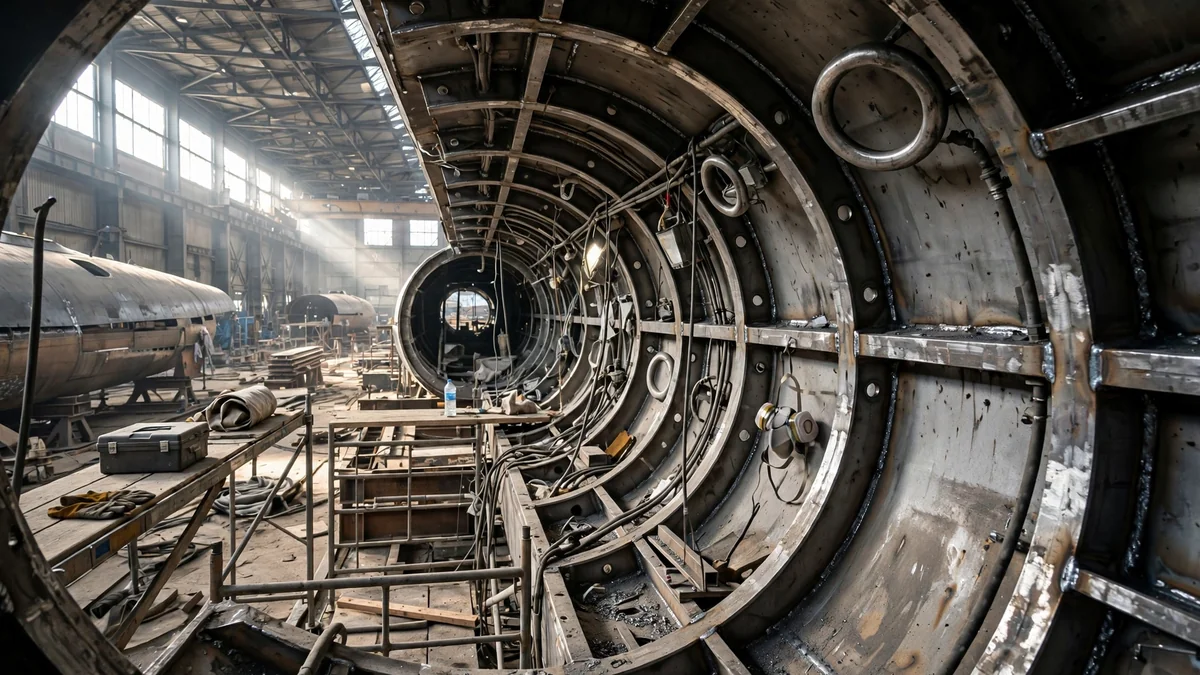
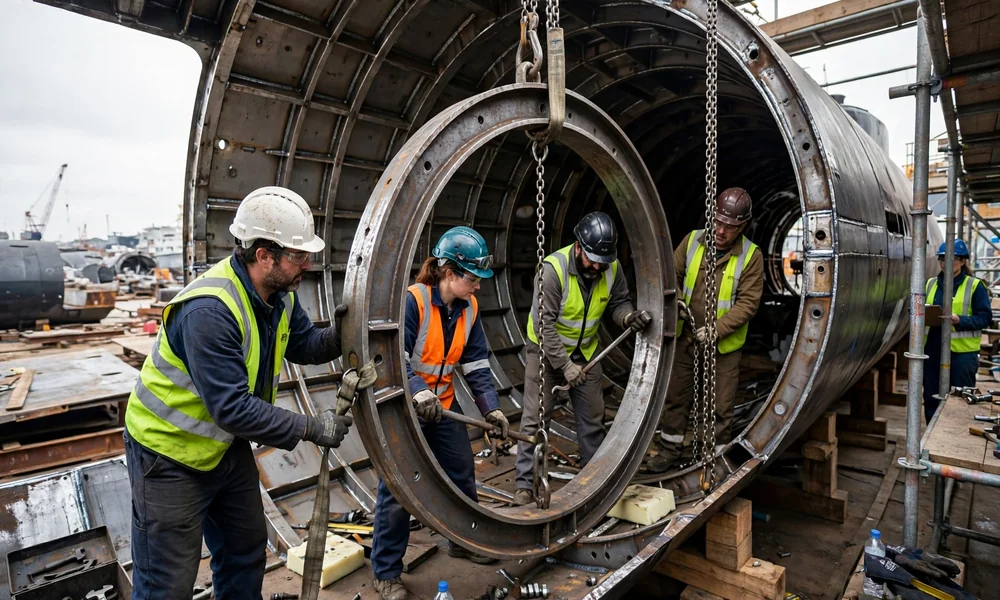
The hull is stiffened by ring frames, great circles of steel that stop the tube from collapsing inward under pressure. These rings are not bent from bar stock. They are forged, rolled and machined from thick sections, then fitted inside the hull to tolerances measured in millimetres over diameters of several metres. Each ring has to be perfectly round, because any flat spot becomes a point where the pressure concentrates.
3. Welding under rules written in lives
The welds in a pressure hull are among the most inspected joints in engineering. Welders are qualified to military standards, and every butt weld in the shell is examined by radiography and ultrasound, seam by seam, with no sampling and no shortcuts. A weld that fails is cut out and redone, and the repair is inspected again. The steel is thick, so joints are welded in many passes, with preheating and controlled cooling to prevent cracking.
4. A perfect cylinder, checked to the millimetre
A pressure hull is a cylinder because a cylinder spreads pressure evenly. But that only works if the cylinder is truly round. The yard measures the hull constantly as it is built, using laser trackers and templates, because a deviation of a few millimetres over a ten-metre diameter changes how the steel carries the load. Plates are fitted, tacked, welded and re-measured, and the hull is checked again after every major stage.
5. Pressure testing that leaves no doubt
Before a submarine dives, its hull is tested far beyond anything it will meet in service. Sections are pressure-tested in chambers, and the whole boat is taken through a carefully staged dive programme, going deeper in steps while instruments measure how the hull flexes. The steel is designed to flex slightly and spring back, and the test proves it does. The testing programme costs millions, takes months, and is the reason a submarine’s first deep dive is a formality rather than a gamble.
6. A yard that few countries possess
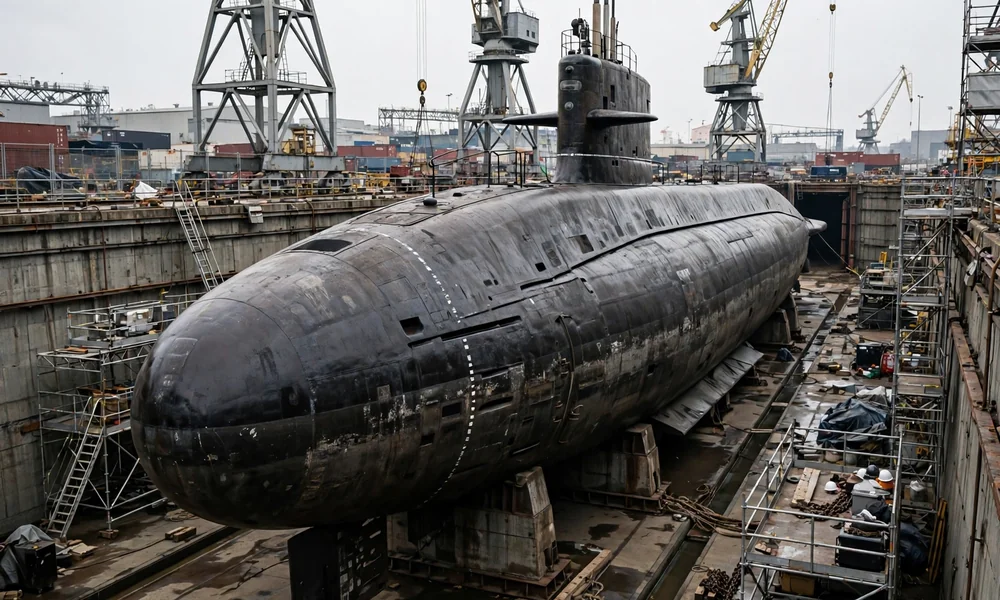
Only a handful of shipyards in the world can build a modern pressure hull, and that scarcity is part of the price. The yard needs heavy forging and rolling equipment, huge fabrication halls, deep-water access, a workforce of certified welders and fitters, and a security regime, since much of the work is classified. How a submarine pressure hull is made shows the build step by step, from plate to pressure test, inside one of those rare yards.
What the Numbers Say
| Specification | Submarine pressure hull |
|---|---|
| Hull material | High-strength quenched and tempered steel |
| Typical shell thickness | 25 to 50 mm, thicker at the frames |
| Typical hull diameter | 7 to 13 metres for a large submarine |
| Test depth | Several hundred metres, by class |
| Build time | Several years from first steel to launch |
| Weld inspection | 100 percent radiography and ultrasound of shell welds |
| Design life | Thirty years or more, with refits |
What It Costs, and Why
A pressure hull for a modern attack submarine typically costs an estimated $400 million to $800 million as part of the boat, and the hull structure alone is a large share of the submarine’s total price, which can run to several billion dollars. The figure is an estimate because submarine costs are rarely published in detail, and they vary with size, depth rating and the yard building them.
The other reason the price is high is volume. The world builds only a handful of large submarines a year, so the cost of the yard, the tooling and the specialist workforce is spread over very few hulls. There is no production line and no learning curve to exploit at scale. The titanium alternative is even rarer and costlier, and how a submarine titanium hull is made shows what happens when a navy chooses a metal that is lighter and stronger, and far harder to weld.
Why the Price Stays High
The price stays high because the requirements never relax. Every new submarine is asked to dive deeper, run quieter and last longer than the last one, and each demand pushes the steel, the welding and the testing harder. Automation helps with cutting and rolling, but the critical welds are still made by certified people, and the inspection is still done seam by seam. No navy will accept a hull built to a lower standard, because the consequence of failure is the loss of the boat and everyone aboard.
There is also no cheap substitute for the hull itself. A submarine without a pressure hull is not a submarine, and the hull cannot be bought off the shelf or imported from a general shipyard. The capability is strategic, the workforce is scarce, and the order book is measured in single boats, not hundreds.
A Rare Fact
A submarine pressure hull actually shrinks as it dives. The steel compresses measurably under the weight of the water, and the boat becomes slightly shorter and narrower at depth, then springs back to its full size when it surfaces. Crews can hear the hull working as it adjusts, a series of creaks and groans that is normal, expected, and closely watched on every dive.