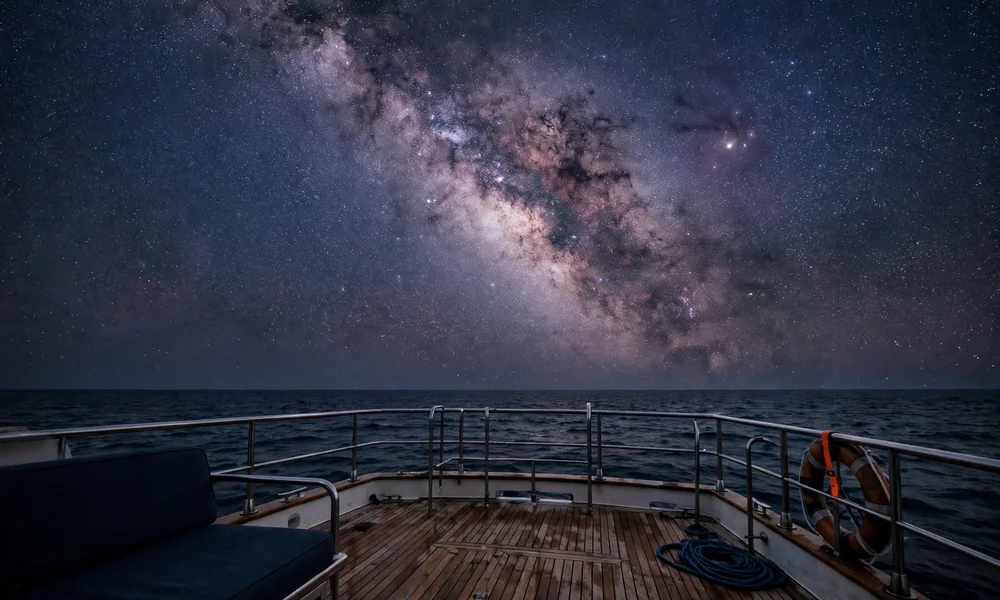
Far from land, on a clear night in the middle of the ocean, the owner of a superyacht climbs a staircase to the top deck, opens a door, and steps into a glass dome where the entire sky is overhead — the Milky Way, the constellations, the satellites drifting past. There is no light pollution, no city glow, nothing between the eye and the stars except a few centimetres of curved glass. It is the most romantic room on the sea, and it is also one of the most expensive rooms ever built on a boat: a superyacht observatory can cost as much as a house in a good neighbourhood.
An observatory on a superyacht is not a telescope on a tripod. It is a sealed glass structure built into the top of a moving ship, carrying precision optics, a rotating dome or retractable roof, and climate control that keeps the glass clear and the instruments steady while the vessel rolls in a swell. It must survive salt, storms and the flexing of a hundred-metre hull, and it must do it all while looking like it belongs on a luxury yacht.

Why It Costs So Much
A land observatory sits on bedrock and never moves. A yacht observatory sits on a ship that rolls, pitches, vibrates and flexes, in salt air, and it still has to deliver a steady view of the stars. Every part of it is engineered against that contradiction, and each solution adds cost.
Reason 1: The glass is a structural engineering problem
The dome is made from curved laminated glass panels, often several layers thick, that must carry their own weight, resist wind and waves, and stay optically clear. The glass is bent to shape in a furnace, laminated with interlayers that hold it together if it ever cracks, and coated to reduce reflections and block ultraviolet light. Building curved glass at this scale is closer to architecture than to boatbuilding, and the same glass expertise shapes the rest of the yacht, as superyacht glass production shows.
Reason 2: The telescope needs a steady platform on a moving ship
A telescope magnifies everything, including the ship’s motion, so the observatory carries a stabilised mount — gyroscopes, motors and sensors that counteract the roll and pitch of the vessel in real time. The mount must hold a heavy optical tube steady to within arc-seconds while the deck beneath it moves, and it must do so silently, without shaking the glass around it. A mount that can do this at sea is a piece of military-grade engineering dressed in yacht joinery.
Reason 3: The dome must open, close and seal perfectly
Many yacht observatories have a dome that rotates, a roof that slides open, or shutters that part to reveal the sky, and every moving part must seal watertight when closed. Salt air corrodes, sun bakes the seals, and a leak over a telescope worth hundreds of thousands of dollars is not an option. The engineering is closer to a submarine hatch than to a skylight.
Reason 4: Climate control keeps the glass clear and the optics safe
Warm, humid sea air meeting cold glass makes condensation, and condensation ruins a night of observing and can damage optics. The observatory therefore has its own climate system: dehumidifiers, gentle heating, filtered air and sensors that keep the interior a few degrees above the dew point all night. The system runs quietly, so it never disturbs the stillness of the room, and it is tied into the yacht’s wider engineering, which the superyacht engine room shows in detail.
Reason 5: The structure must carry the load without disturbing the yacht
An observatory sits at the very top of the yacht, where extra weight matters most for stability. Naval architects must design the deck and the superstructure to carry the dome, the telescope, the mount and the people who use it, without adding so much top weight that the yacht rolls badly or loses speed. The structure is often aluminium or composite, built to yacht standards but to observatory tolerances, and the whole installation is modelled and tested before a single panel is cut. The steel hull far below carries all of this, as how a superyacht steel hull is made shows.
Reason 6: The interior is finished like a luxury room
Inside, the observatory is not a laboratory but a lounge: hand-finished joinery, leather seating, soft lighting that does not ruin night vision, and a floor that stays warm underfoot. The finish is done by the same craftsmen who build the yacht’s saloons and cabins, at the same hourly cost, and the observatory is finished to the same standard as the owner’s suite.
Reason 7: Almost no one builds them, so everything is one-off
Only a handful of yachts in the world carry a true observatory, so there is no production line, no catalogue and no spare-parts shelf. The dome, the mount, the optics and the climate system are designed for one yacht, built once, installed once and tested at sea.

Specifications
| Specification | Detail |
|---|---|
| Structure | Curved laminated glass dome on a marine-grade frame |
| Telescope | Research-grade reflector or refractor, custom optics |
| Mount | Gyroscopically stabilised, counteracts roll and pitch |
| Dome movement | Rotating dome or sliding roof, watertight when closed |
| Climate control | Dehumidification, heating, filtered positive-pressure air |
| Lighting | Red night-vision-preserving lighting throughout |
| Location | Top deck, integrated into the superstructure |
| Build | One-off, designed for a single yacht |
Price
A superyacht observatory is estimated to cost roughly $1,000,000 to $3,000,000 (estimate), including the dome, the stabilised mount, the telescope and optics, the climate system and the luxury interior — with the largest installations going higher. That is the price of a house, for a single room on a boat, and it reflects the curved structural glass, the stabilised mount, the research-grade optics and the fact that everything is designed and built exactly once. Owners pay it because there is no other room on earth where you can watch the Milky Way from the middle of an empty ocean, in perfect comfort, with a telescope that holds steady while the ship moves beneath you.
Rare Fact
Some yacht observatories are fitted with telescopes powerful enough to track satellites and photograph planets, and their stabilised mounts are descended from the systems that keep naval guns and cameras steady at sea. The same technology that once aimed a warship’s weapons now holds a telescope still enough to show the rings of Saturn from a rolling deck.
That is why a superyacht observatory costs so much: it is a research observatory, a structural glass building and a luxury room, all balanced on top of a moving ship and built exactly once. The next time you look up at a washed-out city sky, imagine the same sky from the middle of the ocean, through a glass dome that cost as much as a house — and remember that the dome, the mount and the telescope are all working, quietly, to keep the stars still.


