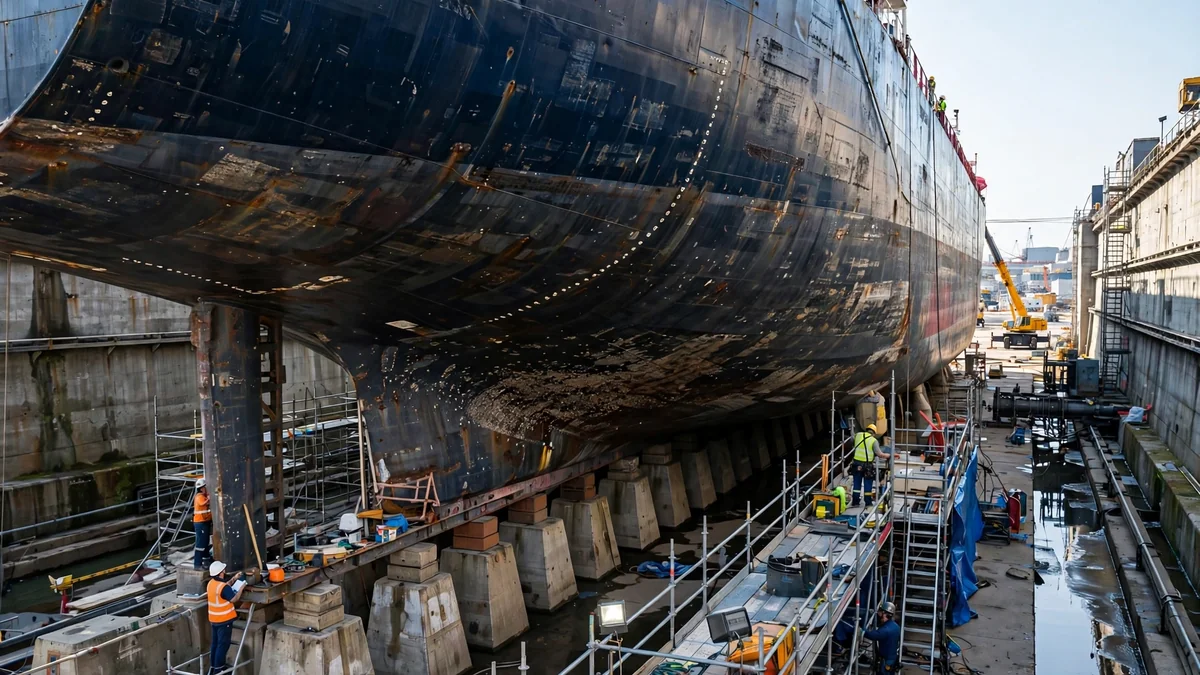
There is a moment in every big ship’s life when the sea is taken away from it. The vessel is floated into a great concrete basin, the gates close behind it, and enormous pumps begin to empty the basin of water. Hour by hour, the waterline drops down the hull, the ship settles onto rows of concrete blocks, and by the end of the day a vessel that normally lives afloat is standing in open air, its rudder, propeller and keel fully exposed for the first time in years. That basin is a dry dock, and it is one of the largest and most patient machines in the shipping world.
The Key Specifications
The first numbers are length and width. A large commercial dry dock is roughly three hundred to four hundred metres long and fifty to sixty metres wide, and both figures are estimates, because docks are built to the ships their yards expect to serve. Length is the hard limit: a ship longer than the dock simply cannot enter, so yards build their docks a little longer than the largest vessel they hope to attract. Width matters just as much, because the ship must have room for scaffolding, cranes and workers along both sides, and for the gates to close behind it.
The keel blocks are the heart of the whole operation. A ship in dry dock does not rest on the floor. It rests on rows of concrete or steel blocks, laid out in lines along the centre of the dock, with side blocks to stop it tipping. The number of blocks runs into the dozens or hundreds, and each one must be set to the exact height of the ship’s keel at that point, because the keel is not flat: it rises towards the bow and the stern. The blocks are placed according to a docking plan drawn up for that specific ship, and if one block is too high, it can push up into the hull and dent the plating.
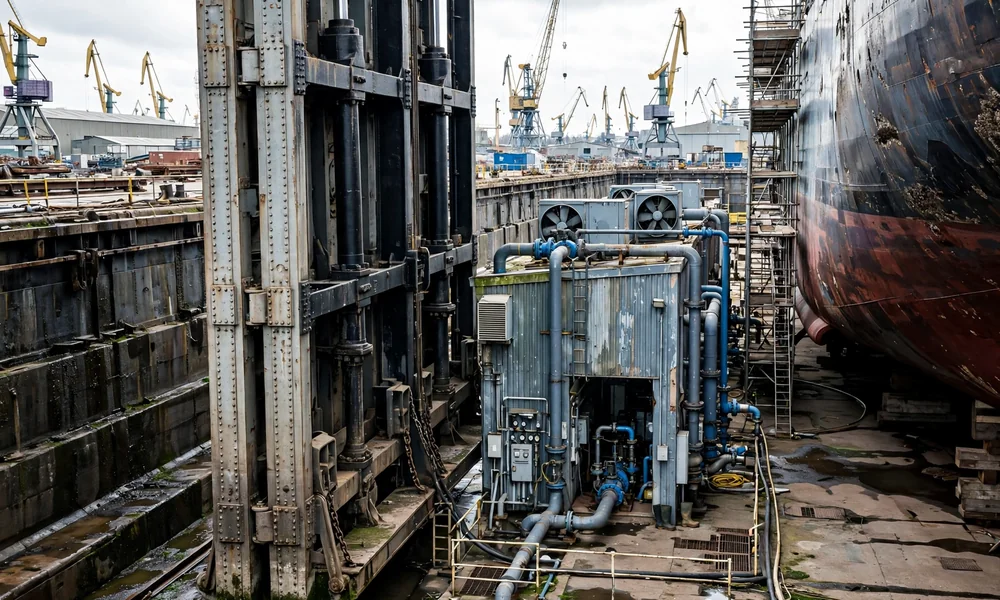
The gates and the pumps are the next numbers. The gate, often a floating steel caisson that is itself the size of a small ship, must seal the basin against the sea outside, and it can weigh hundreds of tonnes. The pumps must empty the whole basin, a volume of tens of thousands of cubic metres of water, in a matter of hours, and the pumping rate is specified in thousands of cubic metres per hour. The two work together: the gate holds the sea back, and the pumps remove the water, lowering the ship gently onto its blocks by centimetres at a time. It is slow work, and it is meant to be slow, because a ship settling too fast can shift on its blocks.
Crane capacity is the final number that shapes what a dock can do. The cranes that run along the sides of a dry dock must be able to lift propellers, rudders, anchors and sections of hull plating, loads that run to tens or even hundreds of tonnes. The cranes, the blocks, the gates and the pumps together decide what work a dock can take on, and a yard’s reputation rests on those numbers. The same heavy engineering thinking runs through the great cargo carriers themselves, as the container ship hull shows.

The Specifications at a Glance
| Specification | Typical figure | What it means |
|---|---|---|
| Dock length | 300–400 m (estimate) | Must be longer than the largest ship it serves |
| Dock width | 50–60 m (estimate) | Room for the ship plus scaffolding and cranes |
| Floor depth below waterline | Several metres (estimate) | Deep enough to float the ship in over its blocks |
| Keel blocks | Dozens to hundreds, set to the keel line | Carry the ship’s full weight in open air |
| Gate type | Floating steel caisson | Seals the basin against the sea outside |
| Pumping rate | Thousands of m³ per hour (estimate) | Empties the basin in a matter of hours |
| Crane lift capacity | Tens to hundreds of tonnes (estimate) | Lifts propellers, rudders and hull sections |
| Typical docking duration | Days to a few weeks (estimate) | Long enough for hull work, paint and repairs |
How the Specs Matter in Use
In use, the dry dock’s numbers show up as a schedule. A ship arrives, is floated in, settles onto its blocks, and is then surrounded by scaffolding, workers and cranes. The hull is washed down, often with high-pressure water that strips away years of marine growth, and then inspected plate by plate. Damaged steel is cut out and replaced, the propeller is polished or repaired, and the rudder and its bearings are checked. The ship’s underwater fittings, the parts that never see daylight between dockings, get their only attention here. The ship anchor chain may be ranged out on the dock floor and inspected link by link, a job that cannot be done properly anywhere else.
Painting is the most visible part of the work, and it is governed by the dock’s dimensions as much as by the paint itself. The whole underwater hull is repainted with antifouling paint, which discourages barnacles and weed from growing on the steel and slowing the ship down. The paint must be applied to a clean, dry surface, which is why the dock exists at all: no paint sticks to a wet hull.
Settling onto the blocks is the moment of greatest care. As the pumps lower the water, divers and surveyors watch the ship from the dockside, checking that it comes down level and lands on the centreline blocks first. If the ship lists to one side, the pumps are stopped and the balance is corrected before the water drops further. The way such a dock is put together in the first place is a story of its own, told in the account of dry dock construction and the yards that build these great basins.
A Rare Fact
Here is a detail that surprises almost everyone who first learns it: the floor of a dry dock must be almost perfectly level, and if it is not, the ship itself can bend. A hull is a flexible structure, designed to flex with the waves, and when it is held out of the water on blocks, its own weight can distort it if the blocks are not set exactly to the shape of the keel. Dockmasters measure the block heights to within millimetres, and they use the ship’s own docking plan, a drawing that shows the shape of the keel at every point along its length, to set each block.
That is the real measure of the design. The numbers in the table describe length, depth and pumping rates, but what they add up to is the only place on Earth where a ship can stand still, out of its element, and be fully seen. Below the waterline, where no passenger ever looks, is where a ship earns its living, and the dry dock is where that hidden half is cleaned, repaired and repainted. The dry dock is not glamorous, but it is essential, and every ship owes part of its life to a few weeks spent standing on blocks, waiting for the gates to open and the sea to come back in.