The electric boat motor has quietly become the most important choice on a small boat, because it decides how far you go, how fast you get there, and how much silence you get in return. The market is confusing: motors are sold by input power, by petrol equivalent, and by thrust, and a motor perfect for a tender will not push a displacement cruiser. This ranking sorts the whole field, from the smallest pod to the most powerful inboard.
We judged each motor type on real thrust and range, efficiency, reliability, ease of installation and service, noise and vibration, and how well it suits the boat it is meant for. Outboard motors alone have their own ranking; this list covers the full range of motor types, and it links to that ranking where outboards are the right answer.

How we ranked them
Real thrust comes first, because a motor’s headline number is usually its electrical input, not the power that reaches the water, and a motor that cannot hold a boat against a tide is a decoration. Efficiency comes next, since every wasted watt is range lost, and then reliability, because a motor that fails leaves a boat with no wind and no sail. Installation, noise, and service follow: the best motor is the one a local yard can fit and fix. How an electric boat motor works explains the technology behind these choices, and this ranking is about which type suits which boat.
10. The trolling motor
The trolling motor is the smallest motor on this list: a quiet, low-power unit clamped to the transom or the bow, made for creeping along a fishing spot rather than travelling. It is cheap, light, and almost silent, and for an angler it is perfect. The verdict is that it is a specialist, not a propulsion system: it will not push a loaded boat against wind or current, its range is short, and it is useless as a main motor.
9. The small pod motor
The small pod motor hangs below the hull in a streamlined casing, with the propeller directly on the motor shaft and no gearbox in between. It is efficient, quiet, and neat, and it suits tenders and small lake boats that need a little push and nothing more. The weakness is power: a small pod cannot drive a heavier boat, and because it sits below the hull it is vulnerable to grounding and weed.
8. The portable outboard motor
The portable outboard is the electric motor most people meet first: a self-contained unit that clamps to the transom, with the battery in the shaft or in a separate pack. It is the easiest motor to buy, fit, and take home for charging, and for a dinghy or a small fishing boat it is all the motor anyone needs. The best electric outboard motors, ranked covers this category in full.
7. The saildrive motor
The saildrive is the electric motor of the modern sailing yacht: a compact unit that passes through the hull and drives a folding propeller, with no shaft, no stern gland, and no alignment to maintain. It is quiet, efficient, and easy to install in a new build, and when the yacht is sailing the propeller folds away and the motor can even regenerate a little charge. The verdict is that it is excellent for its purpose and narrow outside it: it suits sailing yachts and little else, and a damaged saildrive seal is a serious job.
6. The inboard shaft motor
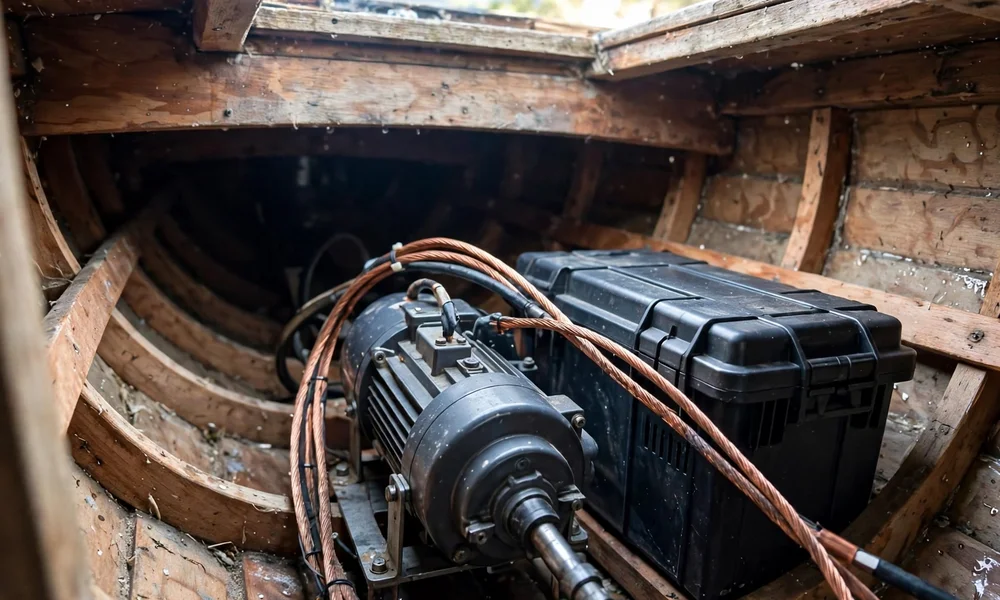
The inboard shaft motor is the traditional boat motor done electrically: a motor mounted inside the hull, driving a propeller shaft through the stern. It is the most familiar layout in boating, which means any yard can fit it and any surveyor understands it, and it scales well, from a small launch to a large cruiser. The trade-offs are the shaft itself, which needs alignment and a seal, and the space the motor takes inside the hull. The best electric boat brands, ranked covers the boats these motors go into.
5. The high-thrust outboard motor
The high-thrust outboard is the portable outboard grown up: more power, a larger propeller, and a battery big enough for a real trip. It can push a pontoon, a fishing boat, or a small cruiser at a useful speed, and it keeps the outboard’s great virtue, which is that the whole motor lifts out of the water and off the boat. The weakness is weight and cost: the bigger battery and the heavier motor need a strong transom and a strong back, and at high power the range still drops fast.
4. The integrated pod drive system
The integrated pod system pairs a pod motor with a matched battery, a joystick control, and a display, all designed to work together. It steers by rotating the pod, so the boat can move sideways and spin on the spot, which makes docking a small boat almost embarrassingly easy.
3. The electric jet drive
The electric jet drive has no propeller at all: it sucks water in and pushes it out of a nozzle at the stern, which makes it safe for swimmers, safe in shallow water, and safe from ropes and weed. It is the motor of the electric jet ski and the shallow-water launch, and it accelerates hard from a standstill. The trade-off is efficiency: a jet is thirstier than a propeller at cruising speed, and it needs clean water to work well.
2. The high-power inboard motor
The high-power inboard is the motor of the serious electric cruiser: a large, liquid-cooled unit driving a big, slow-turning propeller through a shaft, with a battery bank to match. It is the quietest powerful motor on this list, because the motor sits inside the hull and the propeller turns slowly, and it is the most reliable, because it has the fewest parts exposed to the water. It is also the most expensive and the hardest to fit, since it needs a hull designed around it.
1. The mid-power pod drive
The mid-power pod drive wins because it is the best balance of everything on this list. It is efficient, because the propeller sits directly on the motor with no shaft losses. It is quiet, because it is underwater and away from the cabin. It is easy to install, because it bolts through the hull in one unit, and easy to service, because it lifts out without disturbing the rest of the boat. It suits the widest range of boats, from day boats to cruisers, and it gives the best range for the battery. Owners who fit one rarely go back to a shaft or an outboard, because the pod does the same job with less noise, less maintenance, and more space left inside the hull. It is not the most powerful motor here, and it is not the cheapest, but for most electric boats it is the right motor, and that is why it takes first place.

The lesson of this ranking is to match the motor to the boat, not to the brochure.