There is a stretch of coastline somewhere in the world right now that did not exist last year. A new strip of land, pale sand where there was only open water. Nobody trucked that land in. A dredger made it, sucking sand and silt from the seabed miles away, pumping it through a floating pipeline, and raining it down in a slow arc until a new shore rose out of the sea. It is one of the strangest jobs in all of engineering: a ship whose cargo is the ground itself.
Dredgers are the quiet workhorses of the maritime world, and their specifications read very differently from those of a cargo ship or a yacht. A container ship is measured by how much it carries and how fast it goes. A dredger is measured by how much earth it can move, how deep it can dig, and how far it can throw what it digs up. The headline figures are hopper capacity, dredging depth, pump power, and discharge distance, and each one decides what kind of job the vessel can take on.
This guide explains the specifications of a modern luxury trailing suction hopper dredger, the largest and most capable type in service, in plain language. Luxury here means a new, high-specification vessel with the best pumps and the most precise positioning. Every number below is a decision about what the ship can do.
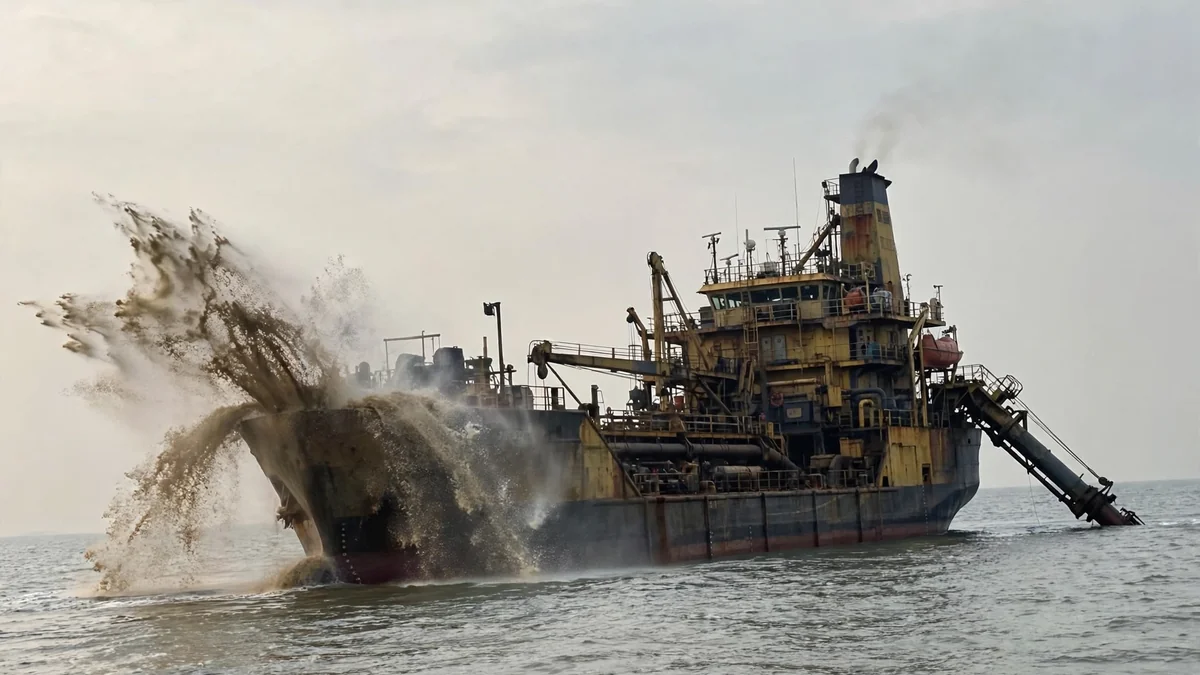
Before the numbers, it helps to picture the machine at work. The dredger lowers a drag arm the length of a city block down to the seabed, dragging a toothed head across the bottom while powerful pumps suck up a slurry of sand and water. The mixture settles in the hopper, the water spills back over the side, and the sand stays aboard. Then the ship sails to where the sand is needed and drops it through bottom doors, or pumps it ashore through a pipeline that can stretch for kilometres.
How the specifications are built into the ship
A dredger’s numbers are fixed during design and construction, driven by the pumps, the drag arms, and the hopper that dominate the vessel.
- Hull and hopper construction. The build starts with the hull and the great open hopper in its middle, a hold without a roof that will carry thousands of cubic metres of wet sand. The hopper walls are built from wear-resistant steel, because sand slurry scours everything it touches, and the bottom doors are fitted with hydraulic rams strong enough to open under a full load. The hopper’s volume is the ship’s first headline figure, fixed the day the steel is cut.
- Dredge pumps and pipework. The dredge pumps are the heart of the machine: enormous centrifugal pumps, each driven by thousands of kilowatts, that move a river of sand and water through steel pipes as wide as a doorway. The pumps sit low in the hull, close to the drag arms, and the pipe runs are lined with wear-resistant material. Pump power decides the dredging depth and the discharge distance, so the pump specification is argued over more than almost any other.
- Drag arms and drag heads. The drag arms are long steel tubes, hinged at the side of the ship, that lower the drag head to the seabed. The drag head is a toothed, jet-assisted tool that loosens the bottom so the pump can swallow it. The length of the arms sets the maximum dredging depth, and on a modern vessel they can reach down more than a hundred metres.
- Positioning and survey systems. A dredger must know exactly where it is and how deep the bottom is beneath it, to the centimetre. Satellite positioning, motion sensors, and multibeam sonar are fitted and calibrated in the yard, and the bridge is built around a dredging control room where the operator watches the drag head’s track on a chart. Precision here is a specification too: a dredger that cannot hold its line digs the wrong place.
- Discharge and rainbowing equipment. To put the sand where it belongs, the ship is fitted with a bow coupling for floating pipelines and, on the largest vessels, a rainbow nozzle that sprays sand and water in a high arc over the side.
- Trials in sand and open water. Sea trials for a dredger include real dredging: the vessel digs a test patch, loads the hopper, and measures the production rate in cubic metres per hour while surveyors check the result. If the measured production falls short of the contracted figure, the yard must fix it. Only when the pumps, the arms, and the hopper all hit their numbers does the owner take delivery.

The headline specifications
These are the figures for a representative large modern trailing suction hopper dredger, the class of vessel that builds ports, deepens channels, and creates new land.
| Specification | Figure |
|---|---|
| Length overall | About 180 metres |
| Beam (width) | About 33 metres |
| Hopper capacity | About 30,000 cubic metres |
| Maximum dredging depth | About 120 metres |
| Dredge pump power | About 20,000 kilowatts |
| Loaded speed | About 16 knots |
| Discharge distance | About 5 kilometres |
| Maximum draft | About 12 metres |
| Production rate | About 10,000 cubic metres per hour |
| Crew | About 35 people |
The figure that surprises most people is the production rate. Ten thousand cubic metres an hour means the ship can fill an Olympic swimming pool with sand roughly every fifteen minutes. The crew is small for a ship that does so much: about thirty-five people run the vessel, the pumps, and the discharge, working in shifts around the clock.
What a dredger like this costs
A new large trailing suction hopper dredger costs an estimated $180 million to $250 million to build, and that figure is an estimate that moves with steel prices, pump availability, and the order book at the specialist yards that build these vessels. The real economics live in the day rate: a large dredger on charter can earn hundreds of thousands of dollars a day, and a single land-reclamation contract can run into the billions. That is why the specifications are fought over so hard. To see how the machine is put together, how a luxury dredger is made follows the build from first steel to launch, and why a luxury dredger is so expensive breaks down where the money goes.

A rare fact worth knowing
Here is a fact that catches almost everyone out: some of the world’s most famous new land was built by dredgers, including whole districts of coastal cities and entire artificial islands that now hold hotels, airports, and neighbourhoods. A single large dredger can move more earth in a week than a fleet of a thousand dump trucks could move in a year, and it does it while floating, with a crew smaller than a village football team. The sand is strangely precious too: desert sand is too smooth for building, so the rough grains of the seabed are prized.
Read the spec sheet of a dredger and you are reading a promise about reshaping the coast. Hopper capacity says how much land it can carry, dredging depth says how deep it can reach, and pump power says how fast it can work. For a look at the other side of the work, the place where great ships are opened up and repaired, how a ship dry dock is made shows the giant basins that make all of this possible.


