Inside a jet engine, a turbine blade spins in gas hotter than the melting point of the metal it is made from. For decades, engineers kept those blades alive with cooling air and coatings that burned away a little on every flight. Then a new material arrived that did not need to be cooled quite so desperately, because it was already a ceramic — a material that expects to live in fire. That material is the ceramic matrix composite, and it is quietly changing what engines, brakes and spacecraft can survive.
A ceramic matrix composite, or CMC, is exactly what its name suggests: ceramic fibres held inside a ceramic matrix. On its own, a ceramic is hard, heat-proof and brittle — drop a plate and it shatters. But weave ceramic fibres into a ceramic body and something remarkable happens. The fibres bridge cracks as they form, the material bends a fraction instead of shattering, and it keeps its strength at temperatures where the best superalloys are turning soft.

The Materials Behind the Ceramic Matrix Composite
Every CMC is a partnership between two ceramics: the fibres that carry the load and the matrix that holds them in place and shields them from the environment. The fibres are usually silicon carbide, a compound of silicon and carbon that is almost as hard as diamond and stable to extraordinary temperatures. The matrix is often silicon carbide too, or alumina, or a glass-ceramic, chosen to match the fibres so the two expand together when heated instead of tearing each other apart.
Step 1: Silicon carbide fibres
The fibres are the soul of the composite. Silicon carbide fibres are made by spinning a polymer precursor into a thread, then heating it until the polymer converts into ceramic, a process not unlike the way carbon fibre is born from acrylic. The resulting filaments are a fraction of a millimetre thick, stiff, and able to carry enormous tension at temperatures above 1,200 degrees Celsius. They arrive on spools as continuous tows, and they are woven into cloth on looms adapted from the textile industry, in patterns — plain, twill, satin — that echo the woven cloth of a carbon fibre weave, but made from a material that laughs at heat.
Step 2: The matrix that holds it together
The matrix is the ceramic that fills the gaps between the fibres, locking the weave into a solid part and protecting the fibres from hot gas, oxidation and erosion. In the most common aerospace CMCs the matrix is silicon carbide itself, which matches the fibres almost perfectly: both expand at the same rate when heated, so the part does not crack itself apart as it warms. In other CMCs the matrix is alumina, an oxide ceramic that resists oxidation even better but is heavier and less stiff, or a glass-ceramic that can be shaped at lower temperatures.

Step 3: The interphase — a coating thinner than a hair
Between fibre and matrix sits the interphase, a coating of boron nitride or carbon only a few hundred nanometres thick, and it is the most important layer in the whole composite. Without it, a crack in the matrix would slice straight through the fibres and the part would fail like a dropped plate. With it, the crack reaches the coating and is deflected along the fibre instead, the fibres pull out slightly, and the material absorbs energy instead of shattering. That controlled debonding is what gives a CMC its toughness. Applying the coating evenly to kilometres of fibre is one of the hardest steps in the whole process.
Step 4: Weaving, layup and shaping
Before any ceramic exists, the part is shaped as cloth. Silicon carbide fibre tows are woven into fabric, cut into plies, and laid into a mould in the orientation the loads demand — fibres along the blade’s length where tension is highest, angled plies where twisting matters. The shaped preform is fragile at this stage, a dry skeleton of ceramic cloth that can be dented by a careless finger, and it is handled with the same care as a carbon nanotube composite preform in a research lab: gloves, clean air, no contamination, because anything trapped inside becomes a flaw that heat will find.
Step 5: Infiltration — turning cloth into ceramic
The preform becomes a solid part by infiltration, and there are three main ways to do it. Chemical vapour infiltration sends silicon-bearing gas through the preform at high temperature, depositing silicon carbide layer by layer inside every pore — slow, taking days or weeks, but producing a very pure matrix. Polymer infiltration and pyrolysis soaks the cloth in a liquid polymer, then bakes it until the polymer turns to ceramic, repeating the cycle several times to fill the pores. Melt infiltration floods the preform with molten silicon, which reacts with carbon to form silicon carbide in place.
Step 6: Machining with diamond and inspection
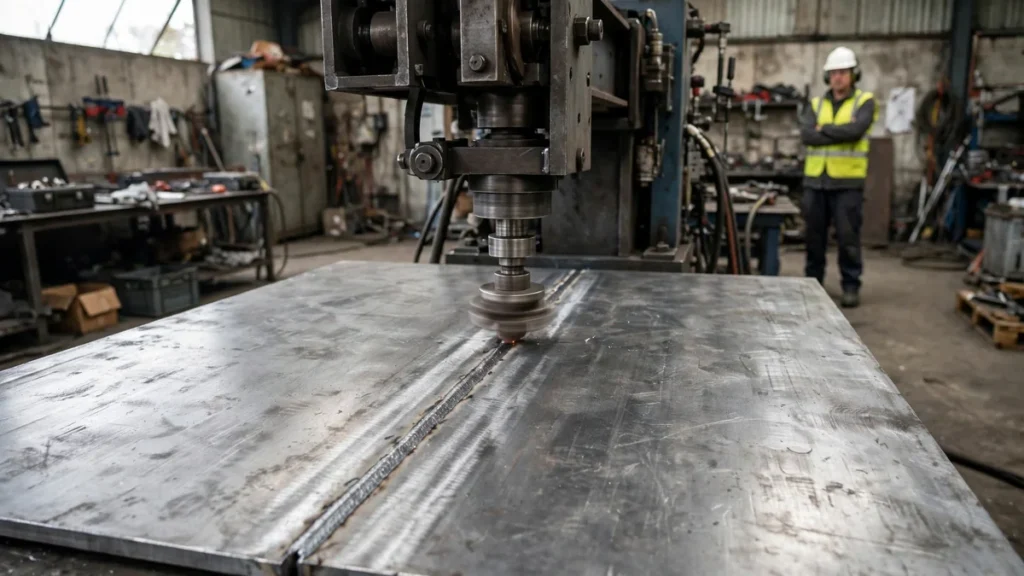
A finished CMC is harder than almost any cutting tool, so it is machined with diamond grinding wheels, slowly, with coolant, because a conventional cutter would simply wear away. Holes are drilled with diamond bits or laser ablation, and every edge is inspected, because a chipped edge in a ceramic is a crack waiting to grow. Parts are checked with X-ray tomography and ultrasound, the same discipline that keeps a carbon-ceramic brake disc trustworthy at racing speeds. Only when the scans are clean does a CMC blade earn its place inside an engine, where it will run hotter, lighter and longer than the metal it replaced.

Ceramic Matrix Composite at a Glance
| Specification | Detail |
|---|---|
| Main fibre | Silicon carbide (SiC), continuous tows |
| Common matrices | Silicon carbide, alumina, glass-ceramic |
| Interphase coating | Boron nitride or carbon, nanometres thick |
| Maximum use temperature | About 1,200–1,400°C, depending on type |
| Density | About 2–3 g/cm³, roughly a third of nickel superalloy |
| Key processes | Chemical vapour infiltration, polymer infiltration, melt infiltration |
| Main uses | Jet engine turbine parts, rocket nozzles, brake discs, heat shields |
What Does It Cost?
Ceramic matrix composites are among the most expensive structural materials in regular use. Silicon carbide fibre alone costs hundreds of dollars per kilogram (estimate), and a finished CMC turbine component can cost tens of thousands of dollars (estimate) once weaving, coating, weeks of infiltration and diamond machining are counted. A full set of CMC parts for one jet engine runs into hundreds of thousands of dollars (estimate). The economics only work where the payoff is large: an engine that runs hotter burns less fuel, and a few percent of fuel saved across a fleet pays for a great deal of ceramic.
A Rare Fact
A ceramic matrix composite can survive temperatures that would melt the superalloy it replaces, yet it is so sensitive to a single hard knock that a dropped turbine blade is often scrapped outright — not because it is cracked, but because nobody can prove it is not. The material that shrugs off a 1,300-degree gas stream can be quietly damaged by a bump on a workbench, since the interphase that gives it toughness can debond invisibly inside. The inspection regime — X-ray tomography of every flight-critical part — exists because the most heat-proof material in aviation is also one of the hardest to trust after a fall.