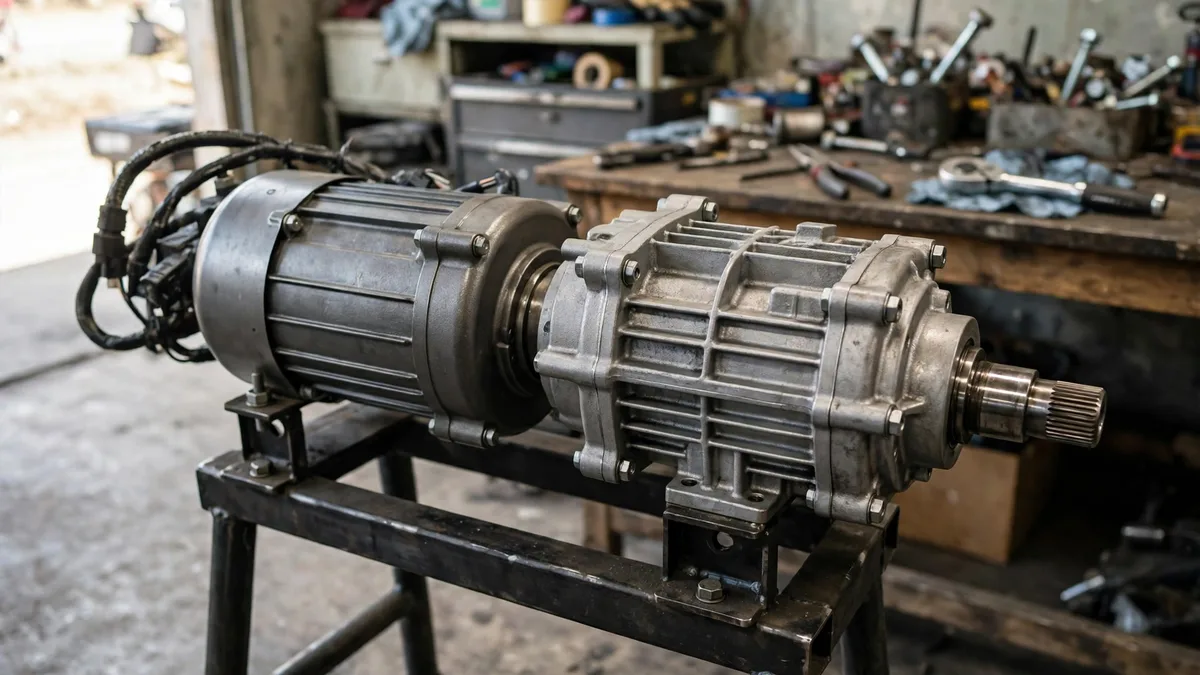
Look underneath a modern electric car and you will notice something strange: there is almost nothing there. No exhaust pipe, no gearbox the size of a suitcase, no driveshaft running down the middle of the car. Instead, tucked between the rear wheels, sits a single compact unit about the size of a large watermelon — the electric axle. Inside it are a motor, a gearbox and the electronics that drive them, all sharing one housing, one cooling system and one job: turning battery power into motion, instantly and silently. It looks simple. It is anything but, and it is one of the most expensive parts of the car.
The electric axle — engineers call it an e-axle — replaced a century of separate parts. In a petrol car, the engine, the gearbox and the differential are three different assemblies, each with its own housing, its own oil and its own factory. In an electric car, all three jobs are squeezed into one unit that must spin at up to 20,000 revolutions per minute, survive potholes and winter salt, and last the life of the car without a service.
Inside the EV Axle: Why It Costs a Fortune
The e-axle is expensive because it packs three systems into one housing and asks each of them to work harder than it ever did on its own. Six reasons explain the cost.
1. The motor spins faster than a jet engine’s fan
The electric motor inside an e-axle spins at up to 20,000 rpm — roughly three times faster than a petrol engine ever revs. At that speed, the rotor is a blur, and the forces trying to tear it apart are enormous. The rotor is built from laminated steel and copper, balanced to a fraction of a gram, and often wrapped in a carbon-fibre sleeve to stop it flying apart. The magnets inside are rare-earth neodymium, and they must survive temperatures that would demagnetise a cheaper magnet.
2. The gearbox is small, quiet and under huge load
The motor’s speed has to be reduced before it reaches the wheels — from 20,000 rpm down to a few hundred — and that job falls to a gearbox no bigger than a shoebox. Its gears are cut to tolerances measured in microns, hardened to survive enormous torque, and designed to run almost silently, because there is no engine noise to hide behind. A whine or a clunk in an electric car is instantly obvious to the driver, so the gears are ground, polished and matched in sets.
3. The power electronics are a computer that handles lightning
Between the battery and the motor sits the inverter, a set of silicon-carbide switches that turn the battery’s direct current into the alternating current the motor needs — thousands of times a second, at hundreds of volts and hundreds of amps. Silicon carbide is a semiconductor material that can switch faster and run hotter than ordinary silicon, but the wafers it is grown on are expensive, the chips are hard to make, and only a few factories in the world produce them in volume. The inverter is the most expensive electronic part of the car after the battery, and it lives inside the same housing as the motor, sharing its cooling.
4. Cooling is a system in itself
An e-axle makes heat — a lot of it — in a very small space. The motor, the gearbox and the inverter all need cooling, and they need it from the same circuit, because there is no room for three separate systems. The housing is cast with cooling channels, the oil is pumped through the motor itself, and the whole unit is sealed against water and dust.
5. Everything is sealed for life
An e-axle is designed to last the life of the car with no servicing. There is no oil change, no filter to replace, no adjustment to make. That means every seal, every bearing and every electrical connection inside it must survive a decade or more of heat, vibration, water and salt without failing. The bearings are special low-friction designs, the seals are multi-layer, and the high-voltage connectors are built to stay watertight even when submerged. Building something to never need opening again is far harder — and more expensive — than building something a mechanic can fix. The EV electric axle specifications show just how tightly every part of the unit is packed.
6. Only a few suppliers can build them at scale
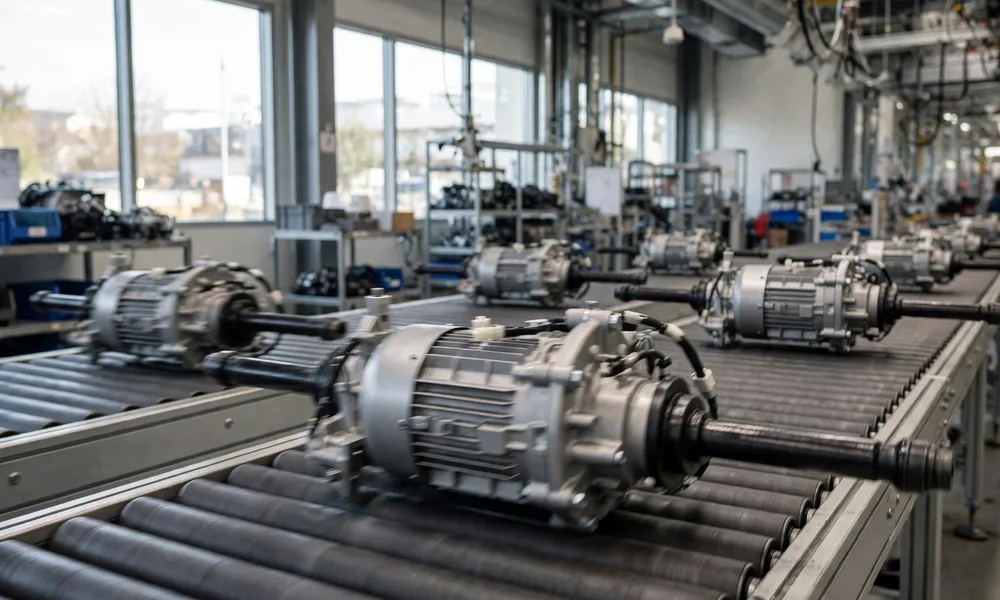
The e-axle is so integrated that most car makers buy it as a complete unit from a specialist supplier rather than building it themselves. Only a handful of suppliers in the world can make e-axles in the millions, and each one guards its designs closely. The tooling — the casting moulds, the winding machines, the test rigs — costs hundreds of millions of pounds, and it is spread across production runs that are still small compared with a century of petrol gearboxes. The way the EV electric axle works explains why so few companies can build one well.
EV Electric Axle at a Glance
| Specification | Typical value |
|---|---|
| Motor speed | Up to 20,000 rpm |
| Power output | 150–400 kW (200–540 hp) |
| Torque | 300–500 Nm at the motor |
| Gear ratio | About 8:1 to 12:1 reduction |
| Inverter material | Silicon carbide (SiC) |
| Voltage | 400 V or 800 V |
| Weight | 70–120 kg complete |
| Cooling | Shared oil and water circuit |
| Service interval | Sealed for life |
How Much Does an EV Electric Axle Cost?
As an estimate, a complete e-axle for a mainstream electric car costs the manufacturer roughly £1,500 to £3,000, while a high-performance unit with silicon-carbide electronics and a 800-volt system is estimated at roughly £3,500 to £6,000. That is more than a petrol engine and gearbox combined in many cars — and it is the second most expensive part of the vehicle after the battery. The price is falling as volumes rise and silicon carbide gets cheaper, but the engineering inside will keep it a premium part for years. The battery is the other half of the story: the Rimac Nevera battery shows how much the energy side of an electric car costs to build.

A Rare Fact
An e-axle can spin its motor backwards to brake the car — a trick called regenerative braking — and in doing so it turns the motor into a generator that pushes electricity back into the battery. In city driving, this can recover as much as a fifth of the energy the car uses, and it means the brake pads on an electric car can last more than 150,000 kilometres, because the motor does most of the braking. The same unit that launches the car silently to motorway speed is also its most important brake — a piece of engineering that a petrol car needs three separate systems to match.


