Far below the surface, a submarine listens. Its own hull is noisy — pumps hum, crew move about, water rushes past steel — and the faint sounds it hunts for, the distant thrum of another vessel or the whisper of a current over a ridge, can be drowned out by its own machinery. So the submarine does something clever: it trails its ears behind it, hundreds of metres back, on a long cable that floats in quiet water far from the boat’s own noise. That cable, studded with listening devices, is the towed array, and it is one of the most delicate pieces of engineering ever put to sea.
A towed array looks unremarkable on a workbench — a thick black hose, a few centimetres across, coiled on a drum like an oversized garden hose. Building one means joining the skills of a cable factory, an electronics lab, and a shipyard, and getting every joint right, because a single leak at depth can silence the whole array.
This is how that quiet cable is made, from the first strand of fibre to the moment it slides into the water behind a submarine.

How a Towed Array Is Made
The work begins not with electronics but with strength. At the centre of the array runs a strength member, usually made from braided aramid or high-strength synthetic fibre, sometimes with a steel core. It has to carry the full towing load — the drag of hundreds of metres of cable moving through water — without stretching, because any stretch would change the spacing between the hydrophones and blur the listening picture. The fibres are braided on a large braiding machine into a tight, even rope.
1. Building the hydrophone modules
Each hydrophone starts as a small ceramic disc or cylinder, a piezoelectric element that turns tiny pressure changes in the water into tiny electrical signals. The ceramics are cut, polished, and poled — given a permanent electric charge by a high voltage — in a clean, quiet laboratory, because dust or a fingerprint can spoil the sensitivity. Technicians then solder hair-fine wires to each element by hand under a microscope, pot the assembly in a soft polymer that couples sound from the water into the ceramic, and test it in a water tank against a known sound source. Only modules that pass move on to the next stage.

2. Wiring the listening chain
The hydrophones are spaced along the cable at precise intervals, often a metre or more apart, and each one is wired into the array’s electrical core. Some arrays carry a separate wire for every hydrophone; others digitise the signal inside the module itself and send the data down a shared digital line, which keeps the cable thinner. Splices are sealed with heat-shrink sleeves and waterproof compounds, then checked for insulation resistance, because salt water finding a single bare wire would short out a whole section.
3. Filling and sheathing the hose
Once the modules and wires are in place, the whole assembly is pulled into its outer hose, a tough polyurethane tube chosen for flexibility, abrasion resistance, and neutral buoyancy. The space inside the hose is filled with a special oil or gel that carries sound cleanly to the hydrophones and keeps water out if the outer skin is nicked. The hose is then sealed at both ends with moulded terminations, pressure-tested in a chamber that mimics the deep sea, and checked for leaks with a fine-toothed comb of electrical and acoustic tests.
4. Making the tow cable and the drogue
The listening section is only part of the system. Ahead of it runs a tow cable, a heavy armoured line that takes the strain and carries the signal back to the submarine, and behind it trails a drogue — a small drag device that keeps the array straight and steady in the water, like the tail of a kite. The tow cable is built in a cable factory, with layers of steel wire armour wound over a fibre core, and its electrical conductors are twisted in pairs to cut interference. The drogue is tuned carefully: too much drag and the array tows too deep, too little and it snakes and tangles.
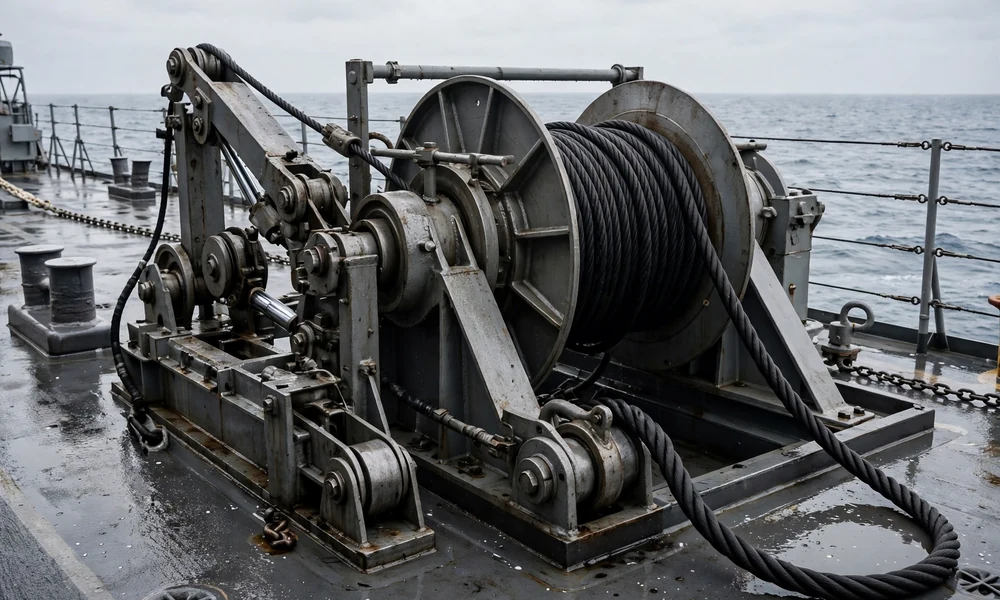
5. The handling system and the winch
On the submarine itself, the array lives on a large winch in the stern, inside a protective housing. The winch drum is built from welded steel, machined true, and fitted with a level-wind mechanism that lays the cable evenly as it comes in — a kinked or crossed cable is a damaged cable. Hydraulic motors drive the drum, and a slip-ring assembly at its centre passes the electrical signals from the spinning drum to the submarine’s fixed wiring. The handling system is tested on land with a dummy cable before it is ever fitted to a boat.
6. Testing, calibration, and sea trials
The finished array is tested as a system before it goes to sea. It is towed in a test tank or a quiet stretch of water, its hydrophones compared against reference sensors, and its beam pattern — the directions it hears best — is mapped and recorded. Technicians check the noise floor, the towing behaviour at different speeds, and the way the array streams at depth. Only when it hears cleanly and streams straight is it signed off and shipped to the yard. The same care that shapes a container ship hull goes into this far smaller, far quieter piece of kit, and the sea trial is the final exam: the submarine deploys the array, listens, and the crew check that the distant sounds they expect are really there.
Towed Array Specifications
| Feature | Typical Value |
|---|---|
| Overall length | 200–800 metres of listening section |
| Diameter | 50–90 millimetres |
| Hydrophone count | 40–100+ modules per array |
| Operating depth | Up to 400 metres or more |
| Strength member | Braided aramid fibre, sometimes steel-cored |
| Outer sheath | Polyurethane, oil-filled |
| Tow speed | Typically 4–12 knots while streaming |
| Weight in air | Several tonnes including tow cable and winch |
Those numbers vary between designs, but the pattern is the same: a long, thin, quiet ear, built to survive being dragged through the sea for years. The engineering overlaps with the work behind a deep-sea submersible, where pressure and sealing matter just as much.
What a Towed Array Costs
A full towed array system — the array itself, the tow cable, the winch and handling gear, and the processing electronics inside the submarine — is a major piece of naval equipment. As an estimate, a single system can cost several million dollars, with the array section alone running into the high hundreds of thousands, depending on length, hydrophone count, and depth rating. The price reflects hand-built modules, precision testing, and tiny production runs. Like the steelwork of an aircraft carrier flight deck, it is priced by skilled labour and the cost of getting it exactly right.
A Rare Fact
Here is something few people outside the submarine world know: a towed array can be so sensitive that it picks up the sound of its own towing submarine’s propeller reflected off the seabed, and operators learn to recognise their own boat’s echo among the noise. Early crews sometimes mistook that echo for another vessel trailing them. The fix was better training — a reminder that the quietest ear in the ocean still needs a human brain behind it.


