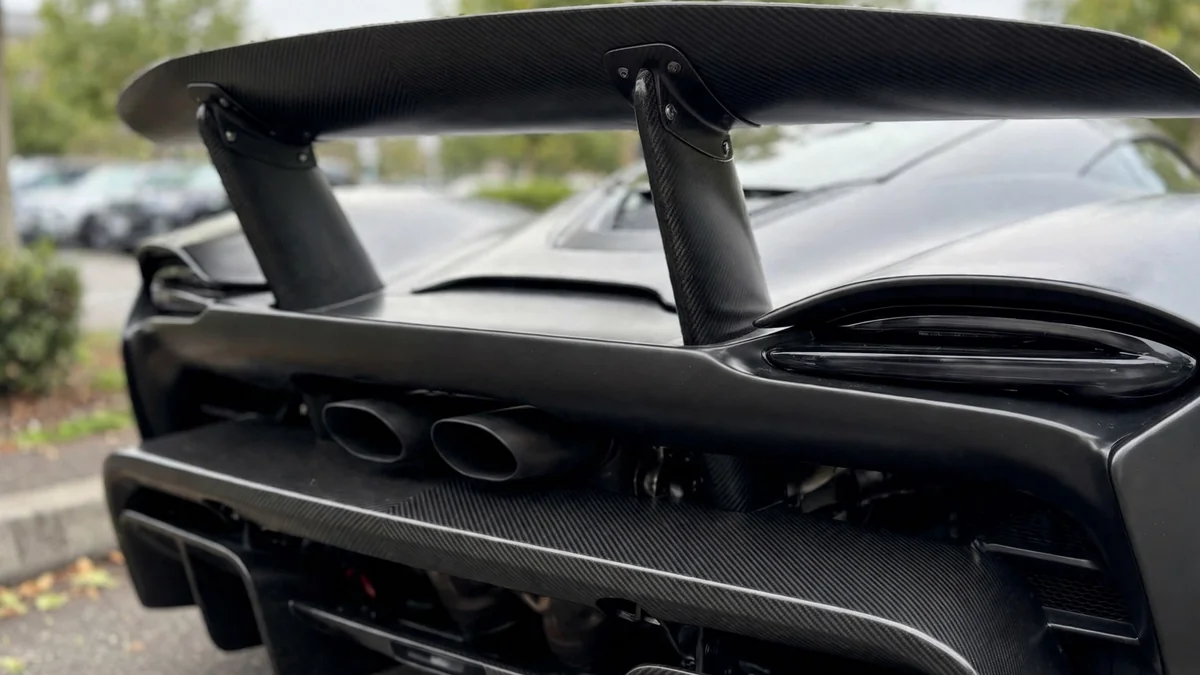
Stand behind a hypercar at full throttle and you will feel it before you see it: a wall of air, pressed down and thrown backwards, as the car claws its way to speed. The thing doing the pressing is not the engine. It is a wing, a flat blade of carbon standing on two slim struts at the back of the car, and it is working harder than any other single panel on the machine. At speed it carries a load measured in tonnes, it changes shape on command, and if it fails, the car behind it becomes uncontrollable in a fraction of a second.
That wing is the spoiler, and it is one of the most abused parts on a hypercar. It lives in dirty air, is baked by exhaust heat, and must hold its shape to the millimetre. Its materials are the reason it survives.
Here is what a hypercar spoiler is made of, and why each material earned its place.
The Materials Behind the Hypercar Spoiler
1. Carbon fibre prepreg, the skin that holds the air
The wing itself is carbon fibre, laid up from prepreg, sheets of carbon cloth already soaked in resin, cut to shape and cured in an autoclave under heat and pressure. Carbon fibre is the only practical choice: stiff enough not to twist under load, light enough for slim struts. The cloth is laid in different directions, so the wing is stiff where the air pushes hardest. The same woven material is used across the car, and the story of how carbon fibre cloth is made explains why the direction of the weave matters as much as the fibre itself.
2. Aluminium honeycomb, the core that keeps it light
Inside the carbon skin is a core, usually aluminium honeycomb, a sheet of tiny hexagonal cells bonded between the two faces of the wing. The honeycomb holds the two carbon skins apart, and that separation is what makes the wing stiff. Aluminium honeycomb is light, it does not absorb water, and it survives the heat of the autoclave cure. Some wings use a foam core instead, cheaper to shape but heavier for the same stiffness. Either way, the core is the quiet hero of the spoiler, the part nobody sees and the wing cannot do without.
3. Titanium, the mounts that take the load
The wing is held to the car by struts, and those struts are usually titanium or high-strength aluminium. They carry the full downforce of the wing into the chassis, a load that can exceed the weight of the car itself, and they must do it without stretching or bending. Titanium is chosen for the most extreme cars because it is strong, light and immune to fatigue, the slow weakening that comes from thousands of load cycles. The mounts are machined from solid billet, not cast, because a casting can hide a flaw. The bolts are titanium too.
4. Steel and hydraulics, the active aero that moves the wing
Many modern hypercars have an active spoiler, a wing that changes angle on command: flat for top speed, steep for braking, tilted to act as an air brake. The mechanism that moves it is steel and hydraulics, or a high-torque electric motor driving a steel screw. Steel is used because the actuator sees shock loads every time the wing slams to its air-brake position, and only hardened steel gears and rams survive that abuse. The fluid is a synthetic oil that works from freezing mornings to track-day heat. The system is controlled by the car’s electronics, but the muscle is old-fashioned metal. The power behind that muscle comes from engines like the Bugatti W16, whose own materials are chosen for the same unforgiving loads.
5. Epoxy resin and clearcoat, the glue and the shield
The resin that holds the carbon together is an epoxy, chosen for its strength and its resistance to heat. A spoiler sits close to the exhaust and the engine bay, and a cheap resin would soften on a hot day, letting the wing lose its shape. The epoxy used in a hypercar wing is cured at high temperature and stays rigid well past the hottest day the car will ever see. Over the epoxy goes a clearcoat, a hard, glossy layer that protects the carbon from ultraviolet light, which degrades exposed resin, and from stone chips, which would let water into the laminate. The clearcoat is also why the weave is visible: it is polished to a mirror finish.
6. Rubber and composite seals, the details that keep it alive
Around the moving parts of an active wing are seals and gaskets, usually rubber or a composite, that keep water and grit out of the mechanism. The wing’s endplates, the vertical fins at each end, are carbon fibre too, and they carry small vortex generators, tiny fins that control the airflow spilling off the wing’s tips. A dirty hinge or a worn seal is how an active wing starts to stick. The pursuit of a wing that works the same way every time is the same obsession that drives cars like the Aston Martin Valkyrie, where the aero is the car, not an accessory.
| Material | Where it is used | Why it is chosen |
|---|---|---|
| Carbon fibre prepreg | Wing skins | Extremely stiff and light, holds its shape under tonnes of load |
| Aluminium honeycomb | Wing core | Holds the skins apart, huge stiffness for almost no weight |
| Titanium | Struts, mounts and bolts | Strong, light, resists fatigue, carries full downforce |
| Hardened steel | Active aero gears and rams | Survives shock loads when the wing slams to air-brake angle |
| High-temperature epoxy | Resin binding the carbon | Stays rigid in exhaust heat, bonds the laminate |
| Clearcoat | Outer finish | Shields carbon from UV and stone chips, shows the weave |
| Rubber and composites | Seals, endplates, vortex generators | Keep grit out of the mechanism, tidy the airflow |
What Does a Hypercar Spoiler Cost?
A hypercar spoiler is priced by its carbon and its mechanism. A fixed carbon wing is estimated at roughly $5,000 to $15,000, depending on size and finish, and an active aero wing, with its hydraulics, sensors and control system, is estimated at roughly $20,000 to $60,000. The struts and mounts add an estimated $2,000 to $6,000, and a full replacement, wing, mechanism and calibration, is estimated at roughly $25,000 to $70,000. That is the price of staying planted at 200 miles per hour.
A Rare Fact
At top speed, the rear wing of a hypercar can press down with more force than the car itself weighs, which means the car could, in theory, drive upside down on a ceiling at full speed. The maths is real, and it is why the wing mounts are machined from solid titanium.


A hypercar spoiler looks like a styling flourish, a wing bolted on for show, but it is a structural part doing a structural job. The carbon skin holds the air, the honeycomb holds the skin, the titanium holds the wing, and the steel moves it when the car asks. Together, they are why a hypercar can brake later and corner harder.


