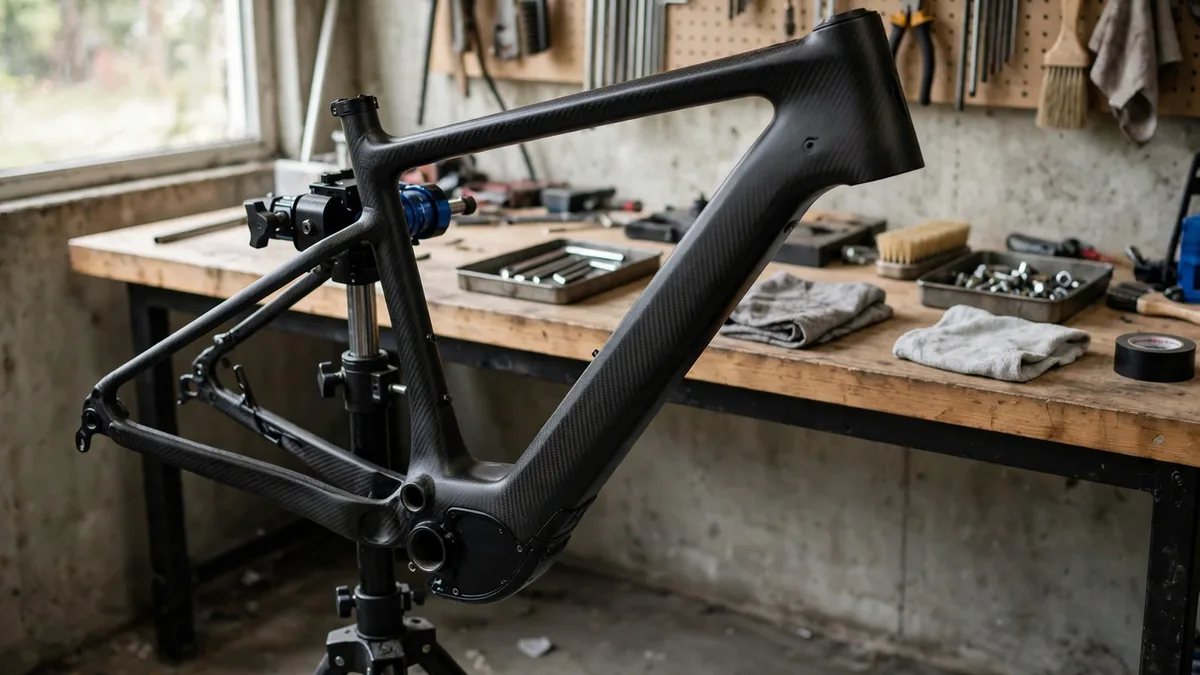
Pick up a carbon-fibre e-bike frame and the first thing you notice is how little it weighs. A frame that can carry a rider, a motor and a battery, survive potholes and kerbs, and still feel alive under you can weigh less than two kilograms — about the same as a bag of sugar. The second thing you notice, when you see the price tag, is how much that lightness costs. A carbon e-bike frame can cost more than an entire aluminium e-bike, and the reason is not the material alone. It is the weeks of handwork, the ovens, the moulds and the testing that turn black cloth and sticky resin into something you can trust your life to at 45 kilometres per hour.
Carbon fibre is not a material you buy and bolt together. It is a process. The frame starts as dry sheets of woven carbon cloth, each layer cut by hand, laid into a mould in a precise order, and then baked under pressure until the resin hardens into a single solid piece. Every layer matters: the direction of the fibres decides whether the frame is stiff or flexible, strong or brittle. Get it wrong and the frame cracks.
Carbon, Craft and Cost: The E-Bike Frame Story
A carbon e-bike frame costs so much because it is a hand-made composite structure, built layer by layer and baked in an oven, with no room for error. Six reasons carry most of the price.
1. The carbon fibre itself is expensive to make
Carbon fibre starts life as a plastic thread called polyacrylonitrile, which is heated, stretched and baked in oxygen-free ovens at over 1,000 degrees until almost everything but pure carbon has burned away. The process takes hours, uses enormous amounts of energy, and produces fibre five times stronger than steel at a quarter of the weight — but only a handful of factories in the world make the highest grades, and most of it goes to aerospace first.
2. Every frame is laid up by hand
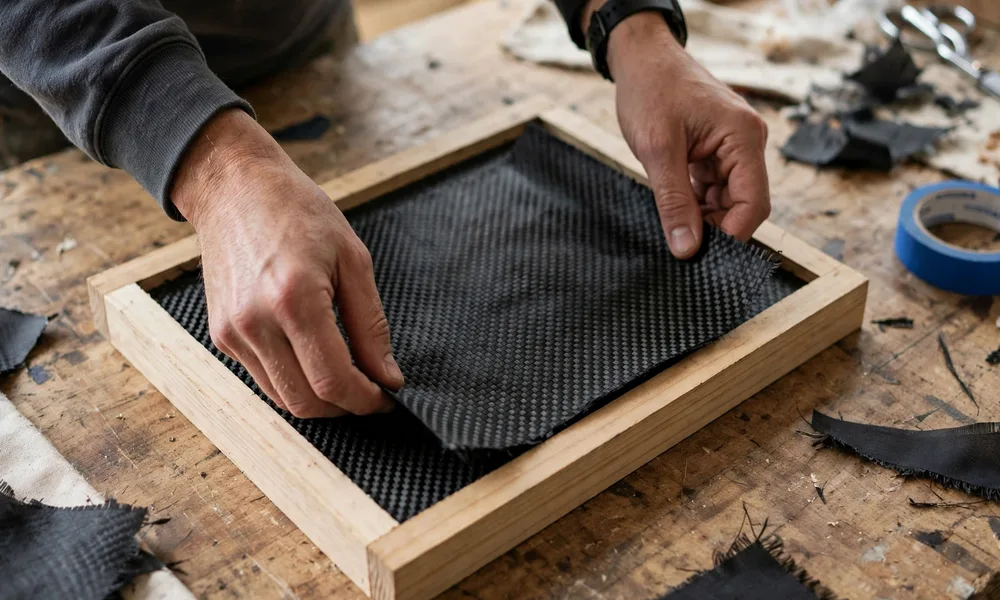
The heart of carbon-frame building is the layup: a skilled worker cutting dozens of pieces of carbon cloth, each one shaped for a specific part of the frame, and placing them into a mould in a precise order and direction. A single frame can contain more than a hundred individual pieces of cloth, and the layup takes hours of careful, repetitive work. There is no machine that can do it as well as a trained pair of hands, because the cloth must be smoothed, stretched and placed without a wrinkle or an air bubble.
3. The moulds cost a fortune and wear out
Every frame size and shape needs its own mould, machined from steel or aluminium to a tolerance of a fraction of a millimetre, and polished to a mirror finish so the finished frame comes out smooth. A set of moulds for one frame model can cost tens of thousands of pounds, and they wear out after a few thousand frames. Because e-bike frames come in many sizes and the production runs are small, the cost of the moulds is spread across relatively few frames.
4. The frame is baked under pressure, and many fail
Once the layup is complete, the mould is sealed, placed in an autoclave — a giant pressurised oven — and baked for hours while the resin hardens. The temperature and pressure must be controlled precisely, or the resin cures unevenly and the frame is weakened. After baking, every frame is inspected: tapped, X-rayed or ultrasound-scanned for hidden voids and delamination. A meaningful share of frames fail inspection and are scrapped, and the cost of those failures is carried by the frames that pass. It is the same logic as any hand-built composite — the carbon-fibre weave behind the frame is only as good as the curing that follows it.
5. An e-bike frame carries loads a normal bike never sees
A carbon e-bike frame is not just a bicycle frame. It has to carry a motor that pushes with up to 85 newton-metres of torque, a battery that weighs three or four kilograms, and a rider — all while the motor’s power tries to twist the frame out of shape. The area around the bottom bracket, where the motor sits, is reinforced with extra layers of carbon, and the battery mount must hold firm over thousands of kilometres of vibration. Designing a frame that is both light and strong enough for a motor is a harder problem than building a racing bike, and it takes more carbon, more testing and more engineering time.
6. Testing is destructive, and it never stops
Before a frame design is sold, sample frames are tested to destruction: bent, twisted, dropped and ridden on machines that simulate years of use in weeks. The tests follow international safety standards, and they destroy dozens of frames before a single one reaches a customer. Even in production, frames are spot-checked and sometimes sacrificed to make sure the process has not drifted.
E-Bike Carbon Frame at a Glance
| Specification | Typical value |
|---|---|
| Frame weight | 1.8–2.5 kg |
| Material | High-modulus carbon fibre and epoxy resin |
| Layers per frame | 100+ pieces of cloth |
| Curing | Autoclave, 120–180 °C under pressure |
| Motor torque handled | Up to 85 Nm |
| Battery carried | 500–750 Wh, 3–4 kg |
| Frame sizes | Usually 4–5 per model |
| Testing standard | ISO 4210 and EN 15194 |
| Typical lifespan | 10+ years with care |
How Much Does a Carbon E-Bike Frame Cost?
As an estimate, a carbon e-bike frame on its own costs roughly £800 to £2,000 at retail, with flagship frames from premium brands estimated at £2,500 or more. The complete e-bike built around it typically sells for £4,000 to £10,000, and the frame is usually the single most expensive part after the battery and motor. The motor it carries is no simpler: the e-bike mid-drive motor is itself a precision unit built to survive the same punishment. For comparison, an aluminium e-bike frame costs a manufacturer a fraction of that — the difference is almost entirely the handwork, the moulds and the failure rate. The battery is the other big cost in the build: the e-bike battery uses its own expensive materials and its own careful engineering.

A Rare Fact
Carbon fibre is stronger than steel by weight, but it fails differently: steel bends and warns you, while carbon can look perfect on the outside and hide damage inside. That is why a carbon frame that has been in a crash should always be inspected with ultrasound or X-ray, even if there is not a mark on it — and why the factories that build them scan every frame before it leaves. Some premium frames even have a tiny sacrificial layer built into the layup, designed to show a visible crack if the frame takes a hard hit, so the damage cannot hide. It is a quiet piece of engineering that exists only because the material is too good to trust blindly.


