The wind tunnel is dark except for the car, and the car is not moving. It sits on a rolling road with its wheels turning, while fans the size of house doors push air over it at motorway speed. Ribbons of smoke stream along the bodywork, and a team of engineers watches the underside on a screen, where the airflow should be smooth and flat — and is not. The engineers note it, and the underbody goes back to the workshop for another round of shaping, another mould, another test.
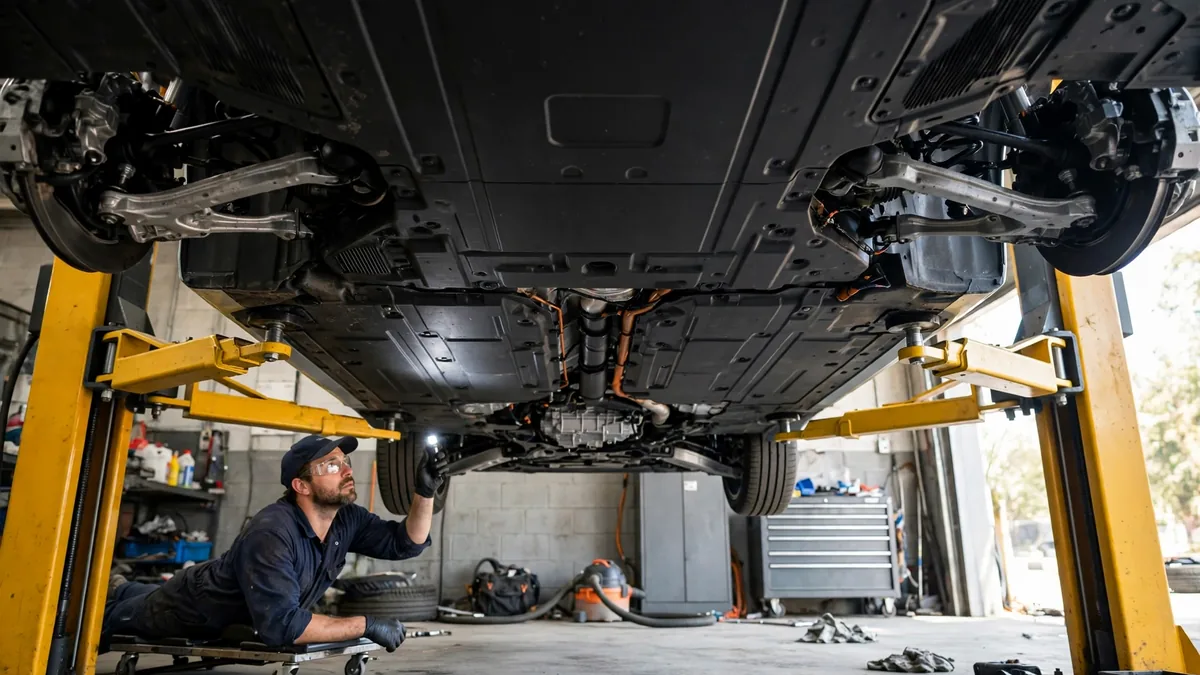
That flat panel underneath an electric car — the aerodynamic underbody — looks like the simplest part of the vehicle. It is a smooth tray that covers the messy underside, and from a distance it could pass for a sheet of plastic. In reality it is one of the most expensive panels on the car, and on some models the underbody package costs more than a set of premium wheels. The reason is simple: on an electric car, air is range, and range is the whole product.
This guide explains why that hidden panel costs so much — the materials, the wind tunnel hours, the hand finishing, and the tiny tolerances — and what the driver gets for the money.
Why It Costs So Much
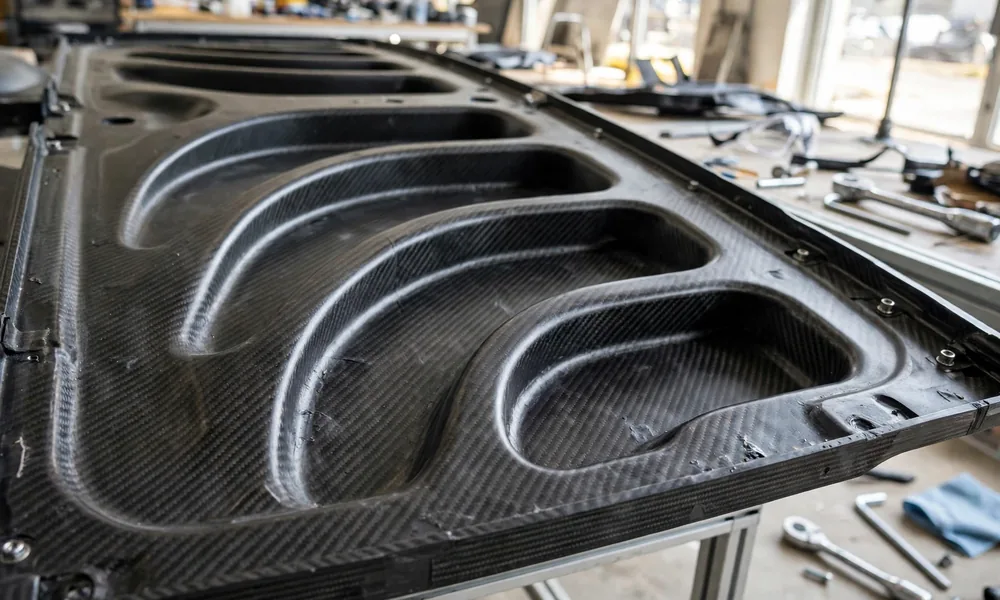
The first cost is the material, and the underbody uses far better stuff than it looks. The panel has to be stiff enough not to flutter at speed, light enough not to eat into range, tough enough to survive stones and road debris, and heat-resistant enough to sit near a battery pack that warms up under fast charging. Cheap plastic fails on the first count: it flexes, and a flexing panel creates the very turbulence it is meant to prevent. So manufacturers use layered composites — glass fibre and carbon fibre skins over a honeycomb or foam core — or high-grade engineered plastics reinforced with fibre. The panel also has to be shaped around the battery, which is why how an EV battery pack works is part of this story: the underbody is the battery’s armour as well as its aerodynamic skin.
Then comes the wind tunnel, which is where the real money disappears. Shaping an underbody is not a matter of drawing a flat panel and bolting it on. Airflow under a car is chaotic: it hits the front wheels, tumbles around suspension arms, and has to be guided out cleanly at the rear. Engineers test scale models, then full-size cars, in tunnels that cost thousands of dollars an hour to run. Each test produces a new shape — a diffuser angle here, a small fin there, a vent moved by a few millimetres — and each new shape needs a new prototype panel. The shape is also tuned for the car’s cooling needs, since the battery and motors still need air, and that balancing act is the subject of how EV thermal management works.
Labour adds the next layer of cost, because the panel is finished largely by hand. The composite layers are laid up, cured in an autoclave, trimmed, and inspected for voids and delamination. Fixings are fitted one by one: the underbody is held on by dozens of fasteners, each placed so the panel sits perfectly flush, because a single proud bolt head can disturb the airflow.
Rarity and low volumes make everything worse. The underbody is specific to one car model — sometimes to one version of one model — so the tooling is used for a single shape and never again. The moulds are large, machined from aluminium or steel, and they cost a small fortune before a single panel is made. The same logic governs the battery it protects, and the figures in EV battery pack specs show how tightly the whole underside of the car is packaged — there is no spare room, and no room for error.
Testing is the final cost driver, and it goes far beyond the wind tunnel. The underbody is crash-tested, because it has to protect the battery in an impact and not shatter into pieces that could puncture it. It is driven over gravel, salt water, and speed bumps for thousands of kilometres, then inspected for cracks and wear. It is heated, frozen, and soaked, and its fasteners are checked for corrosion. The result is a panel that most owners will never see — and that is exactly the point.
Cost Breakdown
All prices below are estimates, based on typical costs for a premium electric car’s aerodynamic underbody package, and they vary by model, material, and region. They show where the money goes rather than a quote for any specific car.
| Part of the cost | Estimated share | Estimated amount | Why it costs that much |
|---|---|---|---|
| Composite materials | About 25% | $375–$750 | Carbon and glass fibre skins over a honeycomb core |
| Wind tunnel development | About 25% | $375–$750 | Dozens of tunnel sessions at thousands of dollars an hour |
| Moulds and tooling | About 20% | $300–$600 | Large machined moulds for a single car model |
| Hand finishing and fitting | About 15% | $225–$450 | Layup, curing, trimming, and flush fitting by hand |
| Crash and durability testing | About 10% | $150–$300 | Impact, gravel, salt, heat, and corrosion test campaigns |
| Fasteners, seals, and vents | About 5% | $75–$150 | Dozens of precision fasteners, seals, and cooling vents |
| Total underbody package | 100% | $1,500–$3,000 | Typical estimated cost for a premium EV underbody |
That figure is the cost of the package as engineered, not the price of a replacement panel at a dealer, which can be higher still once labour and logistics are added.
EV Aerodynamic Underbody Specs
| Spec | Typical figure | What it means |
|---|---|---|
| Panel material | Composite or reinforced plastic | Fibre skins over a core, stiff and light |
| Panel weight | About 15–30 kg | The full underbody tray set, fitted |
| Drag contribution | Up to 10% of total drag | How much of the car’s drag the underside accounts for |
| Ground clearance | About 120–180 mm | Distance from the panel to the road surface |
| Fastener count | 40–80 fixings | Bolts and clips holding the panels flush |
| Temperature range | –40°C to 120°C | Conditions the panel must survive without warping |
| Service life | Life of the car | Designed to last as long as the vehicle, with inspections |
The numbers show why the panel is taken seriously: the underside accounts for a significant share of the car’s total drag, and even a small improvement there is worth more than a similar improvement almost anywhere else on the body.

A Rare Fact
The smoothest underbody ever fitted to a production car was not designed for speed at all — it was designed for silence. Engineers discovered that a flat floor does more than cut drag: it also kills the low-frequency roar that air makes as it tumbles under a car, and on an electric car with no engine noise to mask it, that roar is the loudest thing the driver hears at motorway speed. The underbody, in other words, is also a soundproofing panel, and its shape is tuned as much by ear as by wind.