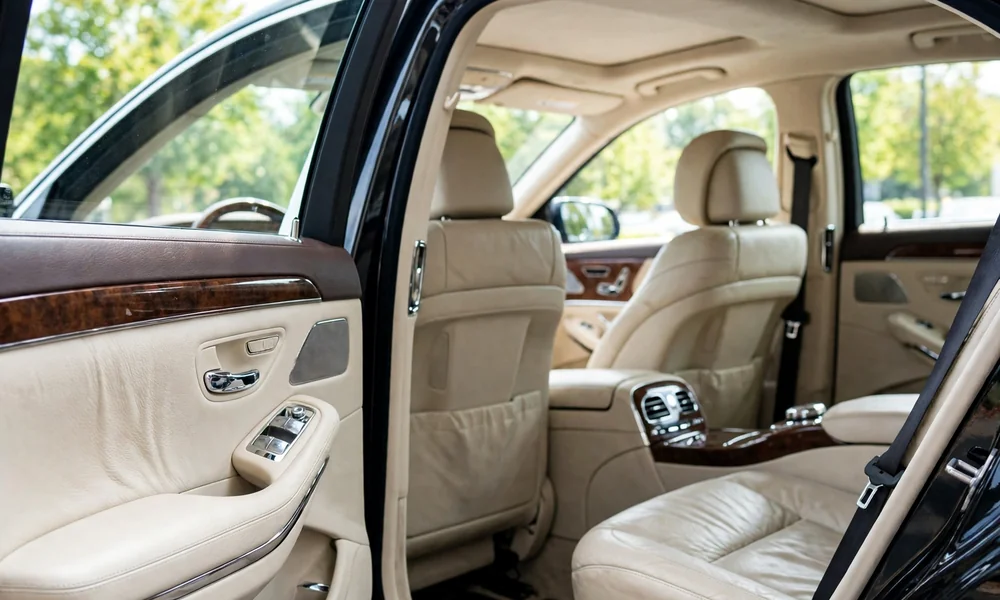
Open the door of a Rolls-Royce Phantom, a Bentley Flying Spur, or a Mercedes-Maybach, and the first thing you notice is not the engine or the badge. It is the smell. Rich leather, polished wood, and wool carpet, all of it warm and quiet, as if the car were a room rather than a machine. Run your hand along the dashboard and you will find no hard plastic, no hollow panel, and no seam that catches a fingernail. Every surface is stitched, wrapped, veneered, or polished by a person who spent years learning to do exactly that one thing. A luxury car interior is not expensive because of what it is made from alone. It is expensive because of who makes it, how long it takes, and how little of it a machine is allowed to touch.
Why It Costs So Much
The leather. Luxury car leather starts with the hide, and most hides never make the cut. A top maker will reject the majority of the leather it is offered, accepting only hides from cattle raised at altitude, where there are fewer insects and fewer barbed-wire scars, and only the centre of each hide, where the grain is finest. A single car can use ten to fifteen hides, and the cutting is done so that the grain runs the same way across the seats, the doors, and the dashboard. The stitching is often done by one person per car, using thread waxed for strength, and a single seat can take hours of hand sewing before it is fitted.
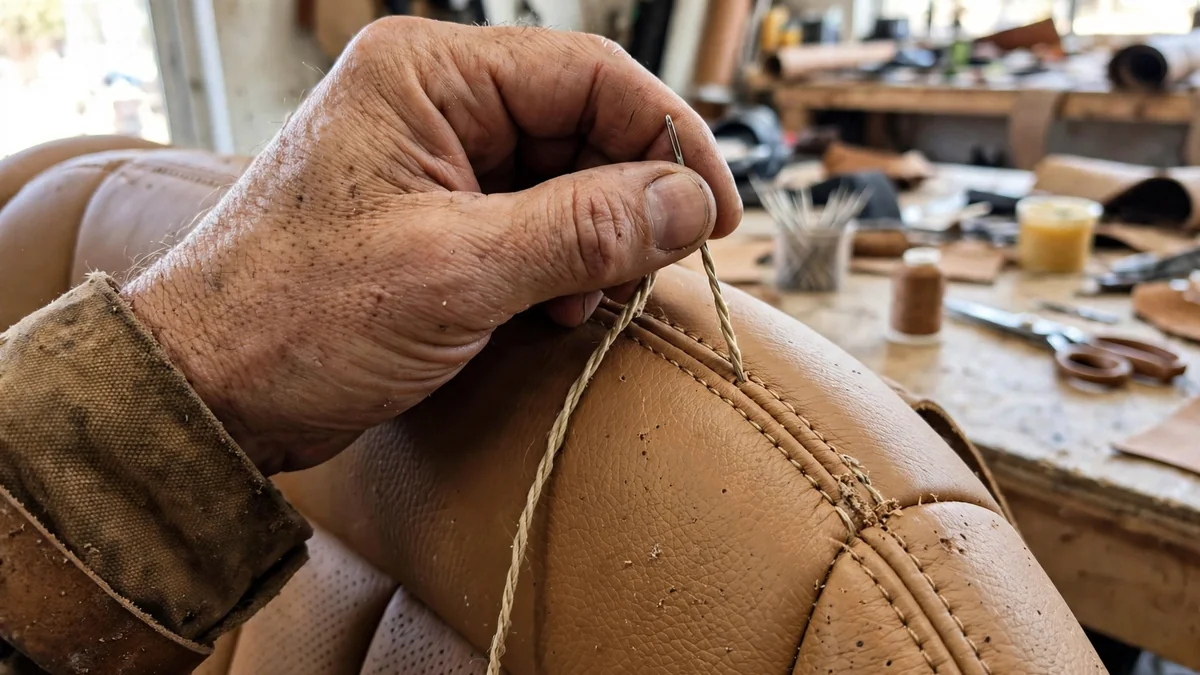
The details and the rarity. The small things cost the most, because they are the things a buyer touches every day. The air vents may be machined from a single billet of aluminium and polished for hours. The knobs may be knurled by hand, the clock in the dashboard may be a real timepiece, and the speaker grilles may be drilled with thousands of tiny holes in a pattern that takes a full day to cut. Some makers offer starlight headliners with hundreds of fibre-optic lights, each one placed by hand, and picnic tables, champagne coolers, and lambswool rugs that are made to order for a single car. None of these parts is shared with a cheaper model, so there is no economy of scale. Every part is made in small numbers, often for one car at a time, and the tooling cost is spread across a handful of vehicles rather than hundreds of thousands. That is why a single replacement trim piece can cost more than a used car. The same logic applies to the best hypercar interiors, where every cabin is a one-off exercise in the same craft.
The sound and the silence. A luxury interior is also an acoustic project. Layers of sound-deadening material are fitted to the floor, the doors, and the roof, the glass is laminated in two layers with an acoustic film between them, and the tyres and suspension are tuned to keep road noise out. The result is a cabin so quiet that the carmaker has to add a gentle sound back in, because total silence feels strange to passengers. The sound system is part of this too, with speakers placed and tuned for the exact shape of the cabin, and the work of building it is as much a craft as the leather. A luxury car sound system can take days to install and tune, with each speaker measured and adjusted by ear as well as by machine, and it is one of the reasons the cabin feels like a concert hall rather than a car.
What Goes Into a Luxury Interior
| Element | What Makes It Expensive |
|---|---|
| Leather | 10 to 15 selected hides per car, hand cut and stitched |
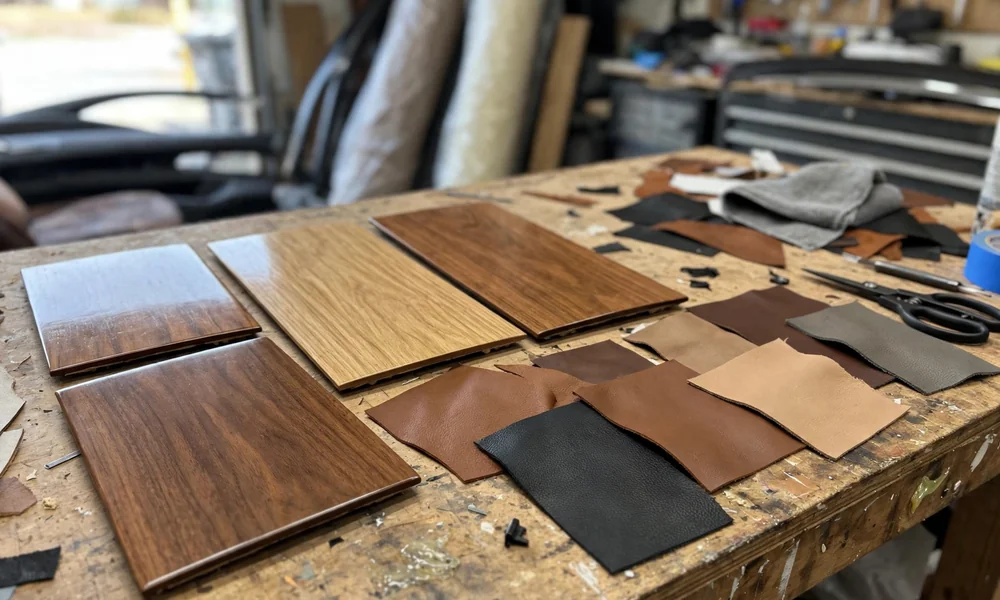
| Wood veneer | Matched from a single tree, hand laid and lacquered |
| Hand labour | Several hundred hours per interior |
| Metal trim | Machined from solid billet, hand polished |
| Sound insulation | Layered materials, acoustic laminated glass |
| Bespoke options | Made to order, no shared parts, tiny volumes |
What a Luxury Car Interior Costs
The cost of a luxury car interior is usually quoted as part of the car, but the figures are revealing. On a car that sells for around four hundred thousand dollars, the interior alone can account for fifty to eighty thousand dollars of the price, and on a fully bespoke commission it can pass one hundred and fifty thousand dollars. The leather, wood, and metal are only part of that sum. Most of it is labour, inspection, and the cost of throwing away anything that is not perfect. A single hide rejected for a scar, a veneer set discarded for a mismatch, or a seat rebuilt because a stitch was a millimetre out all add cost that the buyer never sees, but the buyer does feel it in the finished car. Estimates vary by maker and by specification, but the pattern is consistent: the more of the interior that is made by hand, the more it costs, and the longer it takes.
That cost also explains why luxury interiors age differently from ordinary ones. The leather is thicker, the dye goes deeper, and the stitching is stronger, so a well-kept luxury interior can look good after twenty years while a mass-market cabin is worn and faded. The wood can be repolished, the leather can be fed and cleaned, and the metal trim can be polished again, because all of it is real material rather than a printed imitation. A luxury interior is built to be restored, not replaced, and that is part of what the buyer is paying for. Even the seats carry that thinking, and a hypercar seat shows the same logic taken further, with a single seat costing as much as a small car.
A Rare Fact About Luxury Interiors
Here is a detail that few buyers ever learn: the leather in some of the most expensive cars in the world comes from cattle raised at high altitude, not because the air is cleaner, but because there are almost no insects at that height, and therefore almost no bites to scar the hide. A single insect bite can ruin a panel of leather that would otherwise cover a seat, so the makers pay a premium for hides from herds that live where the bugs do not. It is a strange, quiet detail, and it captures the whole philosophy of a luxury interior. The cost is not in the thing you can see. It is in the hundreds of small decisions, made by people who care about a scar you would never notice, to build a room you will sit in for a few hours a day and remember for the rest of your life.
A luxury car interior is expensive because it is slow, because it is made by hand, and because it refuses to compromise on anything the owner will touch, see, or smell. The leather is chosen, the wood is matched, the metal is polished, and the doors are tuned until they close like a vault. None of that shows up on a specification sheet, and none of it can be copied by a machine working faster. That is why the interior of a great luxury car feels less like a part of a vehicle and more like a piece of furniture, a room, a place to be.